Positive Reinforcement
Positive reinforcement means adding something after a behavior in order to increase the future frequency of that behavior. In dog training, that usually means food, toys, access, social interaction, or a conditioned marker that predicts one of those things. It is one of the most widely used tools in modern companion-dog training, but the science is more specific than the slogan "reward what you want." Documented
What It Means
The formal definition is narrow: if a stimulus is added after a behavior and the behavior becomes more likely in the future, that consequence functioned as positive reinforcement.
This definition matters because not everything the human offers is automatically reinforcing. A reinforcer has to work on the learner actually in front of you, in that moment, under those motivational conditions. A dry biscuit may be powerful in one context and meaningless in another. Verbal praise may maintain responding for some dogs in some short windows and do very little in others. Documented
Behavior analysts usually distinguish between:
- primary reinforcers, such as food or warmth, which are biologically significant without prior learning
- secondary or conditioned reinforcers, such as a clicker or verbal marker, which gain value by being paired with a primary reinforcer
In modern dog training, positive reinforcement is often presented as straightforwardly gentle and universally effective. Observed-JB The actual literature is more technical. Timing matters. Motivation matters. Rate of reinforcement matters. The marker, if one is used, has to be kept functionally paired. The difficulty of the task matters. The context matters.
This is where some training rhetoric outruns the science. A method may be called positive reinforcement while quietly depending on very precise timing, high food value, controlled environments, low distraction, and many repetitions. That does not make the method invalid. It simply means the procedure is more fragile and more parameter-sensitive than simplified public explanations suggest.
Praise is a good example. Dogs can learn with social reinforcement, and social interaction can sometimes function as a reinforcer. But SCR-052 draws an important boundary: what is directly documented is that dogs generally prefer physical contact over verbal praise as a reinforcer, and that verbal praise alone rapidly loses reinforcement value across repeated sessions. Estimated That is a narrower and more careful claim than "praise never works" or "praise flooding ruins dogs." The broader household-level rhetorical leap still needs hedging.
The JB source layer adds another limit worth stating carefully. The contingent operant reinforcement protocol used in formal training has no documented analog in natural canine development. Heuristic That does not invalidate positive reinforcement as a human training technology. It simply means the technology should not be casually mistaken for a directly documented mother-puppy teaching system.
Why It Matters for Your Dog
For families, positive reinforcement matters because it explains how many desirable everyday behaviors get built, including coming when called, sitting for access, going to a mat, walking toward the handler, and settling into predictable routines. Heuristic It also explains why some well-meant habits create problems. If barking sometimes gets attention, jumping sometimes gets touch, or pestering sometimes gets play, those behaviors may be positively reinforced whether the family meant to train them or not.
Positive reinforcement works best when the consequence is actually meaningful, clearly contingent, and precisely timed. This is one place where the JB signal-precision concern overlaps with learning theory, even though the larger philosophical claims go further than the lab literature itself.
The practical takeaway is not that families should become miniature laboratory technicians. It is that reinforcement is specific. Vague enthusiasm is not the same thing as a clear contingency.
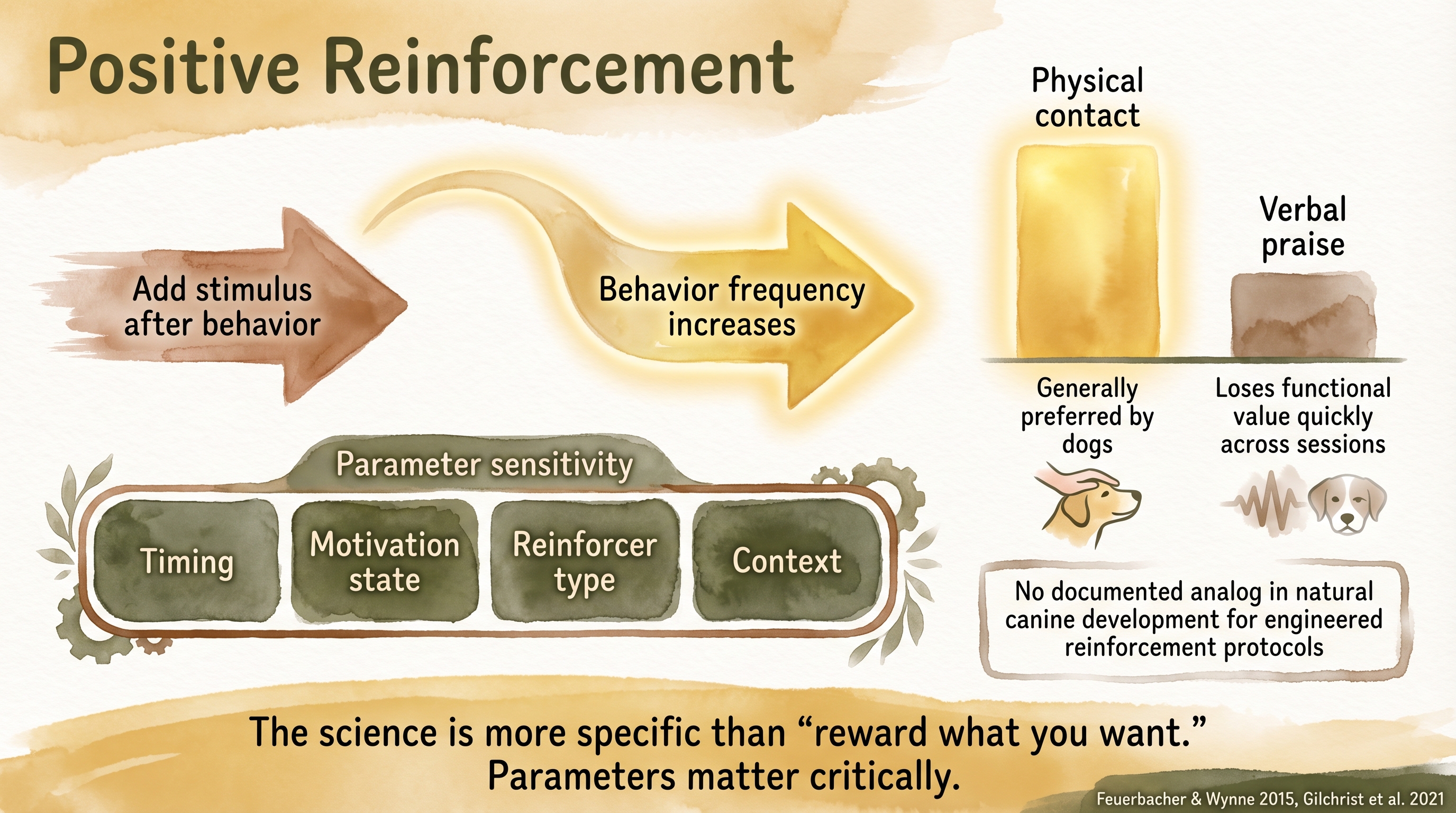
Positive reinforcement increases behavior frequency by adding something valued - the dominant paradigm in modern dog training.
Key Takeaways
- Positive reinforcement means adding a consequence that actually makes the behavior more likely next time.
- A reinforcer has to function for the learner in that moment. Human intention alone does not make it reinforcing.
- Verbal praise is not automatically strong or durable as a reinforcer in dogs.
- The science supports positive reinforcement as a real training technology, while also showing that it is more parameter-sensitive than simplified slogans imply.
The Evidence
This entry uses observed claim-level tags beyond the dedicated EvidenceBlocks below. These tags mark JB program observation or practice-derived claims that need dedicated EvidenceBlock coverage in a later content pass.
This entry uses estimated claim-level tags beyond the dedicated EvidenceBlocks below. These tags mark approximate ranges or timing claims that should remain bounded by the cited sources.
- Skinner, B. F. (1953)multiple species
Defined reinforcement functionally as any consequence that increases future behavior frequency. - Feuerbacher, E. N., & Wynne, C. D. L. (2015)domestic dogs
Direct canine reinforcer-preference work showing that verbal praise alone is generally weaker than physical contact and can lose functional value quickly across repeated sessions. - Gilchrist, R. J. et al. (2021)domestic dogs
Found that clickers and other reinforcement methods do not always produce clear differences in simple acquisition tasks, highlighting parameter sensitivity. - Chiandetti, C. et al. (2016)domestic dogs
Reported no consistent clicker advantage over food alone for a simple novel behavior, cautioning against overgeneralized marker claims.
- Pfaller-Sadovsky, N. et al. (2020)dogs and horses
Systematic review and meta-analysis finding that conditioned reinforcers can facilitate learning, while also noting substantial heterogeneity and limited evidence quality. - Peiris, H. et al. (2022)domestic dogs
Showed that inconsistent click-food pairing can degrade performance and increase unwanted behavior, underscoring the maintenance demands of conditioned reinforcers.
- SCR-004 synthesisdomestic dogs
The claim that engineered positive-reinforcement protocols have no documented analog in natural canine development is a reasoned ethological argument, not a formally settled finding.
No published study has systematically compared long-term behavioral and developmental outcomes between dogs trained with positive-reinforcement protocols versus dogs in relationally structured, non-contingent environments across identical age ranges and long-term follow-up periods.
SCR References
Sources
- Chiandetti, C., Avella, S., Fongaro, E., & Cerri, F. (2016). Can clicker training facilitate conditioning in dogs? Applied Animal Behaviour Science, 184, 109-116.
- Feuerbacher, E. N., & Wynne, C. D. L. (2015). Shut up and pet me! Human social interaction as a reinforcer for dogs. Journal of the Experimental Analysis of Behavior, 104(3), 354-371.
- Gilchrist, R. J., Gunter, L. M., Anderson, S. F., & Wynne, C. D. L. (2021). The click is not the trick: The efficacy of clickers and other reinforcement methods in training naive dogs to perform new tasks. PeerJ, 9, e10881.
- Peiris, H., et al. (2022). Some detrimental effects of conditioned reinforcement on the behavior of dogs. Journal of the Experimental Analysis of Behavior, 118(2), 251-267.
- Pfaller-Sadovsky, N., Hurtado-Parrado, C., et al. (2020). What's in a click? The efficacy of conditioned reinforcement in applied animal training: A systematic review and meta-analysis. Animals, 10(10), 1757.
- Skinner, B. F. (1953). Science and Human Behavior.