Classical Conditioning
Classical conditioning is how animals form automatic associations between stimuli - how a sound, a sight, or a context becomes linked to an emotional or physiological response without any deliberate decision. Documented It is the invisible architecture beneath emotional learning, fear responses, and much of what families experience as their dog's "personality."
What It Means
Ivan Pavlov's discovery in the 1890s remains one of the most replicated findings in all of behavioral science. Documented The core mechanism is simple: when a neutral stimulus (a bell) is repeatedly paired with an unconditioned stimulus that naturally produces a response (food → salivation), the neutral stimulus alone begins to elicit the response. The bell becomes a conditioned stimulus; the salivation becomes a conditioned response.
But the mechanism's simplicity disguises its reach. Classical conditioning doesn't just explain salivation. It explains why your dog gets excited when you pick up the leash. Documented Why a puppy trembles in the vet's parking lot before the appointment starts. Why certain tones of voice calm a dog and others trigger stress before a word is understood. The dog is not "thinking about" these associations. They are happening below conscious processing - automatic, fast, and deeply resistant to logical override.
Key concepts within classical conditioning:
- Unconditioned stimulus (US): Something that naturally produces a response (food, pain, social contact)
- Unconditioned response (UR): The natural response to the US (salivation, flinching, approach)
- Conditioned stimulus (CS): A previously neutral stimulus that has been paired with the US (bell, leash, vet parking lot)
- Conditioned response (CR): The learned response to the CS (salivating at the bell, excitement at the leash, trembling at the parking lot)
Understanding classical conditioning is essential because it operates whether you intend it or not. Every interaction with your dog is creating associations. The question is not whether classical conditioning is happening - it is what you are conditioning.
Why It Matters for Your Dog
Classical conditioning intersects with the Five Pillars at every level:
A household where the default energy is settled creates classical associations between the home environment and parasympathetic tone. The home itself becomes a conditioned stimulus for calm. The industry approach - creating exciting, stimulating environments and then trying to manage the arousal - conditions the home as a stimulus for activation.
Prevention and conditioning. Every behavior that a family inadvertently encourages creates a classical association alongside whatever operant learning occurs. Documented When a puppy jumps up and gets petted, the operant contingency (jumping = petting) is only half the story. The classical association is also forming: the presence of this caregiver = arousal, excitement, physical contact. Prevention operates at both levels - blocking the operant pathway and blocking the classical association from forming.
Counter-conditioning is the primary clinical technique for addressing fear and anxiety in dogs, and it works through classical mechanisms. A dog that has learned to associate the veterinary office with pain can be gradually reconditioned by pairing the office context with positive unconditioned stimuli (high-value food, calm social contact). Documented This works, but it is effortful, slow, and never fully erases the original association - returning us to the extinction problem documented in Bouton's work.
Emotional contagion. Sundman et al. (2019) documented long-term cortisol synchronization between caregivers and dogs. Estimated This is classical conditioning at the deepest level - the caregiver's emotional state becomes the conditioned stimulus, and the dog's physiological response mirrors it automatically.
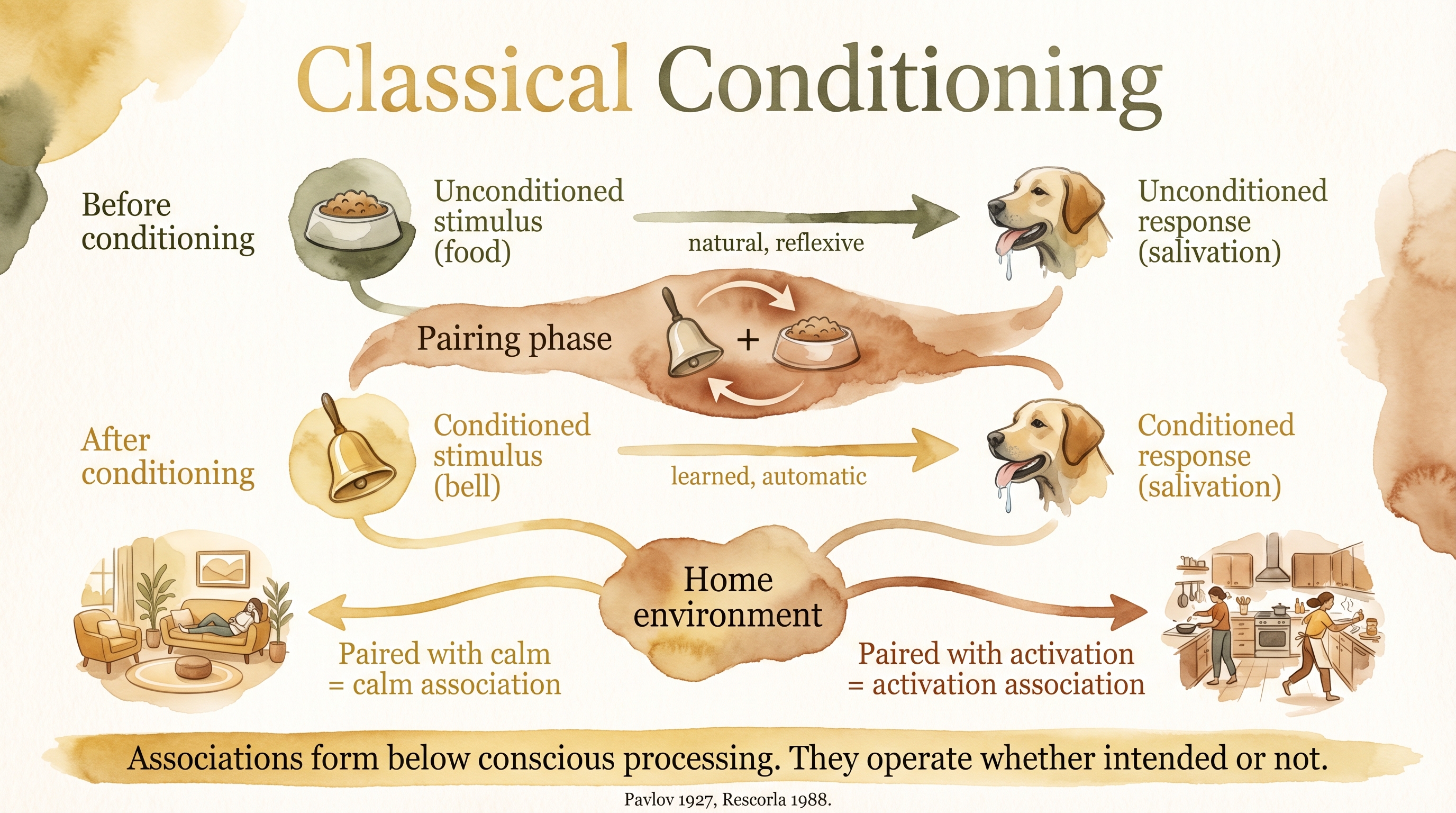
Classical conditioning forms automatic associations between stimuli - operating beneath conscious processing in every interaction.
Key Takeaways
- Your dog forms automatic emotional associations with sounds, sights, and contexts without any deliberate decision - your actions condition these associations constantly.
- A calm household becomes a conditioned stimulus for calm; an exciting household conditions your dog to be aroused in its own home.
- Classical conditioning operates below conscious processing and is deeply resistant to logical override - your dog's excitement at the leash or fear at the vet parking lot happens automatically.
- Counter-conditioning can reduce fear, but prevention is more powerful because it avoids forming the fearful association in the first place.
The Evidence
This entry uses estimated claim-level tags beyond the dedicated EvidenceBlocks below. These tags mark approximate ranges or timing claims that should remain bounded by the cited sources.
- Pavlov, I. P. (1927)dogs
Conditioned Reflexes. The original demonstration of classical conditioning in dogs - among the most replicated findings in behavioral science. The core mechanism (CS-US pairing → CR) is documented beyond dispute. - Rescorla, R. A. (1988)multiple species
Pavlovian conditioning: It's not what you think it is. American Psychologist. Rescorla's revision showed that conditioning depends on the informational or predictive relationship between stimuli, not mere temporal contiguity. - Sundman, A.-S. et al. (2019)domestic dogs
Scientific Reports. Long-term cortisol synchronization between caregivers and dogs - caregiver personality as primary driver. Direct evidence that emotional states classically condition across the human-dog dyad.
- Fernandes, J. G. et al. (2017)domestic dogs
JAVMA. Counter-conditioning and desensitization for fear-based behavior problems in dogs - systematic review of clinical techniques based on classical conditioning principles. - Overall, K. L. (2013)domestic dogs
Manual of Clinical Behavioral Medicine for Dogs and Cats. Standard clinical reference confirming classical counter-conditioning as first-line treatment for fear and anxiety.
No published study compares the long-term behavioral outcomes of dogs raised in classically 'calm-conditioned' environments versus high-stimulation environments. The JB claim that a calm household creates better classical associations is consistent with the mechanism but has not been directly tested.
SCR References
Sources
- Fernandes, J. G. et al. (2017). Do aversive-based training methods actually compromise dog welfare?: A literature review. JAVMA.
- Overall, K. L. (2013). Manual of Clinical Behavioral Medicine for Dogs and Cats. Elsevier.
- Pavlov, I. P. (1927). Conditioned Reflexes: An Investigation of the Physiological Activity of the Cerebral Cortex. Oxford University Press.
- Rescorla, R. A. (1988). Pavlovian conditioning: It's not what you think it is. American Psychologist, 43(3), 151-160.
- Sundman, A.-S., Van Poucke, E., Svensson Holm, A.-C., Faresjo, A., Theodorsson, E., Jensen, P., & Roth, L. S. V. (2019). Long-term stress levels are synchronized in dogs and their owners. Scientific Reports, 9, 7391. https://doi.org/10.1038/s41598-019-43851-x