Negative Reinforcement
Negative reinforcement means removing or reducing an aversive stimulus after a behavior in order to increase the future frequency of that behavior. It is often confused with punishment in ordinary conversation, but in learning theory it is a reinforcement process because the behavior becomes more likely, not less likely. Documented
What It Means
The technical definition is simple even if the real-world applications are messy.
If a dog performs a behavior and that behavior causes pressure, discomfort, threat, or another aversive event to end or lessen, and the behavior becomes more likely next time, negative reinforcement has occurred. Documented
The two classic forms are escape learning (where the behavior ends an aversive already in progress) and avoidance learning (where the behavior prevents the aversive from happening at all). Documented Common dog-training examples include leash pressure that is released when the dog moves into position, physical or electronic pressure that stops when the dog complies, and spatial or social pressure that the dog learns to avoid by performing a requested act. This is why the term causes confusion. Many people hear "negative reinforcement" and assume it means punishment because the procedure begins with something aversive. In behavior analysis, the category turns on what happens to the future behavior. If the behavior increases because the aversive ended, it is reinforcement.
The scientific framework is neutral and definitional here. It is not automatically saying the procedure is humane, cruel, wise, or unwise. Those are separate questions.
In dog training, those separate questions matter a great deal because negative reinforcement procedures often depend on the deliberate presence of an aversive that the dog must work to turn off. That structure creates both practical and ethical complications. The behavior may become reliable. The welfare cost may still be meaningful. Documented
This is also one place where the natural-analog question becomes relevant. The JB source layer argues that systematically engineered reinforcement schedules of this kind do not have a documented natural analog in mother-puppy development. Heuristic That point should be kept distinct from the core definition. The definition of negative reinforcement is documented. The claim about natural analogs is a separate ethological argument.
Why It Matters for Your Dog
Families need this concept because many training tools are misunderstood without it. A method may be described publicly as "pressure and release," "guidance," or "clear communication," but from a learning-theory standpoint the operative mechanism may still be negative reinforcement.
That does not automatically settle the ethical question. It does clarify what kind of learning process is being used.
Learning theory can identify the mechanical process at work. It cannot, by itself, decide whether the wider developmental and welfare consequences are acceptable.
This page also helps explain why real-world procedures are often mixed. Observed-JB A dog may comply to shut off pressure, while the same session also contains positive punishment, emotional spillover, or later positive reinforcement. Training is not always cleanly confined to one quadrant just because a method is marketed that way.
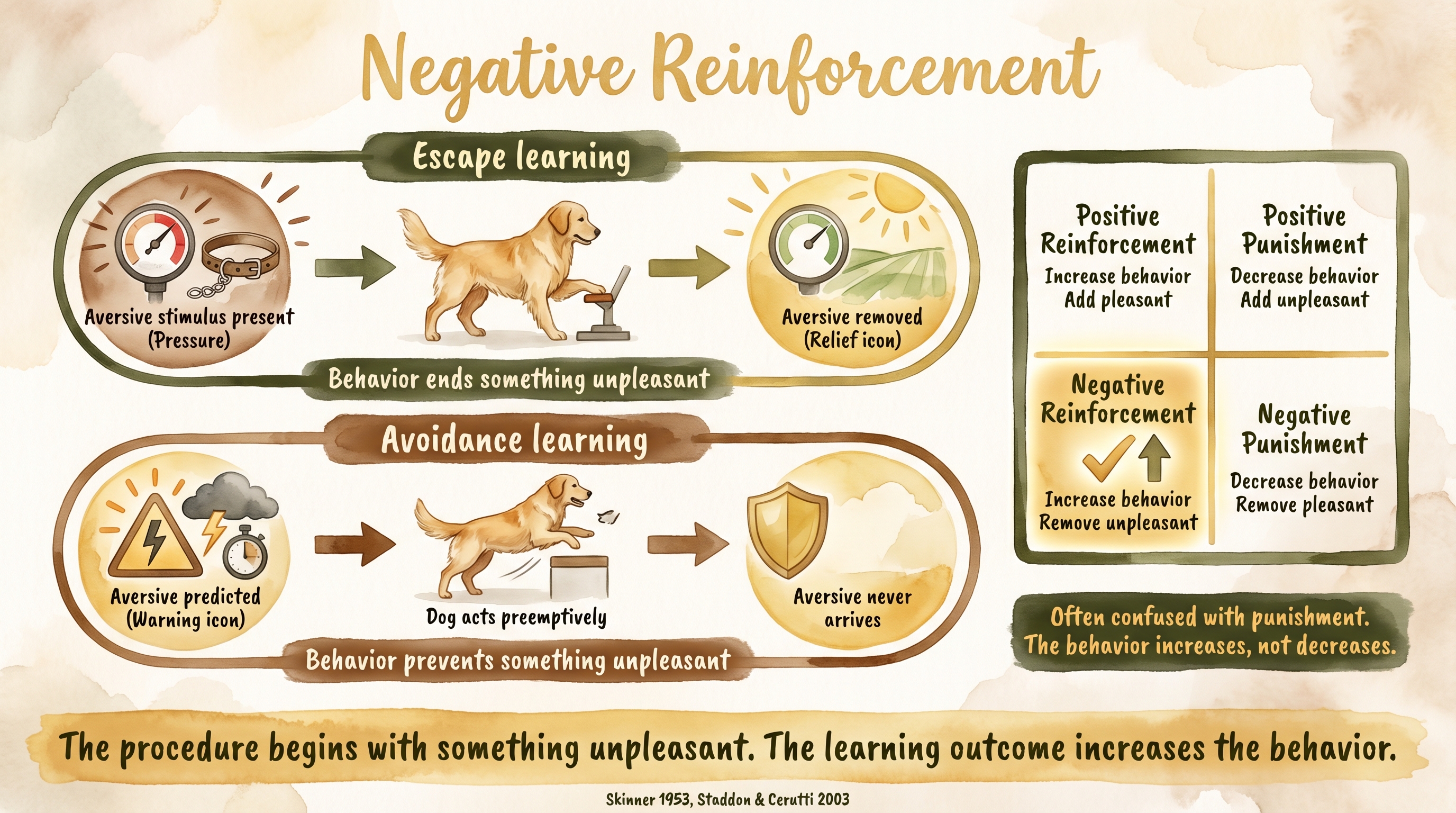
Negative reinforcement increases behavior by removing something aversive - technically effective but often misunderstood.
Key Takeaways
- Negative reinforcement increases behavior by removing an aversive stimulus after the behavior occurs.
- It is often confused with punishment because the procedure begins with something unpleasant.
- Escape and avoidance learning are the two classic forms of negative reinforcement.
- A behavior can become reliable through negative reinforcement while still raising separate welfare concerns.
The Evidence
This entry uses observed claim-level tags beyond the dedicated EvidenceBlocks below. These tags mark JB program observation or practice-derived claims that need dedicated EvidenceBlock coverage in a later content pass.
- Skinner, B. F. (1938, 1953)multiple species
Defined negative reinforcement as an increase in behavior produced by the removal of an aversive stimulus. - Staddon, J. E. R., & Cerutti, D. T. (2003)multiple species
Reviewed escape and avoidance learning as standard negative-reinforcement processes within operant theory. - Learning-theory synthesis in the JB source layerdomestic dogs
Notes that leash pressure release and similar compliance procedures fit the technical definition of negative reinforcement when the dog's behavior terminates the aversive.
- Vieira de Castro, A. C. et al. (2020)domestic dogs
Documented higher cortisol, more stress behavior, and more pessimistic cognitive bias in dogs trained with aversive methods compared with reward-based schools. - Ziv, G. (2017)domestic dogs
Review evidence supports welfare concerns around aversive training methods and does not establish a superior efficacy case that would justify the risks.
- SCR-004 synthesisdomestic dogs
The claim that engineered reinforcement protocols have no documented analog in natural canine development is a reasoned ethological argument rather than a directly verified finding.
No published study has directly compared negative-reinforcement and positive-reinforcement training outcomes in dogs controlling for handler skill, intensity, and frequency to determine whether welfare costs are proportional to procedural differences or categorical.
SCR References
Sources
- Skinner, B. F. (1938). The behavior of organisms: An experimental analysis. Appleton-Century.
- Skinner, B. F. (1953). Science and human behavior. Macmillan.
- Staddon, J. E. R., & Cerutti, D. T. (2003). Operant conditioning. Annual Review of Psychology, 54, 115-144.
- Vieira de Castro, A. C., Fuchs, D., Morello, G. M., et al. (2020). Does training method matter? PLOS ONE, 15(12), e0225023.
- Ziv, G. (2017). The effects of using aversive training methods in dogs: A review. Journal of Veterinary Behavior, 19, 50-60.