The Ainsworth Strange Situation Adapted for Dogs
The Strange Situation Procedure is the methodological backbone of attachment research. In human developmental psychology, Ainsworth designed it to reveal how a child uses a caregiver under novelty, separation, and reunion. When the procedure was adapted for dogs, it became the central test for a specific scientific claim: dogs treat human caregivers as attachment figures rather than as merely familiar companions. Documented
What It Means
The original Strange Situation was built around a simple logic. If the caregiver is an attachment figure, then changing the caregiver's presence should change the young organism's behavior in patterned ways. The subject should show some combination of proximity seeking, distress on separation, contact maintenance on reunion, and freer exploration when the caregiver is available. Documented-Cross-Species
That design matters because attachment is easy to sentimentalize and hard to define. The Strange Situation turns it into observable behavior.
When Topal and colleagues adapted the procedure for dogs, they kept the same core idea: place the dog in an unfamiliar room, vary whether the caregiver or a stranger is present, and code what the dog does. The question is not whether the dog prefers its caregiver in a vague sense. The question is whether the caregiver's presence organizes behavior in the specific pattern expected of attachment.
How the Dog Version Works
The canine procedure uses short episodes involving the dog and caregiver together in a novel room, the entrance of a stranger, caregiver departures and returns, and brief periods where the dog is alone, with the stranger, or reunited with the caregiver.
Researchers code behaviors such as proximity seeking on reunion, contact initiation and maintenance, following the caregiver on departure, greeting intensity, exploration and play in the caregiver's presence, and avoidance, passivity, or disorganized behavior. Documented
The important point is that the test measures relationship organization under mild social stress. It is not a temperament test, not a training test, and not a generic sociability test. A dog may be highly trained and still test insecure. A dog may be friendly to strangers and still show clear caregiver-specific attachment behavior.
What the Adaptation Found
Topal et al. (1998) showed that dogs behave toward caregivers in attachment-relevant ways during the procedure. They showed differential reunion behavior, stronger orientation to the caregiver, and patterns not reducible to simple familiarity alone.
Later work strengthened the method rather than replacing it. Horn et al. (2013) showed that the caregiver functions as a secure base by changing the dog's willingness to explore and persist in a novel context. Documented Solomon et al. (2018/2019) adapted the human classification framework more explicitly and found substantial inter-rater agreement. Mariti, Palestrini, Fallani, Rehn, and others contributed refinements, critiques, and canine-specific measurement work. The result is a maturing literature rather than a one-paper finding.
One useful outcome of this body of work is that it separates attachment quality from training history. A dog can have learned many behaviors, but the Strange Situation asks a different question: when uncertainty rises, what does the relationship do?
Why It Matters for Your Dog
Strengths of the Method
The biggest strength of the canine Strange Situation is that it gives attachment science a repeatable observational structure. Instead of relying only on caregiver reports, the field can watch what dogs actually do under controlled changes in social context.
It also allows multiple outputs to be considered together. A secure-base effect is not only about reunion greeting. It includes exploratory balance, contact seeking, behavioral recovery, and willingness to re-engage with the environment. That broader pattern is part of why the method has held up.
Finally, the procedure created a bridge between human developmental theory and canine behavioral science. It did not prove that dogs are miniature children. It did provide a principled way to test whether the same attachment architecture could be detected in another species living closely with humans. Documented
Limitations and Criticisms
The method also has real limits.
First, it is brief and laboratory based. A short scripted procedure cannot capture every aspect of a long relationship.
Second, order effects matter. Fallani and colleagues showed that some behavioral outputs change depending on the sequence of entries and exits, which means design details can affect interpretation.
Third, the stronger claim that dogs can be cleanly sorted into the full human Ainsworth typology is more debated than the simpler claim that dogs show attachment behavior. Ambiguous The procedure is solid for documenting secure-base and reunion effects. Category mapping is more methodologically delicate.
Fourth, species differences matter. Dogs are adult canids living in human households, not human infants in a nursery. The procedure is an adaptation, not a perfect species-to-species copy. That is why the best canine studies increasingly combine Strange Situation logic with canine-specific scales and secure-base tests rather than treating the original human protocol as untouchable.
JB's pillar pages use the language of secure base and safe haven because the Strange Situation literature shows those functions are real. The procedure itself does not validate a whole raising philosophy. It validates the existence of attachment-relevant organization in dog-human relationships.
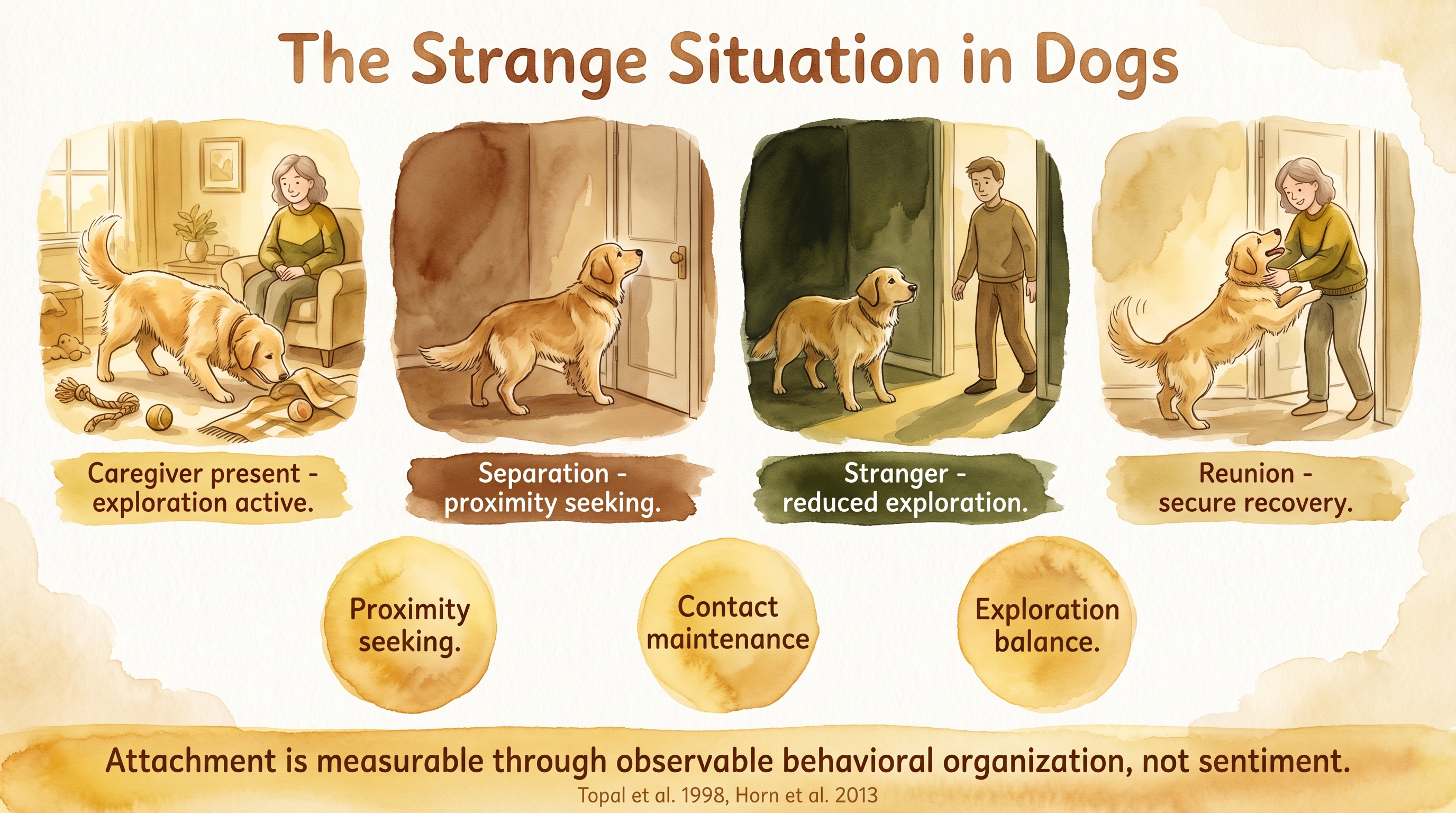
The Strange Situation measures attachment through observable behavioral organization across separation and reunion.
Key Takeaways
- The canine Strange Situation is a relationship test, not a training or obedience test.
- Its main job is to show whether caregiver presence changes behavior in the pattern expected of attachment.
- The procedure strongly supports secure-base and reunion findings in dogs.
- The stricter question of perfect human-style category transfer remains less settled than the basic attachment finding itself.
The Evidence
This entry uses ambiguous claim-level tags beyond the dedicated EvidenceBlocks below. These tags mark claims where the literature remains unsettled or multiple interpretations coexist.
- Topal, J. et al. (1998)domestic dogs
Introduced the canine adaptation of Ainsworth's Strange Situation and showed attachment-relevant caregiver-specific behavior. - Horn, L., Huber, L., & Range, F. (2013)domestic dogs
Confirmed that caregiver presence functions as a secure base by altering exploration and engagement in a novel setting. - Solomon, J. et al. (2018/2019)domestic dogs
Adapted attachment-classification procedures to dogs with substantial inter-rater agreement and meaningful caregiver-sensitivity links. - Fallani, G. et al. (2007)domestic dogs
Showed that counterbalancing matters because order effects can change exploratory behavior in the canine protocol.
- Ainsworth, M. D. S. et al. (1978)humans
Developed the Strange Situation as an operational test of attachment quality through separation and reunion behavior. - Bowlby, J. (1969)humans
Provided the attachment-system framework that made the Strange Situation conceptually meaningful.
- Attachment source synthesisdomestic dogs
The existence of attachment behavior in dogs is documented, but exact one-to-one transfer of full Ainsworth category structure remains methodologically developing rather than fully closed.
No published study has directly compared attachment security outcomes across different breeder-to-family transition protocols in puppies using the Strange Situation procedure.
SCR References
Sources
- Ainsworth, M. D. S., Blehar, M. C., Waters, E., & Wall, S. (1978). Patterns of attachment: A psychological study of the strange situation. Erlbaum.
- Bowlby, J. (1969). Attachment and loss. Vol. 1: Attachment. Basic Books.
- Fallani, G., Prato-Previde, E., & Valsecchi, P. (2007). A counterbalanced version of Ainsworth's Strange Situation Procedure reveals secure-base effects in dog-human relationships. Applied Animal Behaviour Science, 109(2-4), 306-319.
- Horn, L., Huber, L., & Range, F. (2013). The importance of the secure base effect for domestic dogs. PLoS ONE, 8(1), e65296.
- Solomon, J., Beetz, A., Schoberl, I., Gee, N., & Kotrschal, K. (2018/2019). Attachment security in companion dogs: Adaptation of Ainsworth's strange situation and classification procedures to dogs and their human caregivers. Attachment & Human Development, 21(4), 389-417.
- Topal, J., Miklosi, A., Csanyi, V., & Doka, A. (1998). Attachment behavior in dogs: A new application of Ainsworth's Strange Situation Test. Journal of Comparative Psychology, 112(3), 219-229.