Caregiver Sensitivity and Attachment Quality
Compound evidence detail2 SCRs / 5 parts
- Documentedthe human attachment evidence base together with the canine-direct secure-base findings (Topal 1998, Horn 2013) and Schoberl-documented physiological effects of secure caregiving in dogs
- Heuristicthe full attachment-theory apparatus transfer to canine relationships, including internal working models and attachment-classification systems
- Documentedthe Baumrind authoritative-parenting literature in human child development
- Documentedthe canine correlational evidence linking dog-directed caregiving styles to attachment, attention, sociability, and problem-solving outcomes (van Herwijnen 2018/2020, Brubaker and Udell 2023)
- Heuristicthe JB inference that one specific caregiving style experimentally produces the best long-term developmental outcomes in dogs
Caregiver sensitivity is one of the central ideas in attachment science. The basic claim is not that affectionate caregivers are enough. It is that secure attachment grows when the caregiver is reliably available, reads the dependent animal's signals with reasonable accuracy, and responds in a way that fits the situation rather than flooding it, ignoring it, or escalating it. In human developmental psychology, that finding is one of the most replicated in the field. In dogs, the same logic is increasingly supported, but with more caution about causality and mechanism. Mixed Evidence
What It Means
What "Sensitivity" Means
In attachment research, sensitivity is a disciplined concept. Documented It includes noticing the signal, interpreting it reasonably well, responding promptly enough to matter, responding in a way that matches the need, and remaining predictable across time.
That is different from indulgence. A caregiver can be warm but inconsistent, attentive but chaotic, or affectionate but poor at regulation. Sensitive caregiving is not maximal involvement. It is accurate, proportionate, and dependable involvement.
Ainsworth's work made this clear in human infants. Documented-Cross-Species The secure child is not created by constant stimulation or unrestricted access. Security grows from a caregiver who can be present without becoming dysregulating.
Why It Matters for Attachment Quality
Attachment quality reflects whether the caregiver becomes usable under stress and novelty. That depends on the history of responses. If the young organism repeatedly finds that signals are met with reliable availability and calibrated action, the caregiver becomes an anchor. If the caregiver is erratic, overstimulating, punitive, or hard to predict, the relationship becomes less organizing.
This is one reason attachment science and parenting-style research overlap so often. Observed-JB Sensitivity is the moment-to-moment mechanism. Caregiving style is the broader pattern. A relationship can only function as secure base and safe haven if the ongoing responses are legible enough for the dependent animal to trust them.
What Transfers to Dogs
The most important boundary is that SCR-017 is strongest in humans. Secure attachment from consistent, sensitively responsive care is a settled developmental finding there. The canine literature supports a bounded extension rather than a perfect one-to-one transfer. Documented
That extension comes from several converging lines: dogs form attachment bonds and secure-base effects with caregivers, dog-directed parenting styles can be measured, caregiving style covaries with attachment-related outcomes, and caregiver interaction style predicts concrete behavior variables in dogs. Documented
van Herwijnen and colleagues showed that dog-directed parenting styles exist as measurable caregiver patterns and that these styles predict observed handling behavior such as praise, correction, and leash tension. Brubaker and Udell found that authoritative caregiving style was associated with stronger attachment security and better task persistence. Bouma and related work extended the picture into intergenerational transmission and social-context outcomes. Together, these studies do not prove that canine attachment develops through exactly the same causal pathway as human infant attachment, but they strongly support the claim that the caregiver's interaction style is not background noise. It is part of the developmental environment.
Why It Matters for Your Dog
Sensitivity Versus Overinvolvement
One reason this page matters is that it protects against a common error: assuming that "more" caregiving always equals "better" caregiving.
The dog literature does not support that simplification. Some caregiver-interaction findings are mixed. For example, more frequent interaction can correlate with more proximity seeking without proving that the underlying attachment is healthier. High contact can reflect security, dependence, anxiety, or management style depending on the context.
That is why attachment researchers care so much about quality and fit. Sensitive responsiveness is not constant petting, constant reassurance, or constant intervention. It is the caregiver's ability to stay legible and regulating. In dog terms, that often means the caregiver can be available without being frenetic, present without becoming intrusive, and warm without collapsing structure.
The Causality Limit
This is where the evidence level becomes mixed rather than purely documented.
The human literature supports the causal claim more strongly. In dogs, most of the relevant studies are correlational, observational, or cross-sectional. They show that caregiving style and attachment-related outcomes move together. They do not yet isolate the entire developmental mechanism with the same experimental strength seen in some human developmental models.
So the safe scientific statement is: human evidence strongly supports that sensitive, predictable caregiving supports secure attachment, dog evidence strongly shows that caregiver caregiving style is measurable and associated with attachment-related outcomes, and the stronger claim that authoritative or sensitively responsive caregiving directly causes all later dog outcomes is still too strong if stated without caution.
The pillar entry argues that sensitive responsiveness is part of how puppies are raised well. This page stays narrower. The science shows that caregiver style and relationship quality matter. It does not justify turning every form of involvement into "sensitive care."
No published study has directly tested whether JB-style sensitive caregiving produces measurably higher secure-attachment or better behavioral outcomes than other sensitive or responsive caregiving approaches in puppies.
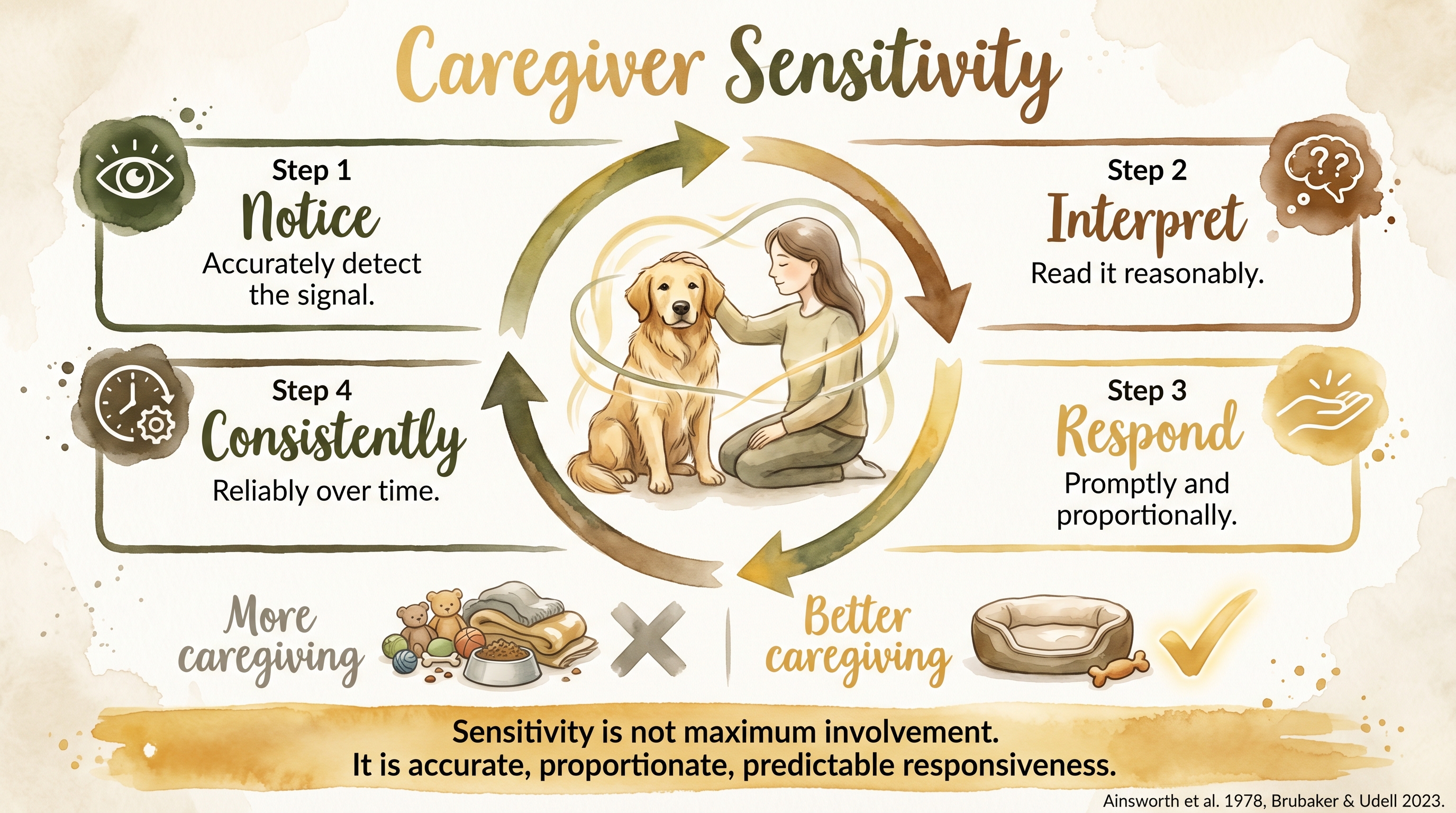
Caregiver sensitivity - reading and responding to signals accurately - is the strongest predictor of attachment security.
Key Takeaways
- Caregiver sensitivity means accurate, proportionate, and predictable responsiveness, not maximum involvement.
- Human attachment science strongly supports the link between sensitive care and secure attachment.
- Dog studies now show that caregiving style is measurable and associated with attachment-related outcomes.
- The canine evidence is strong for association, but broader causal claims still need tighter wording than the human literature does.
The Evidence
This entry uses observed claim-level tags beyond the dedicated EvidenceBlocks below. These tags mark JB program observation or practice-derived claims that need dedicated EvidenceBlock coverage in a later content pass.
This entry uses mixed-evidence claim-level tags beyond the dedicated EvidenceBlocks below. These tags mark claims that combine documented findings with observed practice, heuristic application, or unresolved gaps.
- van Herwijnen, I. R. et al. (2018)domestic dogs and humans
Recovered dog-directed parenting-style dimensions in owner reports, showing that guidance styles are measurable rather than anecdotal. - van Herwijnen, I. R. et al. (2020)domestic dogs and humans
Dog-directed parenting styles predicted concrete handling behavior such as praise, verbal correction, leash tension, and owner-directed attention in distraction contexts. - Brubaker, L., & Udell, M. A. R. (2023)domestic dogs
Authoritative caregiving style was associated with higher attachment security and better social and problem-solving outcomes. - Bouma, E. M. C. et al. (2024)domestic dogs and humans
Parenting-style variables in human-dog relationships were associated with secure attachment, sociability, and social-context sensitivity.
- Ainsworth, M. D. S. et al. (1978)humans
Sensitive, predictable responsiveness is central to secure attachment formation. - SCR-017 synthesishumans
Secure attachment from consistent, responsive care is among the most replicated findings in developmental psychology.
- SCR-019 boundarydomestic dogs and humans
Dog-directed parenting-style findings are now direct and documented for association, but causal developmental transfer from Baumrind's human framework remains more limited. - Attachment source synthesisdomestic dogs
More interaction or more reassurance should not automatically be interpreted as more secure attachment without considering regulation quality and context.
SCR References
Sources
- Ainsworth, M. D. S., Blehar, M. C., Waters, E., & Wall, S. (1978). Patterns of attachment: A psychological study of the strange situation. Erlbaum.
- Bouma, E. M. C., Vingerhoets, A. J. J. M., & van der Veld, W. M. (2024). Parenting styles and intergenerational transmission in human-dog relationships. Anthrozoos / Animals, 14(7), 1038.
- Brubaker, L., & Udell, M. A. R. (2023). Does pet parenting style predict the social and problem-solving behavior of pet dogs? Animal Cognition, 26(1), 345-356.
- van Herwijnen, I. R., van der Borg, J. A. M., Naguib, M., & Beerda, B. (2018). The existence of parenting styles in the owner-dog relationship. PLOS ONE, 13(2), e0193471.
- van Herwijnen, I. R., van der Borg, J. A. M., Naguib, M., & Beerda, B. (2020). Dog-directed parenting styles predict verbal and leash guidance in dog owners and owner-directed attention in dogs. Applied Animal Behaviour Science, 232, 105131. https://doi.org/10.1016/j.applanim.2020.105131