When the Soft Landing Is Harder Than Expected
Not every soft landing feels soft from the inside. Some families do everything they understand to do, and the first month is still rougher, louder, or more confusing than the baseline JB hopes for. That matters because many good families interpret a difficult start as proof that they have failed or that the puppy itself is wrong for them. JB rejects that conclusion. A harder-than-expected transition is usually a sign that more support, more simplification, or more deliberate structure is needed, not a sign that the philosophy has stopped applying. Observed-JB
What It Means
The soft landing is a direction, not a guarantee.
That distinction is important.
Families often imagine two possibilities: the soft landing worked and the soft landing failed. Observed-JB
Real life is usually more layered than that.
A first month can be harder than expected for reasons that have very little to do with effort or love: the household baseline is naturally loud, the resident dog adds tension, a family event disrupts the rhythm, the puppy itself sits toward the more sensitive edge of normal temperament, and the adults are still learning the calm vocabulary while trying to use it. Observed-JB
None of those realities make the household hopeless.
They do mean the family may need more support and a narrower plan.
A Hard Start Is Not Proof of a Bad Puppy
This is one of the most important emotional corrections in the dispatch.
When the first month feels unusually hard, families often begin asking the wrong questions: did we choose wrong, is something wrong with this puppy, and are we just not good at this. Observed-JB
Those questions create shame before they create clarity.
The better questions are: what is making the calm floor harder to hold, where is the household rhythm leaking arousal, and what support do we need that we have not asked for yet.
That shift matters because it keeps the family inside a problem-solving posture instead of a defeat posture.
The Household Is Part of the Dog's Nervous System
This dispatch leans heavily on a simple but load-bearing truth. Puppies do not transition into houses in the abstract. They transition into actual human systems with actual movement, tone, stress, timing, and habits. A house where adults are hurried, children are loud, the resident dog is unstable, or daily life is already compressed places different demands on the puppy than a quieter home does. Documented
That is not a moral failure.
It is a real variable.
The family's job is not to become magically different overnight.
It is to notice the variables honestly and protect the puppy from more of the household's noise than the puppy can handle at once.
Some Puppies Need More Support
Golden Retrievers still vary.
Most JB families will not meet the far edges of the temperament distribution, but variation still exists: some puppies startle more easily, some recover more slowly, some are more socially intense, and some show more persistence in arousal once activated. Observed-JB
Acknowledging that variation is not anti-philosophy.
It is part of being truthful.
The calm floor matters even more, not less, when the puppy is harder to settle.
What Recovery Looks Like
The first step in recovery is not changing everything.
It is simplifying.
Families do best when they return to a smaller working perimeter: quieter greetings, fewer visitors, more protected naps, shorter outings, clearer handoffs between adults, and a call to the breeder sooner rather than later.
Often the household does not need a brand new theory.
It needs a narrower version of the one it already has.
That narrower version usually reveals the true pressure points quickly.
Sometimes the recovery is mostly environmental.
Sometimes it is relational.
Sometimes it is as practical as realizing that too many adults are handling the puppy in too many different ways.
The recovery starts when the family stops trying to keep up appearances and starts trying to make the home more legible.
Why It Matters for Your Dog
This page matters because families who believe the first month should be easy are more likely to abandon good structure the moment the puppy becomes difficult. Families who understand that some transitions are simply harder stay in the work long enough for it to start paying off.
The calm floor matters most when the household is tempted to leave it. A difficult transition does not cancel the philosophy. It clarifies which parts of the philosophy need to be held most deliberately.
That is why the support piece matters so much too. JB is not built on the idea that the family is supposed to decode every difficulty alone. The breeder knows the litter, the parents, and the vocabulary the puppy came from. Reaching back out is not a sign that the transition is going badly. It is a sign the relationship is working the way it was designed to work.
The puppy does not need the family to be flawless.
It needs the family to keep moving toward steadiness.
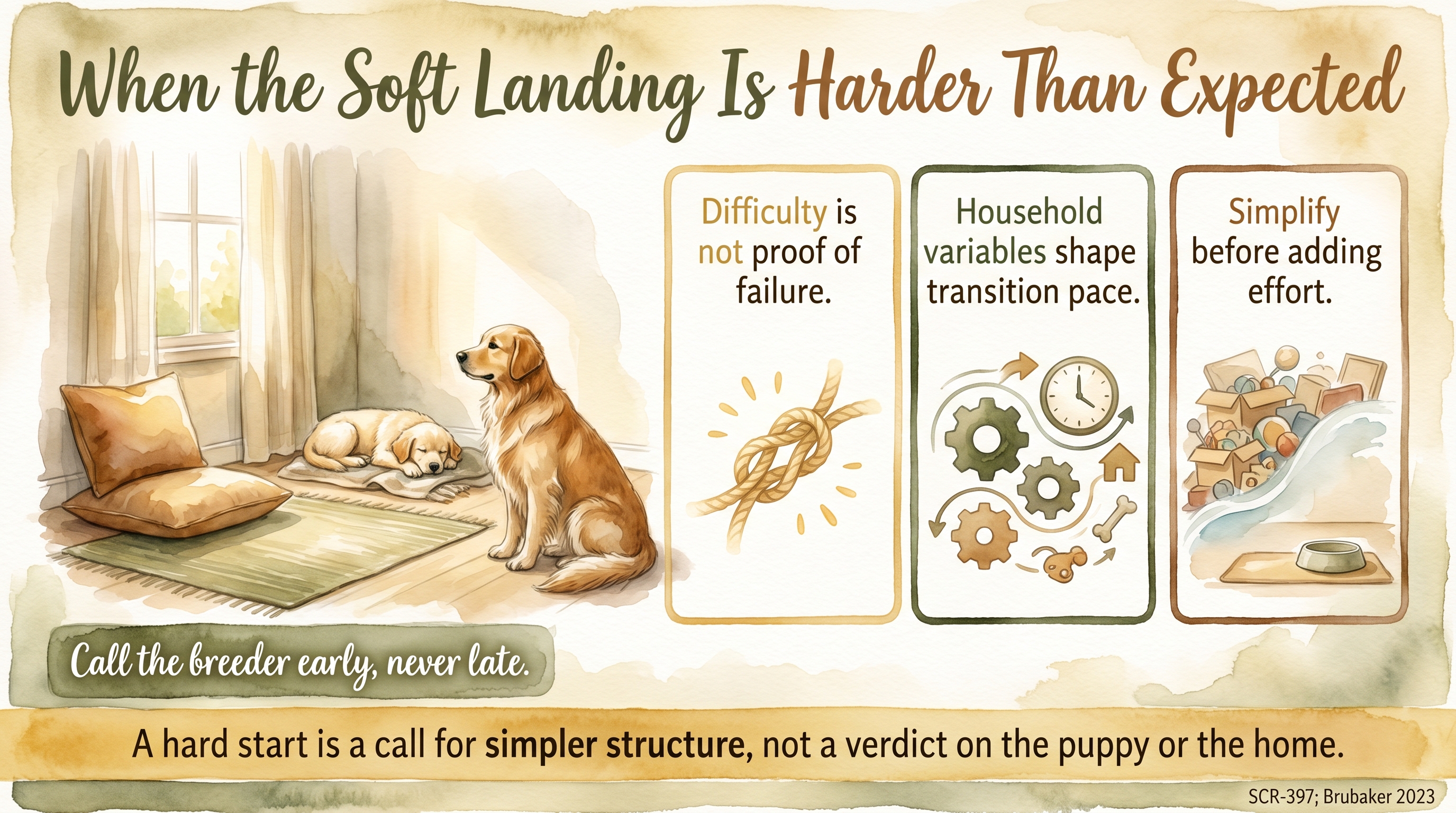
A hard start is a call for simpler structure, not a verdict on the puppy or the home.
Key Takeaways
- A harder-than-expected first month does not mean the family failed or the puppy is wrong for the home.
- Difficult transitions are often shaped by household variables, timing, and temperament, not just by effort.
- The best early recovery move is usually simplification: quieter routines, fewer variables, and faster breeder contact.
- The soft landing remains the right framework even when the first weeks feel rougher than expected.
The Evidence
- Brubaker & Udell (2023); van Herwijnen et al. (2018, 2020); de Assis et al. (2025)domestic dogs
Owner interaction style, stability, and household management patterns measurably shape canine behavioral outcomes, which means early transition difficulty cannot be understood as a puppy-only variable. - Brubaker & Udell (2023); van Herwijnen et al. (2018, 2020); de Assis et al. (2025)domestic dogs
More consistent and authoritative owner patterns are associated with better canine attention, regulation, and social outcomes than inconsistent or harsher-response patterns.
- JB breeder-network observationfamily-raised Golden Retriever puppies
Some first months are harder because the household baseline, family stress load, resident-dog dynamics, or puppy sensitivity make the calm floor harder to hold, but simplification and support often re-anchor the transition.
No published study directly tests the specific Just Behaving guidance on when the soft landing is harder than expected. This entry relies on broader canine evidence, breeder observation, and practical synthesis.
SCR References
Sources
- Brubaker, L., & Udell, M. A. R. (2023). Does pet parenting style predict the social and problem-solving behavior of pet dogs (Canis lupus familiaris)? Animal Cognition, 26(1), 345-356. https://doi.org/10.1007/s10071-022-01694-6
- van Herwijnen, I. R., van der Borg, J. A. M., Naguib, M., & Beerda, B. (2018). The existence of parenting styles in the owner-dog relationship. PLOS ONE, 13(2), e0193471. https://doi.org/10.1371/journal.pone.0193471
- van Herwijnen, I. R., van der Borg, J. A. M., Naguib, M., & Beerda, B. (2020). Dog-directed parenting styles predict verbal and leash guidance in dog owners and owner-directed attention in dogs. Applied Animal Behaviour Science, 232, 105131. https://doi.org/10.1016/j.applanim.2020.105131
- de Assis, L. S., Georgetti, B., Burman, O. H. P., Pike, T. W., & Mills, D. S. (2025). Development of a dog owner caregiving style scale (Lincoln Owner Caregiving Questionnaire, LOCQ) and its relationship with behaviour problems in dogs. Applied Animal Behaviour Science, 287, 106628. https://doi.org/10.1016/j.applanim.2025.106628