Recovery from a Crash Landing
Many families do not realize they had a crash landing until the second or third week. The first days were busy, visitors came through, greetings got excited, naps were interrupted, the puppy got passed around, and by the time the family can name what happened the pattern is already written more deeply than they wanted. JB's answer is not despair. It is recovery. A crash landing is not ideal, but it is not final. Behavior can re-settle faster than people fear, even while some learned over-arousal patterns take longer to fade because they now have a real history behind them. Observed-JB
What It Means
A crash landing does not mean catastrophe.
It means the early transition wrote more noise into the system than JB would choose.
That noise often looks like: bigger greetings, harder nipping, poorer settling, lighter sleep, and more frantic movement around routine events. Observed-JB
The key is recognizing that two things can be true at the same time: the puppy can improve substantially and some patterns will take more work now because they were rehearsed.
What Recovers Quickly
The encouraging part is that the everyday baseline can often improve quickly once the household really simplifies.
Families usually notice early gains in: nap quality, mealtime composure, evening settling, and recovery after small upsets.
That is because the puppy keeps living inside the environment the family provides every day.
When the environment gets quieter and more readable, the puppy often responds with more stability sooner than the adults expected.
What Recovers More Slowly
What tends to take longer is any pattern the family accidentally rehearsed: jumping into greetings, escalating into hand-biting, treating strangers as exciting events, and getting activated by certain rooms, times, or routines.
This is where learning theory matters.
Once a pattern has been reinforced, even accidentally, stopping it is not the same as never having started it. Extinction findings in dogs, together with relapse research primarily from rats and other laboratory species, strongly support the narrower point that previously learned responses can persist, recover, and reappear under changed conditions. Documented-Cross-Species JB's stronger philosophical claim that prevention always leaves no residue while correction always does is best treated as a heuristic extension of that literature, not as a directly measured dog-wide law. Heuristic
Recovery Is Not Punishment
Families often think recovery means getting stricter in a loud way.
It usually means the opposite.
JB is not asking the family to punish the puppy for a noisy start, and it does not treat correction and punishment as the same thing. Observed-JB Correction is communication. Punishment is imposed suffering.
The recovery move is: reduce stimulation, tighten management, stop rehearsing the wrong things, and return to simple calm routines.
The house needs less drama, not more.
What Recovery Looks Like
Practical recovery usually starts with a short reset window.
For several days to two weeks, the family returns to first-week architecture as deliberately as possible: quiet bedroom rest, calm greetings only, fewer or no visitors, minimal novelty, shorter social interactions, matter-of-fact handling, and breeder check-in.
This can feel like going backward.
It is not.
It is re-establishing the floor the family meant to build in the first place.
Families also do best when they stop treating every unwanted behavior as something to confront in the moment. Observed-JB Much of the recovery comes from not setting up the same trigger pattern tomorrow.
That is Prevention re-entering the picture after drift.
Why It Matters for Your Dog
This page matters because families who realize they had a crash landing are often at their most discouraged right when the most useful recovery window is still open. If they panic, add more stimulation, or escalate into harder handling, they deepen the very pattern they are trying to undo.
The calmer alternative is more powerful.
Even after a crash landing, the cleanest recovery tool is still prevention. The family gets traction not by correcting every old pattern harder, but by removing the conditions that keep writing those patterns tomorrow.
This page also protects families from an unrealistic erasure fantasy. The goal is not to pretend the first weeks never happened. The goal is to shift the baseline going forward so the older pattern stops being the one the puppy practices most often.
That is why recovery works.
The house is where the puppy lives, and life keeps teaching.
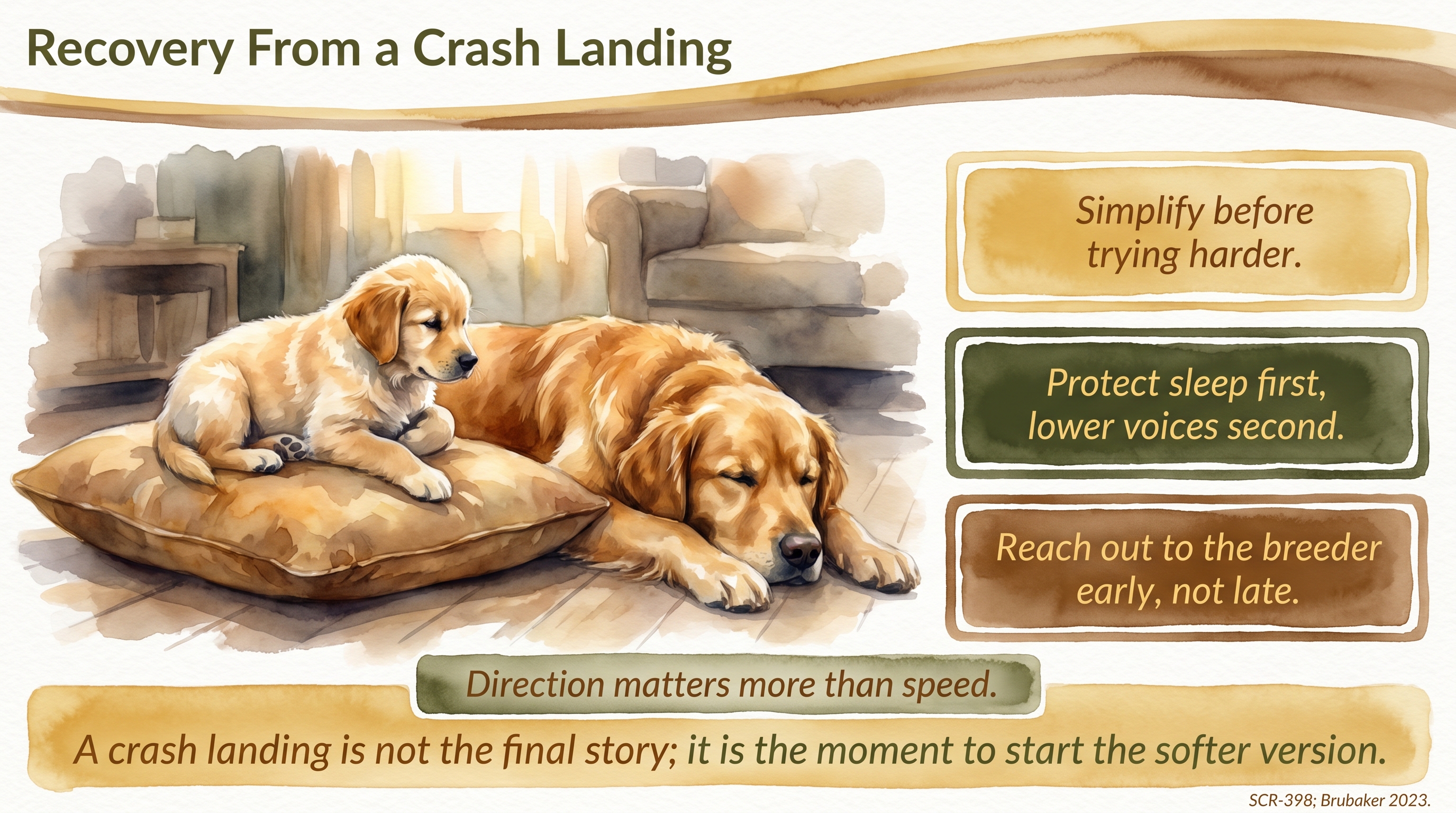
A crash landing is not the final story; it is the moment to start the softer version.
Key Takeaways
- A crash landing is not ideal, but it is not permanent and does not mean the household is beyond recovery.
- The daily baseline often improves faster than families expect once the home becomes quieter and more predictable.
- Rehearsed over-arousal patterns can take longer to fade because previously learned responses are not the same as behaviors that never started.
- Recovery works best when families simplify hard, return to first-week structure, and stop writing the same noisy pattern again tomorrow.
The Evidence
This entry uses documented cross-species claim-level tags beyond the dedicated EvidenceBlocks below. Species and application scope should be checked during the next evidence-chain authoring pass.
- Bouton (2002, 2004); Gazit et al. (2005); Hall & Wynne (2016)rats with canine application boundaries
Extinction does not erase original learning; previously reinforced responses can return through renewal, spontaneous recovery, and rapid reacquisition. - Sundman et al. (2019); Hoglin et al. (2021); Beerda et al. (1999); Hennessy et al. (2009)domestic dogs
Behavioral baselines can improve as environmental predictability and recovery opportunities improve, even when earlier stress or noise complicated the initial settling process.
- JB synthesis anchored to Bouton-style relapse findingsbreeder-to-family transition practice
The idea that behaviors already rehearsed leave more residue than behaviors never initiated is strongly consistent with extinction-relapse logic, but the strongest lifelong version of that claim remains interpretive.
- JB breeder-network observationfamily-raised puppies
Families who deliberately simplify the home and return to first-week calm choreography after a noisy start commonly see the puppy baseline improve within days to weeks, even when some old patterns take longer to unwind.
No published study directly tests the specific Just Behaving guidance on recovery from a crash landing within a breeder-to-family transition, so this entry relies on broader canine evidence, breeder observation, and practical synthesis rather than a direct trial of the full protocol.
SCR References
Sources
- Bouton, M. E. (2002). Context, ambiguity, and unlearning: Sources of relapse after behavioral extinction. Biological Psychiatry, 52(10), 976-986. https://doi.org/10.1016/S0006-3223(02)01546-9
- Bouton, M. E. (2004). Context and behavioral processes in extinction. Learning & Memory, 11(5), 485-494. https://doi.org/10.1101/lm.78804
- Gazit, I., Goldblatt, A., & Terkel, J. (2005). The role of context in extinction of searching behavior in dogs. Animal Cognition, 8(2), 91-99.
- Hall, N. J. (2017). Persistence and resistance to extinction in the domestic dog: Basic research and applications to canine training. Behavioural Processes, 141(Part 3), 67-74. https://doi.org/10.1016/j.beproc.2017.04.001
- Sundman, A.-S., Van Poucke, E., Svensson Holm, A.-C., Faresjo, A., Theodorsson, E., Jensen, P., & Roth, L. S. V. (2019). Long-term stress levels are synchronized in dogs and their owners. Scientific Reports, 9, 7391. https://doi.org/10.1038/s41598-019-43851-x
- Hoglin, A., Van Poucke, E., Katajamaa, R., Jensen, P., Theodorsson, E., & Roth, L. S. V. (2021). Long-term stress in dogs is related to the human-dog relationship and personality traits. Scientific Reports, 11, 8612. https://doi.org/10.1038/s41598-021-88201-y
- Beerda, B., Schilder, M. B. H., van Hooff, J. A. R. A. M., de Vries, H. W., & Mol, J. A. (1999). Chronic stress in dogs subjected to social and spatial restriction. I. Behavioral responses. Physiology & Behavior, 66(2), 233-242. https://doi.org/10.1016/S0031-9384(98)00289-3
- Hennessy, M. B., Voith, V. L., Mazzei, S. J., Buttram, J., Miller, D. D., & Linden, F. (2009). Behavior and cortisol levels of dogs in a public animal shelter, and an exploration of the ability of these measures to predict problem behavior after adoption. Applied Animal Behaviour Science, 113(4), 798-810. https://doi.org/10.1016/j.applanim.2008.06.004