Water Access and Bathroom Rhythm in the First Week
Water access confuses many first-week families because they are trying to solve two real problems at once: keeping the puppy properly hydrated and getting through the night with as few accidents as possible. The mistake is to think those goals compete absolutely. They do not. JB's middle path is straightforward. During the day, water is freely available during active windows. Near bedtime, access narrows so overnight continence becomes more realistic. The key is rhythm, not fear. The family should not manage water out of panic about messes. It should manage water the same way it manages everything else in the first week: predictably, calmly, and with the puppy's physiology rather than its imagined stubbornness in mind. Observed-JB
What It Means
The first-week puppy lives inside a very short interval between: I feel it, I need to go, and I cannot hold it anymore.
That interval is especially brief after: waking, drinking, eating, play, and excitement.
Water therefore needs to be understood as part of the bathroom rhythm, not as a completely separate household question. Observed-JB
Daytime Access Should Be Free
During the day's active hours, puppies should have normal access to water.
This matters because one of the most common fear-driven mistakes is aggressive daytime restriction. Observed-JB Families get worried about accidents and quietly start treating water as the enemy.
That creates a new set of problems: inconsistent hydration, gulping when water finally appears, less predictable drinking pattern, and more human anxiety around the bowl. Observed-JB
JB rejects that approach. During normal daytime activity, the puppy should be allowed to drink and the adults should simply let that information sharpen their bathroom timing.
Water is not the problem. Poor rhythm is the problem.
Evening Is Different
Evening is where the practical adjustment happens.
A very young puppy who drinks freely right up until lights-out is more likely to need to eliminate overnight. That is not a moral failure. It is ordinary physiology.
So the first-week middle path is: daytime free access, evening awareness, water removed some time before bed, and final potty outing before sleep.
The exact timing varies by age, meal schedule, and household. A common workable range is around two hours before bedtime. The principle matters more than the exact minute. The family is simply reducing one predictable overnight pressure point while preserving normal daytime hydration.
Why the Rhythm Has to Be Read as a Whole
Water timing works best when it is understood alongside: meal timing, nap timing, wake windows, and bedtime timing.
A puppy who wakes, drinks, eats, plays, and then is not taken out quickly is much more likely to have an accident than a puppy whose family understands the chain reaction: wake, outside, water, food, and outside again.
This page therefore lives naturally beside the house-training and mealtime pages. All three are teaching the same adult skill: stay ahead of the body's predictable rhythms.
What a Crash Landing Looks Like Here
There are two main crash-landing errors.
The first is harsh daytime restriction: tiny water servings, adults anxious around the bowl, and the puppy drinking desperately whenever water appears.
The second is the opposite: unlimited evening water, no adjustment before bed, and then surprise and frustration when the puppy cannot stay dry through the night.
Both errors come from the same misunderstanding. The family sees the accident and thinks the puppy is the unstable variable. Usually the unstable variable is the management pattern.
The Bowl Should Not Become Emotional
Another common mistake is emotional handling of the water bowl: watching every sip anxiously, moving the bowl in and out unpredictably, offering water constantly because the puppy "looks thirsty", and then removing it suddenly with frustration because of accidents.
That volatility teaches the puppy nothing useful.
The bowl should simply be part of the household rhythm. Water appears when the day's active windows begin. Water remains available. The family notes when drinking happens and moves the puppy outside appropriately. Later in the evening, the bowl leaves quietly and returns in the morning.
This is one more place where calm adult management prevents the household from turning a biological process into emotional theater.
The Wake-Drink-Eliminate Loop
One of the most helpful first-week ideas is to assume that drinking is usually paired with another event: waking, eating, and brief activity.
That means water should rarely be thought of as an isolated action. It belongs in the loop.
For example: wake, outside, back in, water, breakfast, and outside again.
Or: nap ends, outside, short wake window, water, and outside again soon.
Families who start seeing the loop stop being surprised so often.
Prevention Is Still the Right Frame
This page belongs under Prevention as much as under house training.
The family should not wait for: the nighttime accident, the puddle after drinking, and the confused circling after a nap.
and then decide what water management should have been.
The family should assume from the start that hydration and elimination live in close conversation and manage accordingly.
That is not over-management. It is just adult foresight.
Why It Matters for Your Dog
Water rhythm matters because it lets the family be fair.
The first-week goal is not to make the puppy hold more than its body can hold. The goal is to manage water and timing so the puppy gets a fair chance to succeed while staying properly hydrated.
This page also lowers unnecessary guilt. Many families interpret nighttime accidents as evidence that the puppy is not learning quickly enough. Observed-JB In practice, the puppy may be learning perfectly well while the bedtime water rhythm is simply not yet aligned with what the body can do.
It also helps protect welfare. Puppies should not have to pay for the family's fear of accidents through chronic under-hydration, and families should not have to pay for poor planning through repeated preventable overnight messes. The middle path is not complicated once the family stops thinking in absolutes.
Daytime abundance.
Evening taper.
Final outing.
Quiet night.
That is usually enough to make the first-week pattern much clearer.
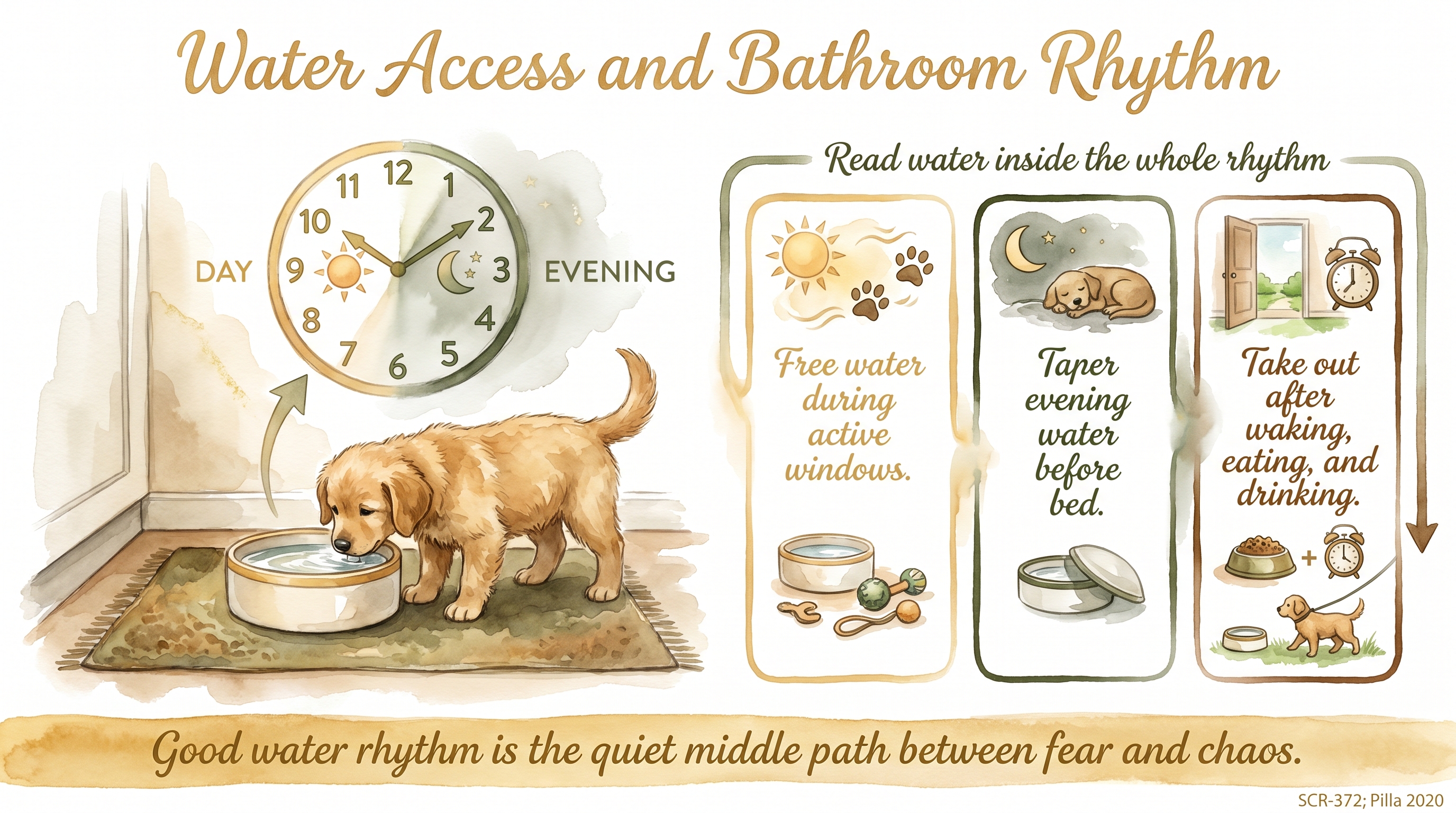
Good water rhythm is the quiet middle path between fear and chaos.
Key Takeaways
- Water should be freely available during daytime active windows, because hydration is not optional and fear-driven restriction creates new problems.
- Evening water can be tapered before bed so overnight accidents become less likely without compromising daytime hydration.
- A crash landing happens when the family either panics and restricts water too hard or leaves evenings unmanaged and then blames the puppy for ordinary physiology.
- Water rhythm works best when it is read together with meals, naps, and potty timing rather than as a separate household issue.
The Evidence
- Freeman et al. (2011); WSAVA; Guard et al. (2017); Liao et al. (2023)growing dogs
Hydration needs are non-negotiable in puppies, while small bladder capacity makes elimination timing especially tight around drinking, eating, and waking.
- JB first-week practicefamily-raised puppies
Free daytime water with a quiet pre-bed taper supports both hydration and more realistic overnight continence, whereas aggressive restriction or completely unmanaged evening access both create preventable problems.
No published study directly tests the specific Just Behaving guidance on water access and bathroom rhythm. This entry relies on broader canine evidence, breeder observation, and practical synthesis.
SCR References
Sources
- WSAVA Global Nutrition Committee. (2011). WSAVA nutritional assessment guidelines. Journal of Small Animal Practice, 52(7), 385-396.
- WSAVA Global Nutrition Committee. (2021). Global nutrition guidelines for companion animals: Nutrient requirements and environmental issues. Journal of the American Veterinary Medical Association, 259(11), 1200-1224.
- Guard, B. C., Mila, H., Steiner, J. M., Mariani, C., Suchodolski, J. S., & Chastant-Maillard, S. (2017). Characterization of the fecal microbiome during neonatal and early pediatric development in puppies. PLOS ONE, 12(4), e0175718. https://doi.org/10.1371/journal.pone.0175718
- Liao, P., et al. (2023). Abrupt Dietary Change and Gradual Dietary Transition Impact Diarrheal Symptoms, Fecal Fermentation Characteristics, Microbiota, and Metabolic Profile in Healthy Puppies. Animals, 13(8), 1300. https://doi.org/10.3390/ani13081300