Mealtime Structure from Day One
In the first week, food should help the house become more predictable, not more theatrical. JB treats meals as calm, repeating, location-anchored events. The puppy eats in the same place, at roughly the same times, with the household present but not hovering. This is not because food is unimportant. It is because food is important enough to keep ordinary. When meals become performances, training games, or bonding rituals layered with too much emotion, the puppy loses one of the cleanest regulatory anchors the day could offer. Observed-JB
What It Means
Most families bring a lot more emotion to meals than the puppy needs.
They worry: Will the puppy eat? Should we make eating more exciting? Should we hand-feed for bonding? Should we use every meal to start training?
Those questions make sense, especially when a puppy has just arrived and everyone wants to do the right thing. Observed-JB But they can easily push the family into too much involvement.
JB argues that meals are more useful when they are simpler.
Food Should Mean Rhythm
In the first week, meals should tell the puppy: food comes reliably, food comes in one place, food is not a social contest, and food does not require performance. Observed-JB
That predictability supports more than appetite. It supports the whole daily map: digestion, elimination timing, morning structure, and evening wind-down.
If the meal is always a little different, happening in a different spot, with different people around, at different levels of noise and attention, then the family is taking one of the easiest regulatory anchors in the day and making it harder to use.
Same Place Matters
The meal location should not wander in the first week.
Pick one quiet spot.
Use it repeatedly.
That spot becomes part of the puppy's growing mental map: this is where food happens, this is where I stand, and this is where the bowl goes.
Small consistencies matter enormously when almost everything else in the puppy's life has just changed. Observed-JB
Why Hovering Changes the Meal
Many families hover over the bowl because they care. They crouch down, talk, praise, reassure, and try to turn food into a social event.
That can subtly change what the meal means.
Instead of: calm intake.
the puppy gets: social pressure, verbal density, excitement, and human faces close to the bowl.
The family then wonders why the puppy eats oddly, looks up constantly, wanders off, or seems uncertain. Observed-JB
Often the meal would be better if the adults simply placed the bowl, stayed nearby without looming, and let the puppy eat.
Hand-Feeding and Early Training
JB is especially cautious about turning first-week meals into: hand-feeding as a bonding ritual, cue-drilling one kibble at a time, and prolonged food luring sessions.
Those methods can have uses in other contexts. The first week is usually not that context.
The first week needs: digestive predictability, low arousal, and a clean food-and-calm association.
When every meal becomes a training spectacle, the puppy begins experiencing food through anticipation, motion, and human activation instead of through steadiness.
That is exactly what JB is trying to avoid.
What a Crash Landing Looks Like Here
The crash-landing version of mealtime often looks warm and involved: the bowl moves around the house, different people feed each meal, children gather close, the puppy is praised for every bite, the meal becomes a cue session, and other pets or people create pressure around the food area.
The family thinks it is building bond and confidence.
What it may actually be building is: meal-time arousal, meal-time confusion, less digestive rhythm, and more bathroom unpredictability later.
This is one of the most useful first-week distinctions in JB. Good rhythm often looks less emotionally expressive than people expect.
Calm Presence, Not Absence
JB is not saying the puppy should eat alone in emotional exile.
The adults can absolutely be present.
They just do not need to turn presence into performance.
A good first-week meal often includes: bowl down, calm adult nearby, minimal verbal traffic, and bowl removed when meal is clearly finished.
That is all. The next meal will come when it comes. The puppy does not need food to double as a reassurance ceremony.
Food and the Calm Floor
This page also belongs in the transition category because food is one of the first repeated household experiences that can either support the calm floor or violate it.
If meals are: orderly, steady, quiet, and predictable.
then the puppy begins to feel the house as one coherent system.
If meals are: improvised, exciting, crowded, and variable.
then even feeding becomes another site of noise and uncertainty.
That is a waste of a very useful daily rhythm.
Why It Matters for Your Dog
Mealtime matters because the family is not only feeding the puppy. It is teaching the puppy what repeated care feels like.
Meals should not ask the puppy to perform connection. They should quietly reinforce that this household is predictable enough that food, bodies, and routine all arrive without drama.
This helps the family too. A calm feeding pattern makes the rest of the day easier: bowel timing becomes easier to predict, appetite is easier to monitor, bathroom rhythm gets cleaner, and fewer household arguments happen around food.
It also lowers the temptation to narrate every bite as though eating were a referendum on the transition. A puppy may eat a little more or a little less in the first days without that meaning a crisis. The calmer the humans stay, the easier it is to read what is actually happening.
The deeper point is that food should stabilize the week. The puppy should experience meals as one of the places where the house makes sense.
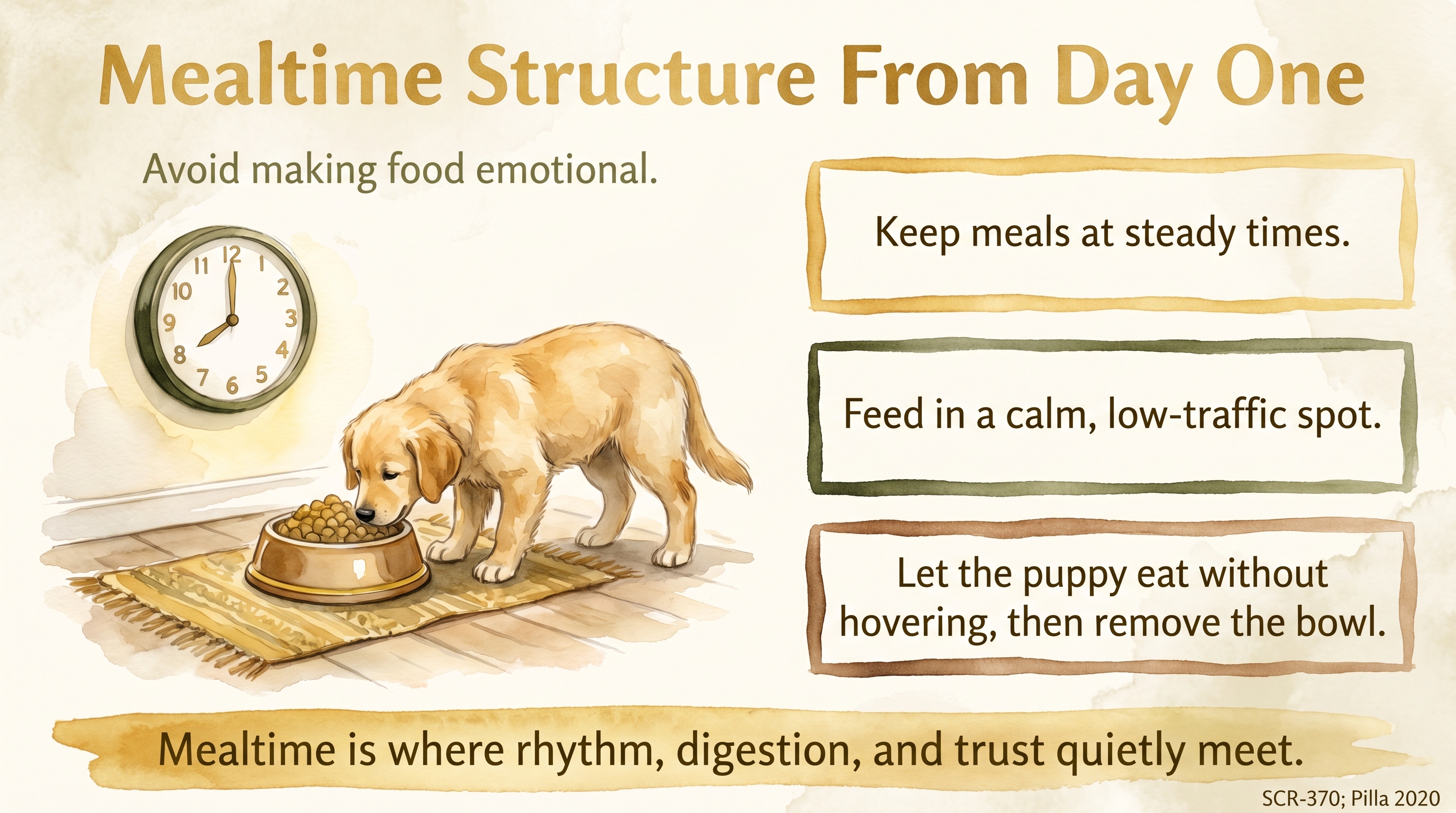
Mealtime is where rhythm, digestion, and trust quietly meet.
Key Takeaways
- First-week meals should be predictable, location-anchored, and calm so food becomes part of the house's rhythm rather than another event.
- Hovering, hand-feeding, and turning every meal into a training session often create more arousal and less clarity than families realize.
- A crash landing at mealtime happens when the bowl becomes a social performance instead of a steady biological routine.
- Mealtime structure helps appetite, digestion, and bathroom rhythm all at once, which is why it belongs at the center of the first-week architecture.
The Evidence
- Freeman et al. (2011); WSAVA; Guard et al. (2017); Liao et al. (2023)growing dogs
Regular feeding schedules support digestive predictability, monitoring of appetite, and more reliable elimination timing in young puppies.
- JB first-week practicefamily-raised puppies
Meals that happen in the same place, at roughly the same times, with calm adult presence and little performance pressure create a steadier transition than hand-feeding rituals or cue-heavy meal sessions.
No published study directly tests the specific Just Behaving guidance on mealtime structure from day one. This entry relies on broader canine evidence, breeder observation, and practical synthesis.
SCR References
Sources
- WSAVA Global Nutrition Committee. (2011). WSAVA nutritional assessment guidelines. Journal of Small Animal Practice, 52(7), 385-396.
- WSAVA Global Nutrition Committee. (2021). Global nutrition guidelines for companion animals: Nutrient requirements and environmental issues. Journal of the American Veterinary Medical Association, 259(11), 1200-1224.
- Guard, B. C., Mila, H., Steiner, J. M., Mariani, C., Suchodolski, J. S., & Chastant-Maillard, S. (2017). Characterization of the fecal microbiome during neonatal and early pediatric development in puppies. PLOS ONE, 12(4), e0175718. https://doi.org/10.1371/journal.pone.0175718
- Liao, P., et al. (2023). Abrupt Dietary Change and Gradual Dietary Transition Impact Diarrheal Symptoms, Fecal Fermentation Characteristics, Microbiota, and Metabolic Profile in Healthy Puppies. Animals, 13(8), 1300. https://doi.org/10.3390/ani13081300