Meeting Other Dogs in the First Month
The broad culture often tells families that puppies need as many dog-to-dog interactions as possible, as early as possible. JB disagrees. The first month is not the time for a puppy to learn that other dogs mainly mean wrestling, chaos, and peer-level over-arousal. It is the time to preserve the mentor pattern the puppy already knew from the breeder environment: calm, adult-guided canine social life. Observed-JB
What It Means
Dog socialization is important.
That does not mean all dog exposure is equally useful.
A puppy in the first month is still building very basic expectations about: what canine company feels like, how intensity starts and stops, and who sets the tone in social moments.
JB wants those expectations shaped by stable adult dogs whenever possible. Observed-JB
Who Counts as a Good First-Month Dog
The narrow answer is: resident adult dogs with good temperaments, the breeder's adult dogs on follow-up visits when possible, and a very small number of trusted adult dogs belonging to people the family already knows well.
The wider answer is no. The first month is not a good time to hand the puppy over to unknown dogs in uncontrolled environments and call it socialization.
Why Adult Dogs Matter More Than Peer Groups
Adult dogs offer something puppies do not: thresholding, social asymmetry, steadier pauses, and better correction of excess.
The play literature supports that dog play is structured, not random, and that adult dog social life is not just a pile of equal-energy peers. Documented That does not prove every adult dog is a good teacher, but it does support JB's intuition that calm adult dogs are a better early model than loose groups of similarly immature puppies.
The Problem With Puppy Socials and Dog Parks
JB's criticism here is not that socialization is bad. It is that many common socialization environments teach the wrong lesson first.
In those settings, the puppy can quickly learn: other dogs mean instant arousal, speed is normal, roughness is normal, and humans stand back while the dogs sort it out. Observed-JB
That is not the only possible outcome, but it is common enough that JB does not want the first-month baseline built there.
Curated Exposure Is Still Exposure
Families sometimes worry that avoiding puppy chaos means under-socializing the dog.
Not if the puppy is still seeing and learning from: stable adult dogs, calm parallel presence, measured interaction, and canine signals that are readable and low-drama. Observed-JB
A few good canine experiences are often developmentally worth more than many noisy ones.
Why It Matters for Your Dog
Month-one dog exposure matters because it shapes expectation. A puppy that learns other dogs mainly mean explosive play starts carrying that anticipation into later life. A puppy that learns other dogs can mean calm proximity, normal communication, and adult structure carries a different social template forward.
This page also protects families from outsourcing too much of early development to mixed-quality public spaces. Observed-JB Not every friendly-looking dog is a good first-month teacher. Not every puppy class builds what the family thinks it builds.
What the puppy needs most early is not quantity.
It is quality.
That is why the mentorship language matters so much here. The first month is still part of the developmental handoff from breeder to family. Throwing the puppy immediately into peer-level canine chaos breaks that continuity at exactly the wrong time.
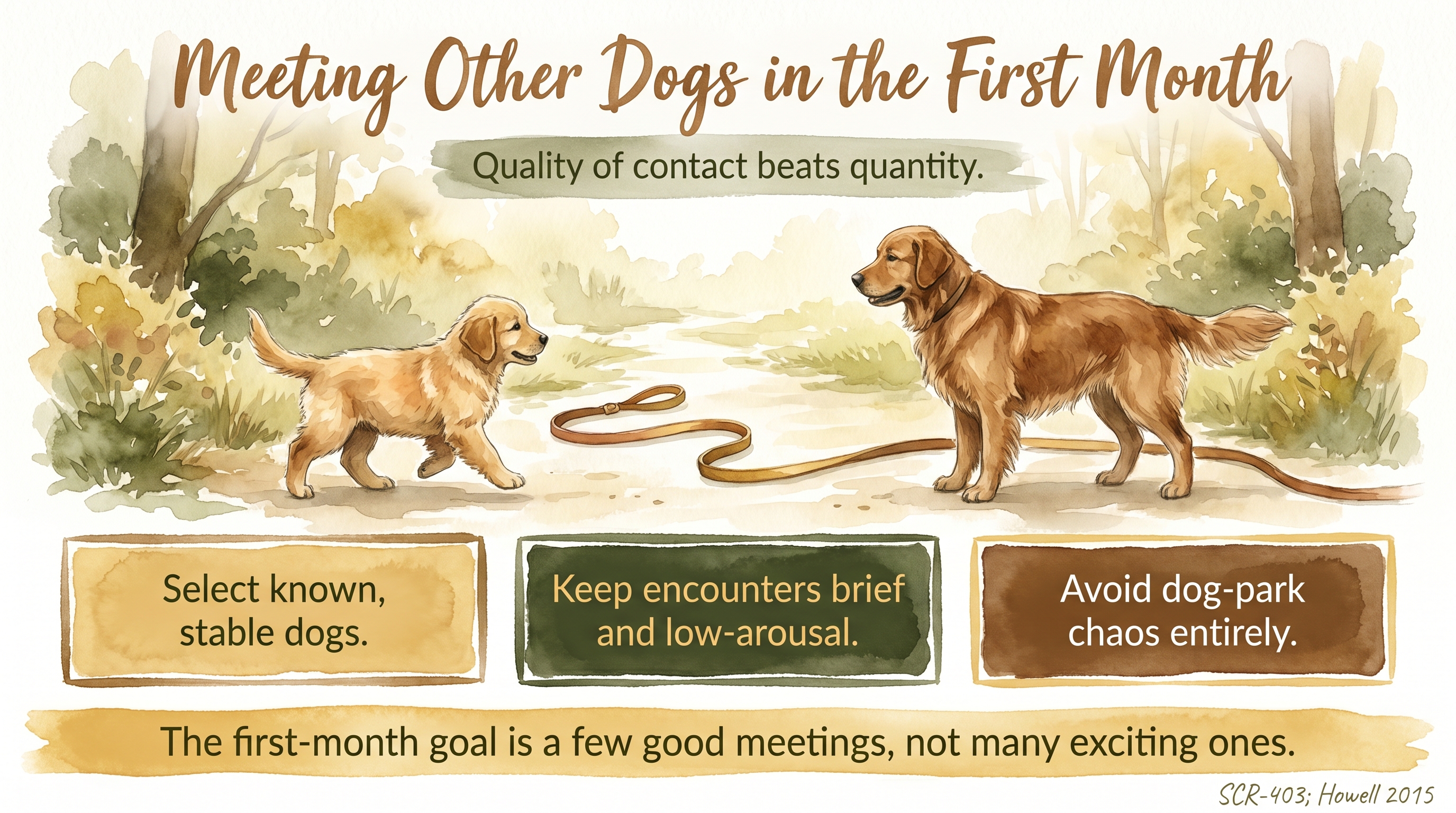
The first-month goal is a few good meetings, not many exciting ones.
Key Takeaways
- Dog socialization matters, but not every dog-to-dog setting gives the puppy the kind of early experience it actually needs.
- The first month is best anchored to resident or otherwise trusted calm adult dogs rather than to chaotic peer-level dog groups.
- Puppy socials and uncontrolled dog spaces often teach that other dogs mean instant arousal, which is not the baseline JB wants written first.
- A few curated canine experiences with good adult dogs usually do more for long-term stability than many intense, poorly filtered ones.
The Evidence
- Rooney et al. (2000); Horvath et al. (2008); Ward et al. (2008)domestic dogs
Dog play is structured rather than random, and dog-dog interaction includes measurable asymmetry, signaling, threshold management, and status-related features. - Freedman et al. (1961); Scott & Fuller (1965); Morrow et al. (2015); Howell et al. (2015)domestic dogs
Early social experiences matter, but the quality and form of those experiences, not only the amount, help determine their developmental value.
- JB transition practicefamily-raised puppies
Calm adult dogs are preferred over chaotic peer-group sessions in the first month because they preserve the mentor pattern the puppy already knew before leaving the breeder.
No published study directly tests the specific Just Behaving guidance on meeting other dogs in the first month within a breeder-to-family transition, so this entry relies on broader canine evidence, breeder observation, and practical synthesis rather than a direct trial of the full protocol.
SCR References
Sources
- Bauer, E. B., & Smuts, B. B. (2007). Cooperation and competition during dyadic play in domestic dogs, Canis familiaris. Animal Behaviour, 73(3), 489-499.
- Rooney, N. J., Bradshaw, J. W. S., & Robinson, I. H. (2000). A comparison of dog-dog and dog-human play behaviour. Applied Animal Behaviour Science, 66(3), 235-248.
- Horvath, Z., Doka, A., & Miklosi, A. (2008). Affiliative and disciplinary behavior of human handlers during play with their dog affects cortisol concentrations in opposite directions. Hormones and Behavior, 54(1), 107-114.
- Ward, C., Bauer, E. B., & Smuts, B. B. (2008). Partner preferences and asymmetries in social play among domestic dog, Canis lupus familiaris, littermates. Animal Behaviour, 76, 1187-1199.
- Freedman, D. G., King, J. A., & Elliot, O. (1961). Critical period in the social development of dogs. Science, 133(3457), 1016-1017.
- Scott, J. P., & Fuller, J. L. (1965). Genetics and the Social Behavior of the Dog. University of Chicago Press.
- Morrow, M., Ottobre, J. S., Ottobre, A. C., Neville, P., St-Pierre, N., Dreschel, N. A., & Pate, J. L. (2015). Breed-dependent differences in the onset of fear-related avoidance behavior in puppies. Journal of Veterinary Behavior, 10(4), 286-294. https://doi.org/10.1016/j.jveb.2015.03.002
- Howell, T. J., King, T., & Bennett, P. C. (2015). Puppy parties and beyond: The role of early age socialization practices on adult dog behavior. Veterinary Medicine: Research and Reports, 6, 143-153. https://doi.org/10.2147/VMRR.S62081