Introducing Children to the New Puppy
The first week teaches the puppy what children mean inside this household. That lesson becomes sticky very fast. If children arrive as high voices, rapid movement, crowding, and emotional unpredictability, the puppy begins learning that children are exciting, dysregulating, or worth chasing. If children arrive as calm, coached, low-to-the-ground, and structurally contained, the puppy begins learning something very different: the small humans belong to the same calm social system as the adults. That is JB's goal. The puppy should meet children as part of the household's structure, not as an exception to it. Observed-JB
What It Means
Children and puppies are a culturally celebrated pairing, which is exactly why they need so much structure.
Each side naturally amplifies the other: children get excited by puppies, puppies get activated by fast small humans, movement invites movement, sound invites sound, and novelty invites escalation. Observed-JB
Without adult guidance, the pairing easily becomes a cycle of mutual arousal.
This is why JB starts from a harder truth than the culture usually offers: children do not automatically know how to welcome a puppy kindly. They know how to welcome a puppy excitedly. Those are not the same thing.
The Child's First Job Is Not to Love Loudly
The first child-facing lesson is not "be gentle" in a vague sense. It is much more specific: sit down, keep the voice low, let the puppy approach, do not crowd, do not chase, and do not hold the puppy in the first hour.
This feels restrictive to adults who are imagining a magical moment. But the restriction is exactly what makes the moment developmentally useful.
The puppy should be able to experience children as: physically smaller than adults, emotionally contained, non-threatening, and predictable. Observed-JB
That is a huge gift in the long arc of family life.
Why the First Association Matters
Puppies do not build their first associations from speeches about the household philosophy. They build them from repeated sensory pairings.
If the puppy repeatedly experiences children as: shrieking, reaching, falling on the floor, flapping hands, and running away and then reappearing.
the puppy learns a certain kind of excitement script.
If the puppy repeatedly experiences children as: seated, slower, quiet, calmly petting only when invited, and present without pressure.
the puppy learns a different script.
This is one of the reasons JB is so insistent that children be coached before the puppy arrives, not corrected after the first few chaotic interactions. Prevention is doing the work here. The family is deciding what circuit gets started.
What the Introduction Should Look Like
A good first introduction is uneventful.
That is the target.
One practical version looks like this: the puppy has already arrived and had a chance to potty, the child or children are already seated, an adult is physically present and regulating the room, the puppy is allowed to move toward the child rather than being carried into the child's face, and touch is brief, low, and slow.
The adults should be coaching tone as much as behavior: lower voice, slower hands, less talking, and longer pauses. Observed-JB
Children often succeed beautifully once they understand the assignment. What they usually lack is not willingness but translation. The culture told them a puppy should be celebrated. JB teaches them that a puppy should be received.
Age Matters
The same principle applies across ages, but the choreography changes.
With very young children, the adult has to hold both sides of the interaction. The adult is not only managing the puppy. The adult is also managing the child: where the child sits, where the child's hands are, how close the face gets, and when the interaction ends.
With school-age children, coaching can become more verbal and more participatory. These children can understand: why quiet matters, why the puppy needs space, and why the first week is different from later weeks.
With older children and teenagers, something especially valuable can happen. A regulated older child can sometimes become one of the puppy's favorite calm presences very quickly, because older children often have the patience to sit quietly and let the dog settle beside them without needing the interaction to stay active.
What a Crash Landing Looks Like Here
The crash-landing version is easy to recognize because it is so normal.
The family spends days preparing children to be excited.
Then the puppy arrives and the children: rush the door, squeal, kneel over the puppy, try to hold it immediately, call to it continuously, wave toys, and follow it from room to room.
From the human side, this looks affectionate.
From the puppy's side, it often looks like: too much motion, too much sound, and too much direct social pressure.
The result may be: avoidance, mouthing, jumping, chase behavior, and inability to settle around children. Observed-JB
Families then frequently misread the puppy's reaction as temperament: she is wild around kids, he loves children so much, and she gets overexcited.
Often the more truthful sentence is simpler: this is how the puppy first learned children.
Structured Leadership Protects Everyone
This page is one of the clearest places where Structured Leadership benefits both species at once.
The adults are not only protecting the puppy from overload.
They are protecting the child from learning the wrong relationship model.
When children are taught to interact through calmness, waiting, and measured touch, they learn: emotional containment, respect for another creature's signals, and how to join a relationship without dominating it.
That is part of why JB refuses the sentimental idea that structure spoils the magic. In a family with children, structure creates the kind of magic that can last beyond the first week.
Why It Matters for Your Dog
The first-week child-puppy pattern often becomes the long-term household pattern unless adults deliberately interrupt it.
That is why this page matters so much. If the puppy learns that children are the loudest, fastest, least predictable beings in the house, then the puppy will often reserve its highest arousal for them. That becomes: jumping at the kids, nipping at sleeves, frantic greetings after school, chasing in hallways, and no settling when children are present.
If the puppy learns instead that children live under the same calm household law as everyone else, then the puppy gets a very different developmental floor.
Children should not become the puppy's excitement channel. The adults' job is to make sure the puppy learns that children belong to the same calm social order as the rest of the household.
This page also matters because parents often feel torn between two loyalties: their children have waited for this puppy and the puppy clearly needs less stimulation than the children want to give.
JB resolves that tension by telling the truth. The kindest thing for both is not full access. It is coached, contained access that makes the relationship more successful later.
The family is not denying affection. It is sequencing it.
Quiet first.
Trust second.
More freedom later.
That sequence gives the puppy the best chance to feel safe with children instead of merely activated by them.
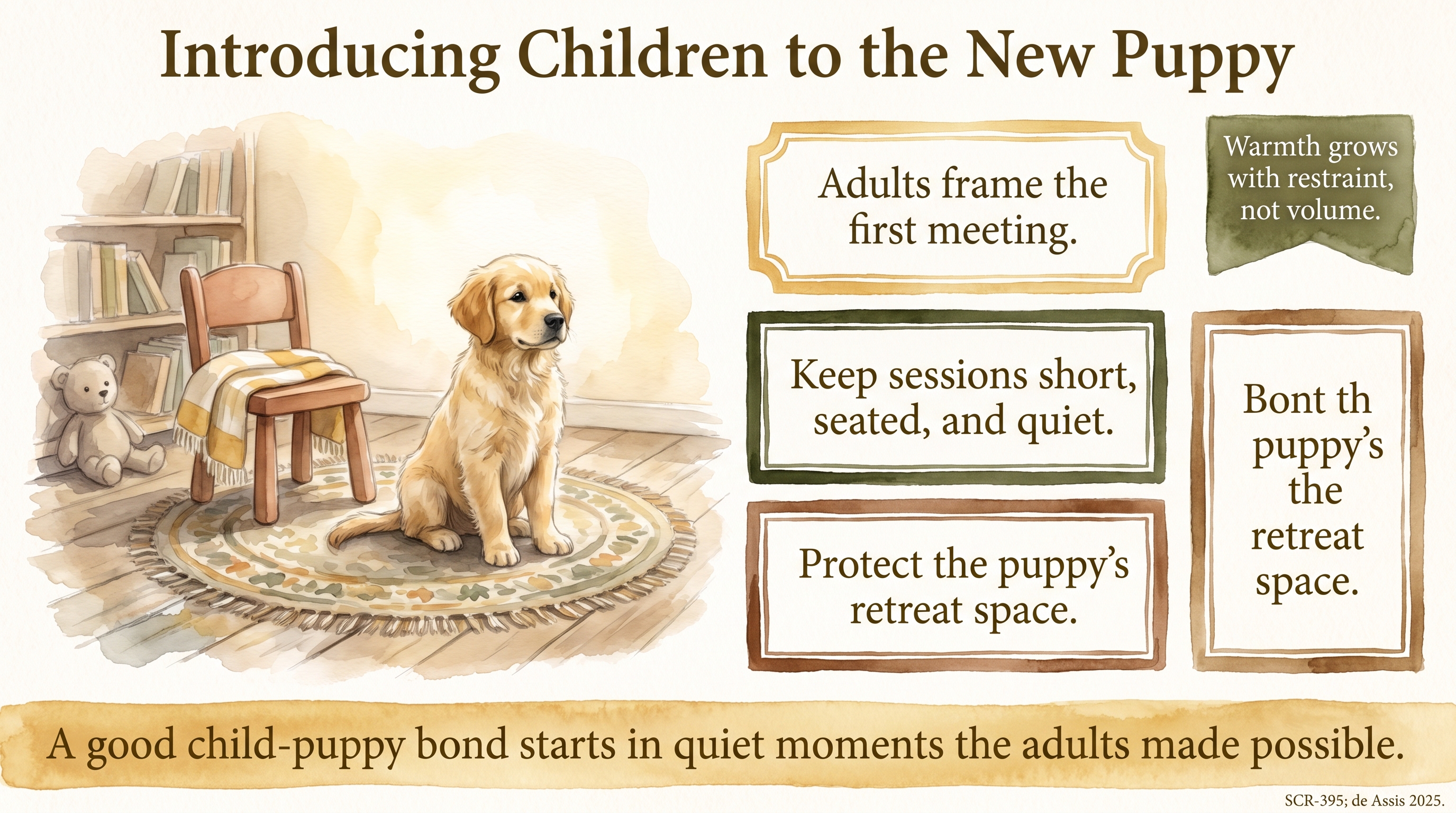
A good child-puppy bond starts in quiet moments the adults made possible.
Key Takeaways
- The first week teaches the puppy what children mean in this house, so the introduction should teach calm relationship rather than mutual excitement.
- Children need coaching before the puppy arrives because the culture teaches excitement by default, not regulation.
- A crash landing happens when children are encouraged to celebrate loudly and the puppy learns that children are a cue for arousal.
- Structured, quiet first interactions protect both the puppy and the child while building a relationship that can widen safely later.
The Evidence
- Brubaker & Udell (2023); van Herwijnen et al. (2018, 2020); de Assis et al. (2025)domestic dogs
Human interaction style, reunion behavior, and handling patterns shape canine arousal, attention, and later behavior rather than merely reflecting them.
- JB family-transition practicechildren and newly placed puppies
Children who are coached to sit quietly, lower their voices, and let the puppy approach create a calmer and more stable first-week association than children encouraged to celebrate the puppy's arrival through excitement.
No published study directly tests the specific Just Behaving guidance on introducing children to the new puppy. This entry relies on broader canine evidence, breeder observation, and practical synthesis.
SCR References
Sources
- Brubaker, L., & Udell, M. A. R. (2023). Does pet parenting style predict the social and problem-solving behavior of pet dogs (Canis lupus familiaris)? Animal Cognition, 26(1), 345-356. https://doi.org/10.1007/s10071-022-01694-6
- van Herwijnen, I. R., van der Borg, J. A. M., Naguib, M., & Beerda, B. (2018). The existence of parenting styles in the owner-dog relationship. PLOS ONE, 13(2), e0193471. https://doi.org/10.1371/journal.pone.0193471
- van Herwijnen, I. R., van der Borg, J. A. M., Naguib, M., & Beerda, B. (2020). Dog-directed parenting styles predict verbal and leash guidance in dog owners and owner-directed attention in dogs. Applied Animal Behaviour Science, 232, 105131. https://doi.org/10.1016/j.applanim.2020.105131
- de Assis, L. S., Georgetti, B., Burman, O. H. P., Pike, T. W., & Mills, D. S. (2025). Development of a dog owner caregiving style scale (Lincoln Owner Caregiving Questionnaire, LOCQ) and its relationship with behaviour problems in dogs. Applied Animal Behaviour Science, 287, 106628. https://doi.org/10.1016/j.applanim.2025.106628