Transition During Household Illness
Illness changes the household even when no one wants it to. The adults are tired, attention narrows, routines shrink, and the whole home begins running on lower reserve. If that happens during the transition, families often fear they have ruined the month or that the puppy is being shortchanged in some irreversible way. JB takes a steadier position. Illness is a real disruption to the calm floor, but it does not require abandoning the principles. It requires a smaller, more protected version of them. Observed-JB
What It Means
The puppy does not need the household to be perfect. Observed-JB
It needs the household to stay understandable.
When illness enters the home, that usually means: fewer extra activities, clearer division of labor, less social ambition, and more protected sleep. Observed-JB
The transition narrows.
That narrowing is not neglect.
It is good judgment.
The Minimum Viable Calm Floor
Families sometimes think that if they cannot do the full ideal version of the first month, then the whole thing is lost.
It is not.
A sick household can still protect the essentials: naps, mealtimes, bathroom rhythm, calm handling, and brief quiet contact. Observed-JB
Those basics go much farther than families realize.
The Common Trap
There are two common traps here.
The first is over-relying on containment because the adults are exhausted: too much crate time without rhythm, missed naps because everyone is improvising, and a puppy wandering into overtired chaos.
The second trap is trying to compensate with stimulation: turning the puppy into the bright spot of the sick week, adding interaction every time guilt rises, and letting ordinary boundaries dissolve because everyone feels bad.
Both patterns make the puppy harder to settle.
The right move is simpler and more restrained.
Leadership Often Changes Hands
In many families, one adult is meant to be the primary puppy handler.
Illness can interrupt that plan.
When it does, the most important thing is not preserving the original assignment at all costs.
It is making sure whoever steps in can hold a similar tempo: same calm voice, same low-drama greetings, same matter-of-fact care, and same protection of sleep.
That continuity matters more than which adult is technically on duty.
What Recovery Looks Like
Recovery during illness is often about reducing ambition, not adding effort.
Families do best when they intentionally pause: social visits, extra outings, novelty for novelty sake, and big household projects.
The puppy's world becomes smaller for a few days, and that is fine.
If the adults can maintain calm care while sick, the puppy often comes through the period far better than the family expects. Observed-JB
When the illness passes, the household can widen again gradually.
That widening should be deliberate.
The goal is not to spring back into noise because everyone is finally feeling better.
The goal is to preserve what the smaller perimeter was teaching: quieter timing, better rest, and simpler transitions.
Why It Matters for Your Dog
This page matters because stress in the household tends to make adults think the puppy needs more management theater than it actually does. In reality, many puppies need less novelty and more predictability when the humans are depleted.
That is good news.
It means a sick week does not have to become a chaotic week for the dog.
The puppy can tolerate a smaller life for a while if that smaller life is calm and coherent.
This page also matters because it gives families permission to stop trying to perform the ideal month while they are unwell. The puppy is not counting activities. It is reading the environment.
If the environment still feels calm, safe, and bounded, a great deal is preserved.
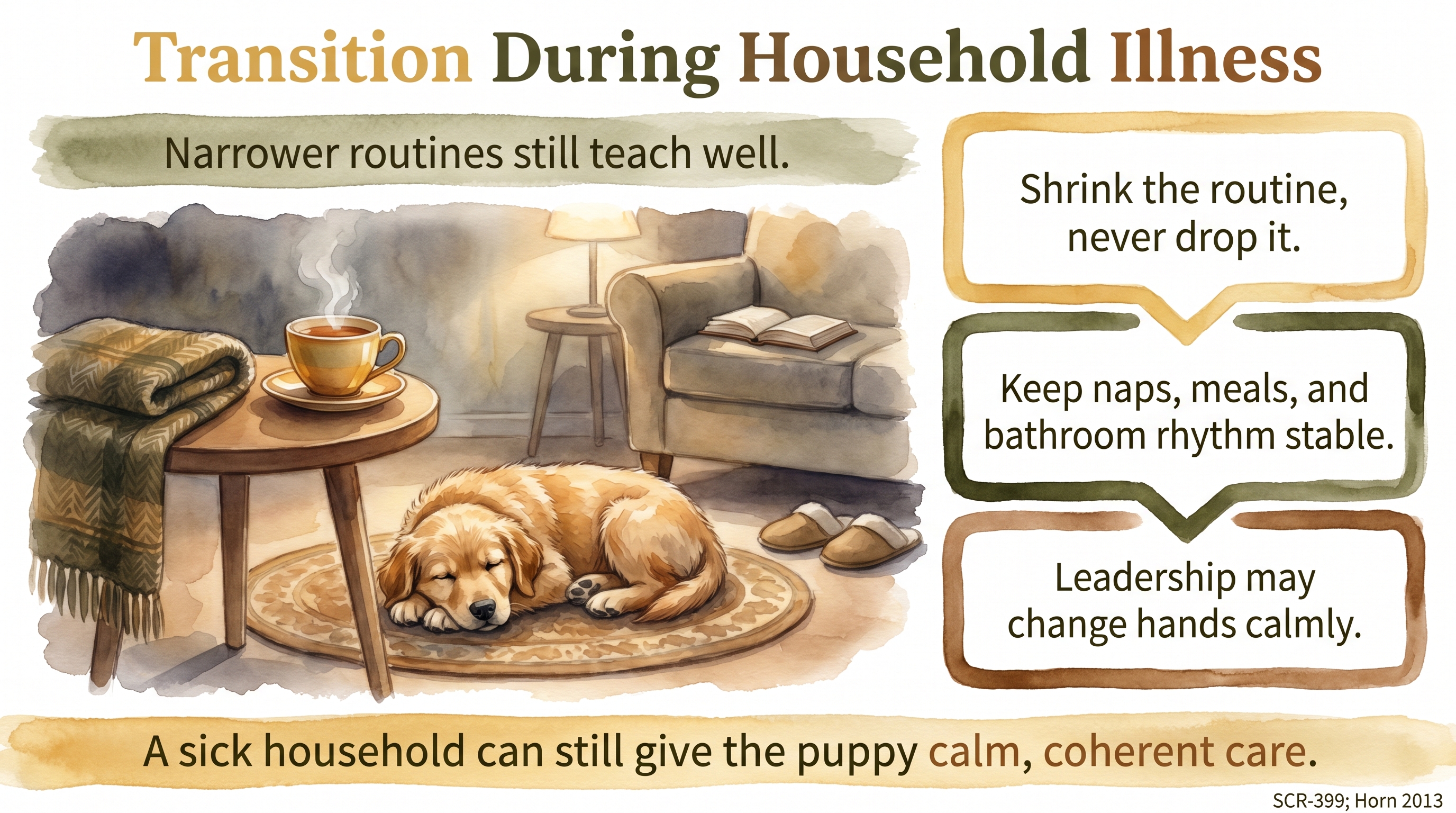
A sick household can still give the puppy calm, coherent care.
Key Takeaways
- Household illness is a real transition stressor, but it does not require abandoning the soft-landing principles.
- A smaller routine built around naps, meals, bathroom rhythm, and calm handling is often the best answer while the family is sick.
- The two main traps are too much containment without rhythm and too much stimulation driven by guilt.
- The puppy does not need a perfect month during illness; it needs a household that remains calm and understandable under pressure.
The Evidence
- Topal et al. (1998); Horn et al. (2013); Dale et al. (2024); Thielke & Udell (2019)domestic dogs
Predictable caregiver presence and readable social support help buffer canine stress during difficult or unfamiliar periods. - Adams & Johnson (1993); Kis et al. (2014, 2017); Reicher et al. (2021)domestic dogs
Protected rest and lower environmental disruption support better regulation than fragmented rest in stimulating or inconsistent contexts.
- JB family-coaching observationfamily-raised puppies
When illness hits a household, simplifying the puppy schedule and protecting core routines leads to better outcomes than either over-stimulating out of guilt or over-confining out of exhaustion.
No published study directly tests the specific Just Behaving guidance on transition during household illness within a breeder-to-family transition, so this entry relies on broader canine evidence, breeder observation, and practical synthesis rather than a direct trial of the full protocol.
SCR References
Sources
- Topal, J., Miklosi, A., Csanyi, V., and Doka, A. (1998). Attachment behavior in dogs: A new application of Ainsworth's Strange Situation Test. Journal of Comparative Psychology, 112(3), 219-229. https://doi.org/10.1037/0735-7036.112.3.219
- Horn, L., Huber, L., and Range, F. (2013). The importance of the secure base effect for domestic dogs. PLoS ONE, 8(1), e65296. https://doi.org/10.1371/journal.pone.0065296
- Dale, F. C., Burn, C. C., Murray, J., & Casey, R. (2024). Canine separation-related behaviour at six months of age: Dog, owner and early-life risk factors identified using the 'Generation Pup' longitudinal study. Animal Welfare, 33, e60, 1-16. https://doi.org/10.1017/awf.2024.56
- Thielke, L. E., & Udell, M. A. R. (2019). Evaluating cognitive and behavioral outcomes in conjunction with the secure base effect for dogs in shelter and foster environments. Animals, 9(11), 932. https://doi.org/10.3390/ani9110932
- Adams, G. J., & Johnson, K. G. (1993). Sleep-wake cycles and other night-time behaviours of the domestic dog (Canis familiaris). Applied Animal Behaviour Science, 36(2-3), 233-248.
- Kis, A., Szakadat, S., Kovacs, E., Gacsi, M., Simor, P., Gombos, F., Topal, J., Miklosi, A., & Bodizs, R. (2014). Development of a non-invasive polysomnography technique for dogs (Canis familiaris). Physiology & Behavior, 130, 149-156.
- Kis, A., Szakadat, S., Gacsi, M., Kovacs, E., Simor, P., Torok, C., Gombos, F., Bodizs, R., & Topal, J. (2017). The interrelated effect of sleep and learning in dogs (Canis familiaris); an EEG and behavioural study. Scientific Reports, 7, 41873.
- Reicher, V., Bunford, N., Kis, A., Carreiro, C., Csibra, B., Kratz, L., et al. (2021). Developmental features of sleep electrophysiology in family dogs. Scientific Reports, 11, 22760. https://doi.org/10.1038/s41598-021-02117-1