The Vaccination Question in the First Month
Compound evidence detail1 SCR / 2 parts
- Documentedcanine vaccination immunology and current WSAVA and AAHA-aligned vaccination schedules for puppies
- Heuristichow JB families navigate vaccination conversations with their veterinarian during the calm-baseline first month
The vaccination conversation is one of the places where families most need calm, clean distinctions. The immunology under the puppy series is well established. Maternal antibodies protect the puppy early and also interfere with active vaccine response, which is why core vaccination happens as a series rather than as one simple shot. At the same time, there is real professional nuance around schedule optimization, titer use, and exactly how some decisions are individualized in practice. JB's role is not to replace the veterinarian's judgment. It is to help families understand the science and then handle the month-one appointments calmly. Mixed Evidence
What It Means
The first thing to understand is why the puppy series exists at all.
Many families assume repeated vaccinations mean the first dose did not work. That is not the right frame.
The better frame is timing.
Maternal Antibodies Are Helpful and Inconvenient
The dam passes passive protection to the puppy early in life. That protection is valuable. It helps cover the puppy during a vulnerable period.
But maternal-derived antibodies also create the central timing problem in puppy vaccination. They can neutralize vaccine antigen before the puppy's own immune system mounts a durable active response (WSAVA 2024; AAHA 2022; Schultz 2006). Documented
That is why the series exists.
The goal is to make sure at least one core dose lands after maternal interference has fallen low enough for the puppy to respond well (WSAVA 2024; AAHA 2022).
Why the Guidelines Use a Series
This is also why respected veterinary frameworks do not treat a clean environment as a substitute for the puppy series. The main constraint is not household cleanliness. It is biologic variability in antibody timing from one puppy to another (WSAVA 2024; AAHA 2022). Documented
That is the load-bearing science here.
It is also the point families most need to hear clearly, because online conversations often drift into: "my puppy came from a good breeder, so maybe it needs less" and "the house is clean, so maybe we can shorten it".
Those are understandable thoughts, but they do not solve maternal antibody variability.
Where Genuine Ambiguity Still Exists
Not every vaccination question is equally settled.
The underlying series logic is strong. The more nuanced questions are where professional emphasis can differ: exact intervals in specific contexts, when titers are useful, whether later follow-up serology is preferred in some cases, and how non-core decisions should be individualized by region and exposure.
WSAVA and AAHA both provide serious guidance, but they do not say every practical thing in exactly the same way. That does not mean the field is confused. It means there is legitimate nuance inside good medicine.
What JB Does Not Do
JB does not issue its own replacement vaccine schedule.
That is important enough to say plainly.
The family and veterinarian should decide the protocol they are comfortable with, using the puppy's known history, the local disease environment, and established professional guidance. Documented JB's job is not to override that.
What JB Does Care About
JB cares very much about: accurate breeder-to-family communication about what the puppy already received, calm handling at the appointment, protecting the puppy's rest after the visit, not turning vaccine day into a larger stress event than it already is, and keeping the socialization discussion honest while the series is ongoing. Documented
That last point matters. Early controlled socialization and vaccination are not enemies. The literature supports the idea that vaccinated puppies in carefully controlled socialization settings were not at greater parvovirus risk than vaccinated puppies who did not attend. Documented But "carefully controlled" is doing real work in that sentence. It does not mean every public exposure is wise.
The Best Month-One Vaccination Sentence
For most families, the safest conclusion is simple:
the best protocol is the one the family and veterinarian agree on and carry out calmly.
That sentence sounds modest because it is modest. It also keeps JB in its proper lane while still offering useful science.
Why It Matters for Your Dog
The vaccination question matters because families often arrive at the first month carrying too much internet heat and not enough immunology.
Once the science is clearer, anxiety usually drops.
The family can see: why repeated doses exist, why "clean house" is not the deciding variable, why non-core choices depend on risk profile, and why some schedule questions honestly involve nuance. Documented
That clarity helps the adults make better decisions with less ideology.
It also protects the puppy from a different kind of problem: an appointment day that becomes medically necessary and emotionally chaotic at the same time.
Even when a vaccine visit is routine, it is still a day worth handling carefully: lower the social pressure, keep the transport calm, let the puppy rest afterward, and do not stack extra stimulation onto the event.
Those are not anti-vaccine ideas. They are stewardship ideas.
The month-one goal is not only immune protection.
It is immune protection inside a calm, readable caregiving environment.
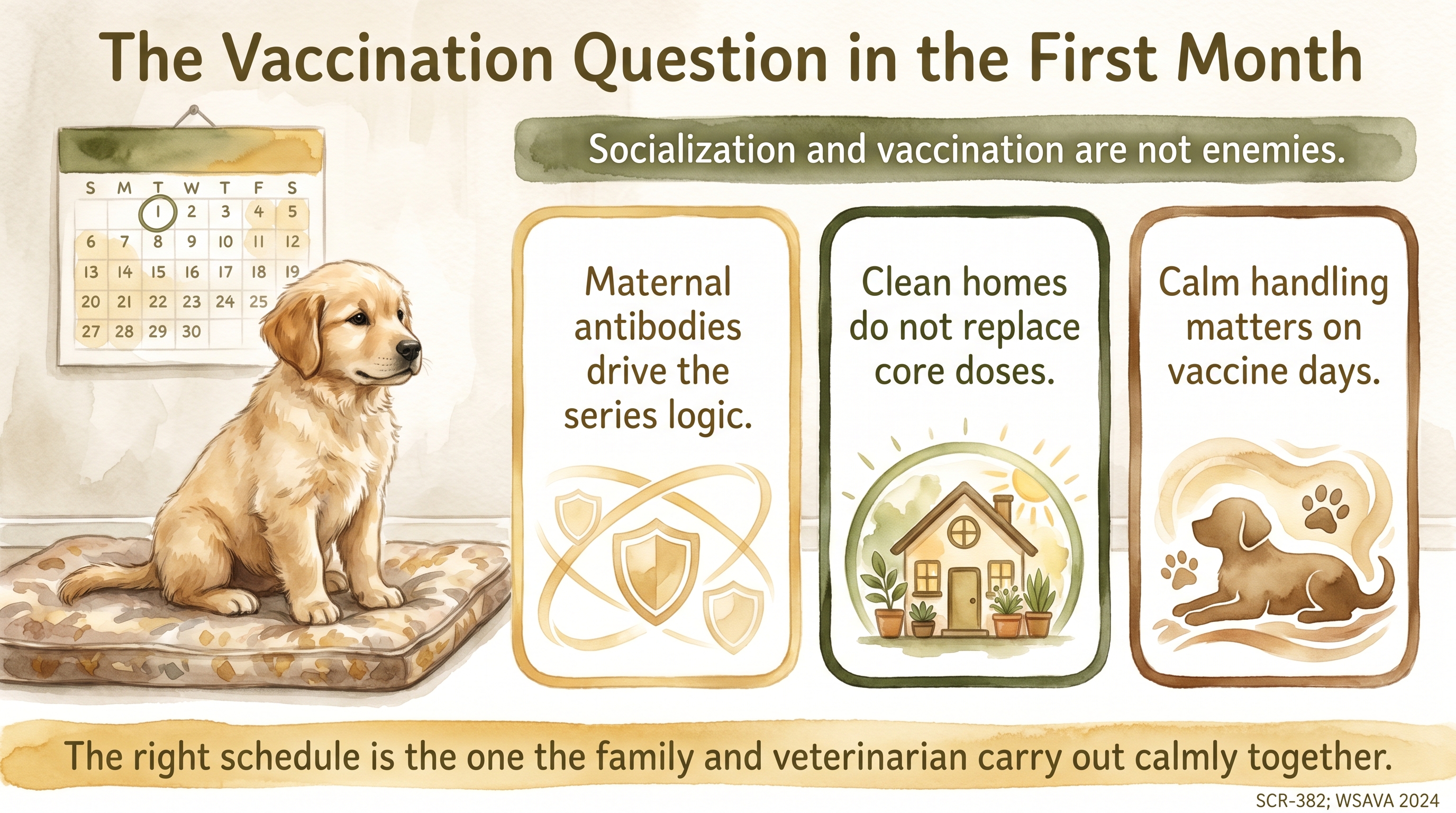
The right schedule is the one the family and veterinarian carry out calmly together.
Key Takeaways
- The puppy series exists because maternal antibodies protect early life and also interfere variably with vaccine response.
- A good breeder history or clean home does not erase the biological reason core vaccines continue through the accepted puppy window.
- The core immunology is strong, while some schedule-optimization and titer questions remain areas of legitimate professional nuance.
- JB's role is not to replace veterinary judgment but to help families understand the science and carry vaccine decisions out calmly.
The Evidence
This entry uses mixed-evidence claim-level tags beyond the dedicated EvidenceBlocks below. These tags mark claims that combine documented findings with observed practice, heuristic application, or unresolved gaps.
- WSAVA (2024); AAHA (2022); Schultz (2006); Stepita et al. (2013)domestic dogs
Maternal antibody interference is the binding reason core puppy vaccination uses repeated doses through at least 16 weeks rather than relying on one early inoculation. - WSAVA (2024); AAHA (2022); Schultz (2006); Stepita et al. (2013)domestic dogs
Core vaccines protect against severe infectious disease, and properly immunized dogs generally achieve multi-year duration of immunity after the primary series and follow-up booster structure.
- WSAVA versus AAHA framingdomestic dogs
Professional guidance broadly agrees on the core logic of the series while differing in emphasis around follow-up serology, titer use, and some schedule-optimization details. - Non-core vaccine frameworksdomestic dogs
Non-core decisions are explicitly risk-based and can vary appropriately by geography, exposure, and veterinary judgment.
- JB transition practicefamily-raised puppies
JB does not substitute its own vaccine schedule for veterinary guidance but emphasizes calm appointment handling, clear record transfer, and protected rest on vaccine days.
No direct canine research located for this specific topic. Current understanding relies on related research, clinical observation, and cross-species inference.
SCR References
Sources
- Squires, R. A., Crawford, C., Marcondes, M., & Whitley, N. (2024). 2024 guidelines for the vaccination of dogs and cats - compiled by the Vaccination Guidelines Group (VGG) of the World Small Animal Veterinary Association (WSAVA). Journal of Small Animal Practice, 65(5), 277-316. https://doi.org/10.1111/jsap.13718
- Ellis, J., Marziani, E., Aziz, C., Brown, C. M., Cohn, L. A., Lea, C., Moore, G. E., & Taneja, N. (2022). 2022 AAHA Canine Vaccination Guidelines. Journal of the American Animal Hospital Association, 58(5), 213-230. https://doi.org/10.5326/JAAHA-MS-Canine-Vaccination-Guidelines
- Schultz, R. D. (2006). Duration of immunity for canine and feline vaccines: a review. Veterinary Microbiology, 117(1), 75-79. https://doi.org/10.1016/j.vetmic.2006.04.013
- Stepita, M. E., Bain, M. J., & Kass, P. H. (2013). Frequency of CPV infection in vaccinated puppies that attended puppy socialization classes. Journal of the American Animal Hospital Association, 49(2), 95-100. https://doi.org/10.5326/JAAHA-MS-5825