The Transition as a Lifelong Orientation
The transition is not something the family finishes and then leaves behind like airport security. JB treats it as the first concentrated expression of a much longer way of living with the dog. The voice, the pacing, the greeting style, the boundary language, the prevention habits, and the calm floor built in the first month are not temporary tricks to get through puppyhood. They are the beginning of the household's ongoing orientation to the relationship. That lifelong-orientation claim is philosophical and therefore heuristic, but it is one of the most important interpretive bridges in the whole category. Heuristic
What It Means
The first month is concentrated.
That is why it gets its own category-scale treatment.
But the deeper point is continuity.
What the family practices early should still be recognizable later: greetings stay calm, rest remains normal, boundaries stay readable, prevention still matters, and indirect correction still sounds like communication instead of punishment. Heuristic
The dog changes with age. Heuristic
The household language does not need to reinvent itself every time the dog enters a new stage.
Puppyhood Is the First Repetition, Not the Only One
Families sometimes think the transition pages only matter until the dog is easier. Heuristic
JB sees it differently.
The transition pages teach the family how to think: when excitement surges, when adolescence arrives, when life disruptions happen, and when illness or aging changes the rhythm again.
That is why the category reaches beyond the first month.
It is teaching orientation, not just procedure.
The Method Is the Divergence
This is where the larger JB thesis comes back into view.
The divergence is not a single technique used in week one.
It is a different way of being with the dog: less performance, more ordinary life, less external fixing, and more internal regulation.
The transition simply makes that divergence visible early.
Why It Matters for Your Dog
This page matters because households that treat early calmness as temporary often lose it later. Once the puppy seems easier, they drift into the wider cultural defaults again. The relationship becomes louder, more reactive, and more method-driven over time.
The calm floor is not a first-month accommodation. It is the baseline the family is deciding to keep. When the transition is understood as a lifelong orientation, the early structure stops feeling temporary and starts feeling foundational.
This page also prepares the handoff into the next category. Daily life with an older puppy, adolescent dog, adult, and senior all still draw from the same vocabulary introduced here. Heuristic
That is why the transition belongs to the whole lifespan.
It does not end.
It deepens.
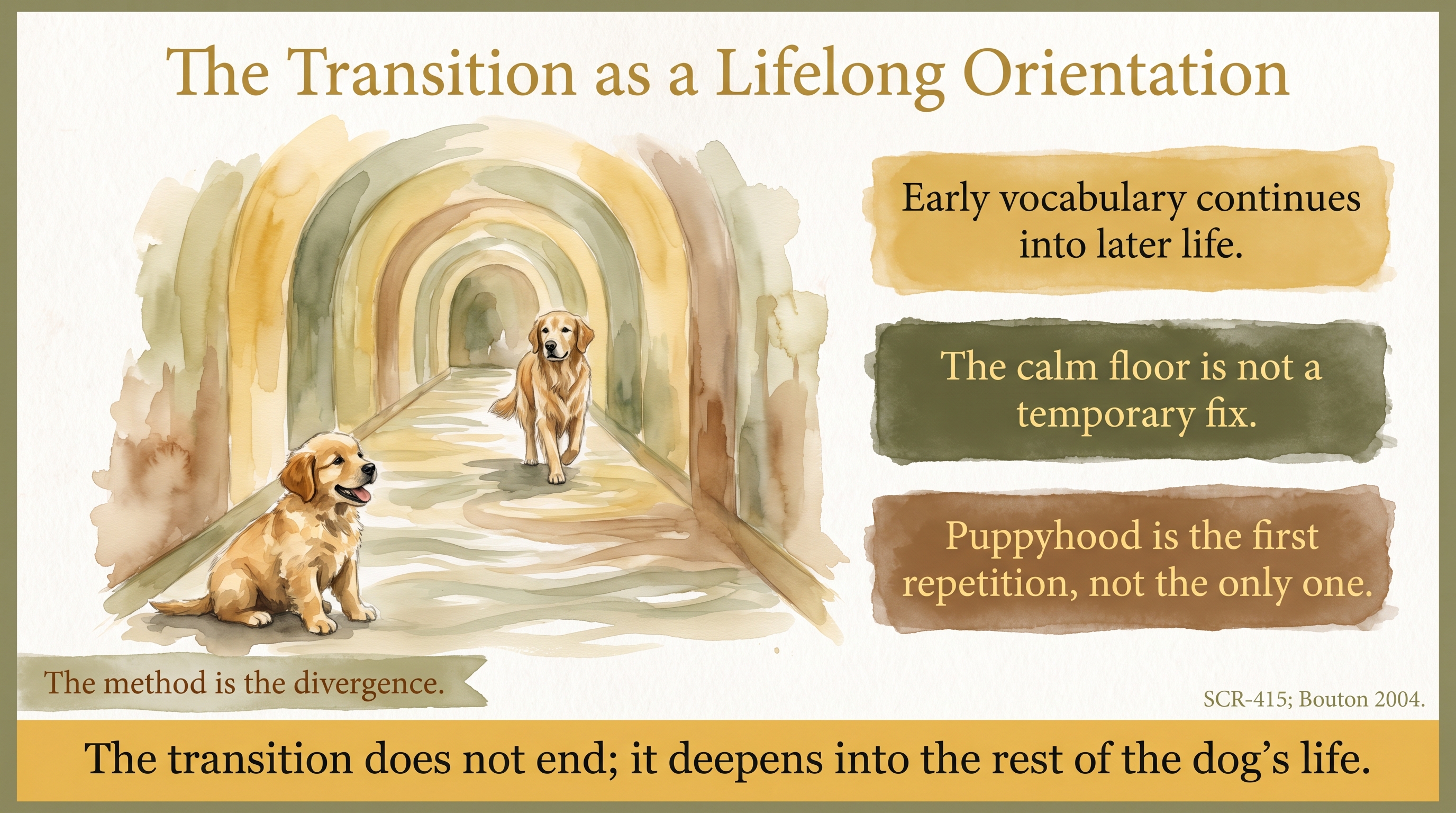
The transition does not end; it deepens into the rest of the dog's life.
Key Takeaways
- The transition is not only a first-month event but the first concentrated expression of a longer way of living with the dog.
- Early calm greetings, prevention habits, and indirect correction language are meant to remain recognizable across later life stages.
- The broader JB divergence is not a week-one technique but a sustained household orientation.
- This lifelong-orientation claim is philosophical and heuristic, but it helps explain why the next category is a continuation rather than a reset.
The Evidence
- Bouton (2002, 2004); Gazit et al. (2005); Hall & Wynne (2016)domestic dogs
Behavior is highly sensitive to context and repetition, which makes a stable household vocabulary a meaningful long-term factor in how dogs read daily life.
- JB philosophical synthesisliving with a family dog
The claim that first-month transition vocabulary becomes a lifelong relational orientation is a philosophical position consistent with the broader evidence base, but it is not a directly measured longitudinal intervention claim.
No published study directly tests the specific Just Behaving guidance on transition as a lifelong orientation within a breeder-to-family transition, so this entry relies on broader canine evidence, breeder observation, and practical synthesis rather than a direct trial of the full protocol.
SCR References
Sources
- Bouton, M. E. (2002). Context, ambiguity, and unlearning: Sources of relapse after behavioral extinction. Biological Psychiatry, 52(10), 976-986. https://doi.org/10.1016/S0006-3223(02)01546-9
- Bouton, M. E. (2004). Context and behavioral processes in extinction. Learning & Memory, 11(5), 485-494. https://doi.org/10.1101/lm.78804
- Gazit, I., Goldblatt, A., & Terkel, J. (2005). The role of context in extinction of searching behavior in dogs. Animal Cognition, 8(2), 91-99.
- Hall, N. J. (2017). Persistence and resistance to extinction in the domestic dog: Basic research and applications to canine training. Behavioural Processes, 141(Part 3), 67-74. https://doi.org/10.1016/j.beproc.2017.04.001