Pretend Like It's Been There
"Pretend like it's been there" is one of the simplest JB instructions and one of the deepest. It sounds almost throwaway until you realize how many first-week mistakes it prevents at once. The phrase tells the family to behave, from the first moment the puppy comes home, as though the puppy is already an ordinary member of an already-functioning household. Not a guest. Not a toy. Not a surprise. Not an emotional event. A member. That shift in posture changes greetings, handling, sleep, visitors, play, and the entire emotional weather of the first week. It is a JB heuristic rather than a directly trialed canine intervention, but it maps closely onto the developmental logic beneath the soft landing: predictability regulates, while performance destabilizes. Heuristic
What It Means
The instruction works because it removes the human temptation to make the puppy's arrival into theater. Heuristic
Most families do not intend harm in that moment. They are trying to welcome the puppy. They want the puppy to feel loved, chosen, and celebrated. The problem is that human celebration often arrives in a form the puppy cannot metabolize: high voices, fast movement, repeated handling, over-attention, too many faces, constant commentary, and suspended rules.
When JB says "pretend like it's been there," it is not asking the family to become cold. It is asking the family to stop making the puppy's arrival larger than the puppy's nervous system can hold.
If the puppy had been living with you for three years, how would you behave when you walked in the door?
You would not scream.
You would not gather the entire extended family.
You would not let the dog climb on every guest, mouth every hand, or stay awake all evening because everyone wanted one more cuddle and one more photo. Heuristic
You would live your life, and the dog would join it.
That is the point.
Ordinariness Is a Gift
Human beings often mistake ordinariness for indifference. JB treats ordinariness as a form of welcome.
An ordinary household is a household with shape: meals happen at predictable times, rooms have purposes, doors do not trigger emotional storms, rest is protected, adults sound like adults, touch is calm and intentional, and no one needs the puppy to perform happiness for the household.
The puppy entering that environment receives a very specific developmental message: this place already knows what it is. Heuristic You do not have to organize it. You do not have to light it up. You do not have to escalate it to belong in it.
That message is one of the most stabilizing messages a young social animal can receive.
This is where the instruction becomes more than etiquette. It becomes prevention. If the family greets the puppy as though the puppy is an event, the puppy learns that household transitions are events. If the family greets the puppy as though the puppy has already belonged there for years, the puppy learns that household life is already coherent and worth settling into.
The Bond Is Not Built by Hype
One reason families resist this instruction is fear. They worry that if they are not emotionally expansive enough, the puppy will not bond.
That fear belongs to the human imagination more than to canine development.
Bonds are not built from spectacle. They are built from repetition: repeated calm presence, repeated predictability, repeated safety, repeated successful recovery, and repeated ordinary closeness.
This is exactly why the phrase is so useful. It moves the family away from a performance model of bonding and toward a caregiving model of bonding. The puppy does not need to be convinced that it is exciting. The puppy needs to experience the family as reliable.
Attachment science supports the importance of caregiver predictability far more strongly than it supports theatrical reunion behavior. The strongest direct canine claims remain bounded, but the direction is clear. Dogs form secure-base relationships around stable, legible caregivers, not around emotional volume.
What the Phrase Changes in Practice
Once the family adopts the phrase, many decisions become easier.
It changes the welcome: no crowd around the car, no passing the puppy from person to person, and no rush to show the puppy every room. Heuristic
It changes the first evening: no visitors, no late-night excitement, and no demand that the puppy "meet everyone".
It changes handling: calmer touch, fewer words, more observation, and less stimulation disguised as affection.
It changes how children are coached: not "be excited" and but "be quiet, sit low, and let the puppy come to you".
It changes how rules begin: if the puppy will not jump on people later, it does not get invited to jump now, if the puppy will not sleep in the center of the living room chaos later, it does not learn that as the first-week pattern, and if greetings will be calm later, calm begins immediately.
The phrase compresses all of this into one memorable instruction.
Why the Phrase Is So Different from Culture
Modern dog culture tends to cast puppy arrival as the emotional peak of the relationship. There are announcement posts, welcome-home baskets, special toys, celebratory visits, and a kind of social permission for the whole household to become dysregulated because "it is the puppy's first day."
JB argues that the first day should not be the emotional peak.
It should be almost boring.
Not boring in the sense of joyless.
Boring in the sense of safe.
That distinction is hard for people because we live in a culture that proves affection through stimulation. The JB argument is that dogs, especially puppies, often experience love most clearly through steadiness.
The Phrase Protects the Future
Another reason the instruction matters is that it protects future household life.
The family may think it is only making an exception for the first week: extra excited greetings, extra carrying, extra indulgence, and extra interaction.
But the puppy does not file those moments under temporary exception. The puppy files them under this is how this house works.
That is why JB is so insistent about beginning with the adult version of the relationship at the lowest-intensity version possible. The family is not being asked to give the puppy less love. It is being asked to love in a way that can last.
What a Crash Landing Looks Like
The crash-landing version of this page is easy to recognize.
The puppy comes through the door and the house erupts.
Everyone kneels down at once. Voices rise. Hands multiply. The puppy is cheered for franticness because franticness looks like enthusiasm. The puppy is allowed to stay awake because everyone wants more time with it. Children are told to enjoy it while it is little. Adults hover over every bite of food and every movement. The puppy is never left alone for a moment, but is also never given true quiet. Then by day three or four the family is bewildered: Why won't it settle? Why is it whining? Why is it mouthing? Why is it so wound up at the door?
The answer is usually not that the puppy is difficult.
The answer is that the puppy read the welcome correctly.
The crash landing taught: people entering rooms is exciting, human attention gets bigger when the puppy gets bigger, rest is interruptible, excitement is social currency, and boundaries are vague until humans get tired.
The family often feels guilt at this point, which is not the goal of the category. The category exists to remove guilt by replacing vagueness with a better script. Most families were never taught that the quiet version is the kinder version.
Why It Matters for Your Dog
This phrase matters because it gives families something they can actually do under pressure.
A first-week transition produces many decisions in real time: How should we greet the puppy? Should we let the kids hold it now? Should we bring the puppy into the busiest room? Should grandma stop by tonight? Should we make the puppy feel special right now?
The phrase answers those questions without requiring the family to remember a whole theory.
Pretend like it's been there.
That means: the puppy belongs, so there is no need to prove belonging theatrically, the house already has structure, so the puppy does not reorganize it, the adults are already adults, so they do not drop into puppy energy, and the relationship already has dignity, so it does not need hype.
Pretend like it's been there means the adults keep being adults. The puppy is welcomed into an already-regulated household instead of being asked to become the household's emotional center.
For the puppy, this creates clarity. The dog learns from the beginning that home life is made of: quiet arrivals, clear rest windows, measured touch, calm voices, low drama, and stable expectations.
Those are not small things. They are the raw material of a dog who later greets guests with interest rather than frenzy, who can settle in a room with people, and who does not interpret every transition as a call to escalate.
For the family, the phrase removes a great deal of panic. It frees them from the idea that they need to manufacture attachment on command. The bond does not have to be proved in one weekend. It will be built by living together under readable leadership.
That is what makes the instruction so powerful. It is short, memorable, protective, and humane all at once.
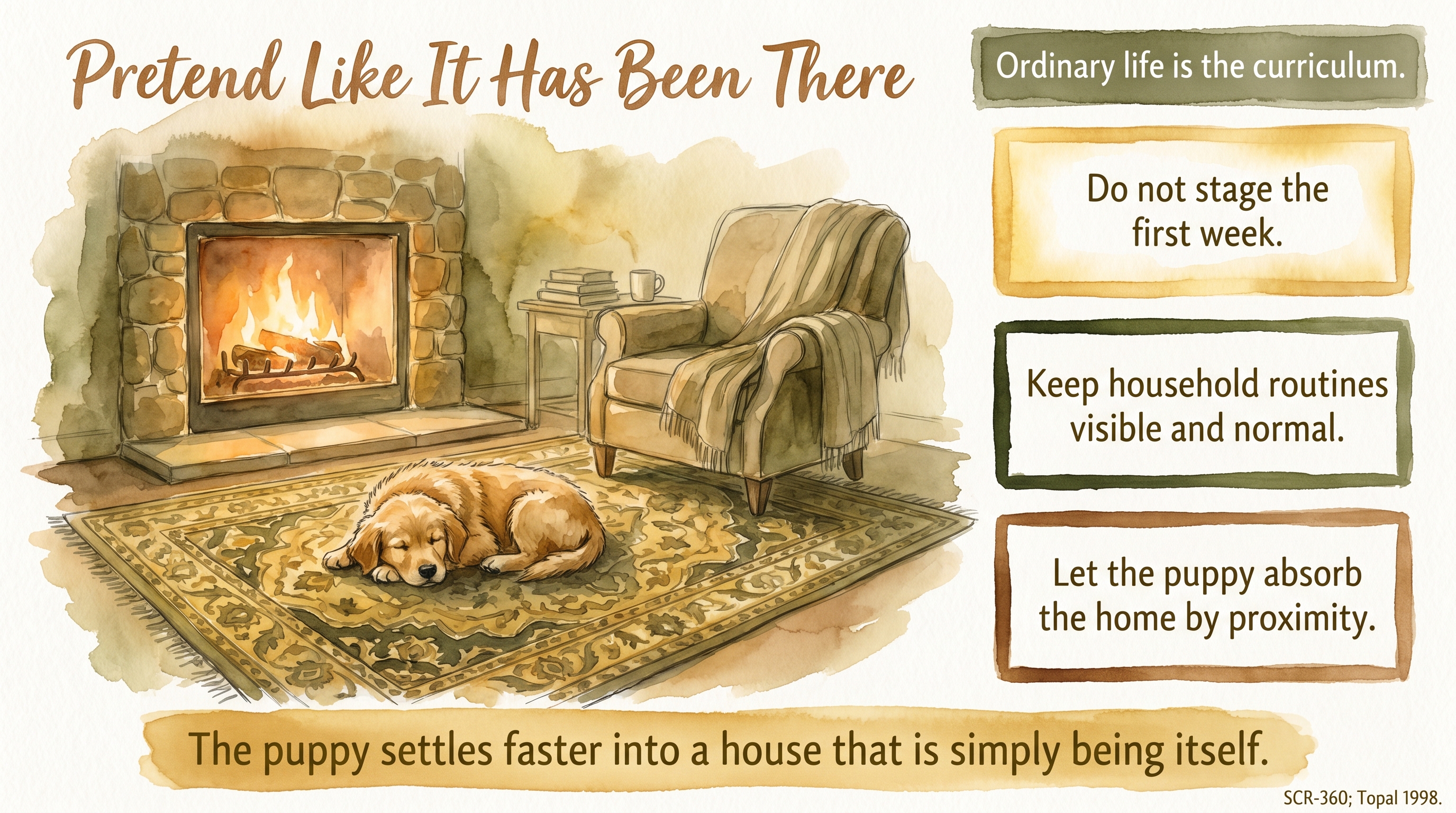
The puppy settles faster into a house that is simply being itself.
Key Takeaways
- Pretend like it's been there means welcoming the puppy through ordinariness, not through theatrical excitement.
- The bond is built by repeated calm, predictable caregiving rather than by a dramatic first-day welcome.
- Crash landings often begin when loving families teach the puppy that excitement is the price of connection and belonging.
- The phrase works because it turns a complex first-week philosophy into one protective instruction families can actually remember.
The Evidence
- Topal et al. (1998); Horn et al. (2013); Dale et al. (2024); Thielke & Udell (2019)domestic dogs
Dogs organize behavior around familiar, predictable caregivers, and caregiver quality affects social confidence, recovery, and task engagement. - Brubaker & Udell (2023); van Herwijnen et al. (2018, 2020); de Assis et al. (2025)domestic dogs
Human reunion style, handling patterns, interaction density, and emotional tone shape later canine behavior rather than merely expressing affection.
- JB synthesisfamily-dog transition practice
Acting as though the puppy already belongs reduces the human tendency to turn homecoming into stimulation, preserving continuity with the calm developmental language the puppy already knows. - JB synthesisfamily homes with new puppies
The phrase is not a measured intervention. It is a practical heuristic that translates attachment, prevention, and calmness principles into a single memorable instruction.
No published study directly tests the specific Just Behaving guidance on pretend like it has been there within a breeder-to-family transition, so this entry relies on broader canine evidence, breeder observation, and practical synthesis rather than a direct trial of the full protocol.
SCR References
Sources
- Topal, J., Miklosi, A., Csanyi, V., and Doka, A. (1998). Attachment behavior in dogs: A new application of Ainsworth's Strange Situation Test. Journal of Comparative Psychology, 112(3), 219-229. https://doi.org/10.1037/0735-7036.112.3.219
- Horn, L., Huber, L., and Range, F. (2013). The importance of the secure base effect for domestic dogs. PLoS ONE, 8(1), e65296. https://doi.org/10.1371/journal.pone.0065296
- Dale, F. C., Burn, C. C., Murray, J., & Casey, R. (2024). Canine separation-related behaviour at six months of age: Dog, owner and early-life risk factors identified using the 'Generation Pup' longitudinal study. Animal Welfare, 33, e60, 1-16. https://doi.org/10.1017/awf.2024.56
- Thielke, L. E., & Udell, M. A. R. (2019). Evaluating cognitive and behavioral outcomes in conjunction with the secure base effect for dogs in shelter and foster environments. Animals, 9(11), 932. https://doi.org/10.3390/ani9110932
- Brubaker, L., & Udell, M. A. R. (2023). Does pet parenting style predict the social and problem-solving behavior of pet dogs (Canis lupus familiaris)? Animal Cognition, 26(1), 345-356. https://doi.org/10.1007/s10071-022-01694-6
- van Herwijnen, I. R., van der Borg, J. A. M., Naguib, M., & Beerda, B. (2018). The existence of parenting styles in the owner-dog relationship. PLOS ONE, 13(2), e0193471. https://doi.org/10.1371/journal.pone.0193471
- van Herwijnen, I. R., van der Borg, J. A. M., Naguib, M., & Beerda, B. (2020). Dog-directed parenting styles predict verbal and leash guidance in dog owners and owner-directed attention in dogs. Applied Animal Behaviour Science, 232, 105131. https://doi.org/10.1016/j.applanim.2020.105131
- de Assis, L. S., Georgetti, B., Burman, O. H. P., Pike, T. W., & Mills, D. S. (2025). Development of a dog owner caregiving style scale (Lincoln Owner Caregiving Questionnaire, LOCQ) and its relationship with behaviour problems in dogs. Applied Animal Behaviour Science, 287, 106628. https://doi.org/10.1016/j.applanim.2025.106628