The Ride Home: The First Transition
The ride home is the puppy's first hour inside the new family system, and that makes it the first place the transition can either stay soft or become a crash landing. From a human point of view, it is a sentimental drive. From the puppy's point of view, it is a maximal change event: separation from the mother and litter, removal from the familiar smell map, motion in an unfamiliar vehicle, and physical proximity to new humans whose handling style the puppy does not yet know. JB treats the ride home accordingly. It is not a celebration window. It is a recovery window. The goal is simple: get the puppy to the house in the lowest-arousal state the family can realistically maintain. Observed-JB
What It Means
Families often imagine the transition begins when the puppy walks through the front door. Observed-JB
It does not.
It begins the moment the puppy leaves the breeder's arms.
That matters because the car is not a neutral space for a young puppy. It combines several stressors at once: social separation, novelty, motion, confinement or restraint, unfamiliar sounds and smells, and human emotional intensity.
Any one of those can elevate arousal. Taken together, they make the ride home the first true test of whether the family understands the soft landing at all.
The Standard Mistake
The standard family script is extremely common: everyone crowds around the puppy before leaving, the puppy is handed from lap to lap, photos and videos begin immediately, the adults speak in excited voices, children lean in close, and the car becomes a moving celebration.
What usually makes this mistake harder to recognize is that the puppy may become very still. Observed-JB
People interpret that stillness as: "He's so calm", "She's being so good", and "Look how sweet and quiet".
But stillness in a newly separated puppy is not automatically calm. It may be inhibition, overwhelm, sympathetic over-activation, freezing, fatigue, or shutdown. A puppy who curls tightly, stops moving, pants lightly, avoids eye contact, drools, or stares may not be beautifully adjusted. The puppy may just be flooded.
This is one of the reasons the ride-home page matters. The family has to learn not to read shutdown as success.
The Soft-Landing Alternative
The JB version is quieter and more intentional: one calm primary person handles the puppy if the puppy is being held, or the puppy rides in a secure crate if that is the chosen transport plan, voices stay low, conversation stays minimal, music is off or very quiet, no one passes the puppy around, and the drive is treated like a decompression corridor, not a party.
That does not make the ride stress-free. It makes the stress cleaner.
The family cannot remove the puppy's loss in that moment. It can remove the unnecessary layers humans usually add to it.
This distinction matters a great deal in JB. Many first-week problems are not caused by the unavoidable stressors of transition. They are caused by the optional stressors people stack on top of the unavoidable ones.
Why Low Stimulation Helps
The neurochemical language here should be handled carefully. The family does not need to imagine that every new sound is biologically catastrophic. But it should understand that arousal states are cumulative.
A puppy who has just experienced separation does not need: more novelty, more voices, more touch, and more social demand. Observed-JB
The puppy needs fewer inputs competing for processing.
In practical terms, calm handling reduces the chance that the ride home becomes the first lesson in human unpredictability. The puppy is not yet deciding whether the new family is lovable in an abstract sense. The puppy is deciding whether proximity to these people feels regulating or dysregulating.
That is a profound distinction.
Held Puppy or Crated Puppy
Families often want a single rule here, but there is no single universal answer.
Some puppies do best held by one calm adult who provides containment, warmth, and a steady body. Other puppies travel more safely and more quietly in a secured crate lined with bedding. The JB criterion is not ideological. The criterion is functional: Is the puppy physically safe? Is the setup minimizing unnecessary arousal? Is the handling calm, stable, and legible?
What JB rejects is the moving social-circle version of the ride, where the puppy is treated like the entertainment system for the trip home.
If the puppy is held, the holding should be quiet. No constant petting, no face-to-face stimulation, no animated talking. If the puppy is crated, the crate should not be used as an emotional hardening exercise. It is transportation, not a lesson in isolation.
The Ride Home Is the Family's First Test
One reason the ride home matters so much is that it reveals whether the adults can regulate themselves.
The puppy is not the only one in transition.
The family is excited, nervous, anticipatory, and often emotionally fuller than it realizes. That internal state will enter the car whether or not anyone talks about it. So the ride home becomes the first moment when the adults have to decide: are we going to soothe ourselves through excitement, or are we going to hold the calm floor the puppy needs?
This is why the transition category leans so heavily on Calmness. The first week is not mostly about what the puppy does. It is mostly about what the adults can maintain.
What a Crash Landing Looks Like
The crash-landing version of the car ride is not hard to picture.
The puppy is picked up and everyone leans in at once.
The children want to hold it. One adult films. Another talks in a high voice. There is laughter, reassurance, commentary, and too much touch. The ride itself becomes full of checking, adjusting, petting, and verbal soothing. If the puppy whines, the humans amplify. If the puppy is quiet, they stimulate it because the stillness feels awkward.
By the time the car pulls into the driveway, the puppy has not arrived calmer. Observed-JB It has arrived with a nervous system already pushed upward.
That makes the next stage harder: the front-door entry is harder, the first potty break is harder, the introduction to the room is harder, and the first rest window is harder.
The crash landing usually starts with good intentions and bad pacing. The ride home is often the first place where the humans accidentally make the puppy responsible for the emotional tone of the event.
Why It Matters for Your Dog
The ride home matters because first impressions of state are sticky.
If the puppy's first experience of the new family is that proximity to them means noise, motion, and emotional pressure, then the family has begun by teaching the wrong lesson. If the puppy's first experience is that proximity means warm containment, quiet voices, and a lowering of demand, then the family has begun in the right direction.
The ride home should lower demand, not raise it. The puppy does not need to feel that the trip is exciting. The puppy needs to feel that the humans inside the trip are stable.
Families often worry that a quieter ride home will feel less loving.
In practice, the opposite is true. A quiet ride says: you do not have to perform for us, you do not have to manage our feelings, and you are allowed to rest inside this change.
That is one of the kindest messages a puppy can receive in its first hour away from everything familiar.
And the practical payoff is immediate. Puppies who arrive less escalated are easier to settle, easier to orient, easier to take to the potty area, and easier to get through the first nap window. The ride home does not determine the entire first week, but it absolutely influences the state in which the first week begins.
The best family question is therefore not "How do we make the drive special?"
It is "How do we make the drive gentle?"
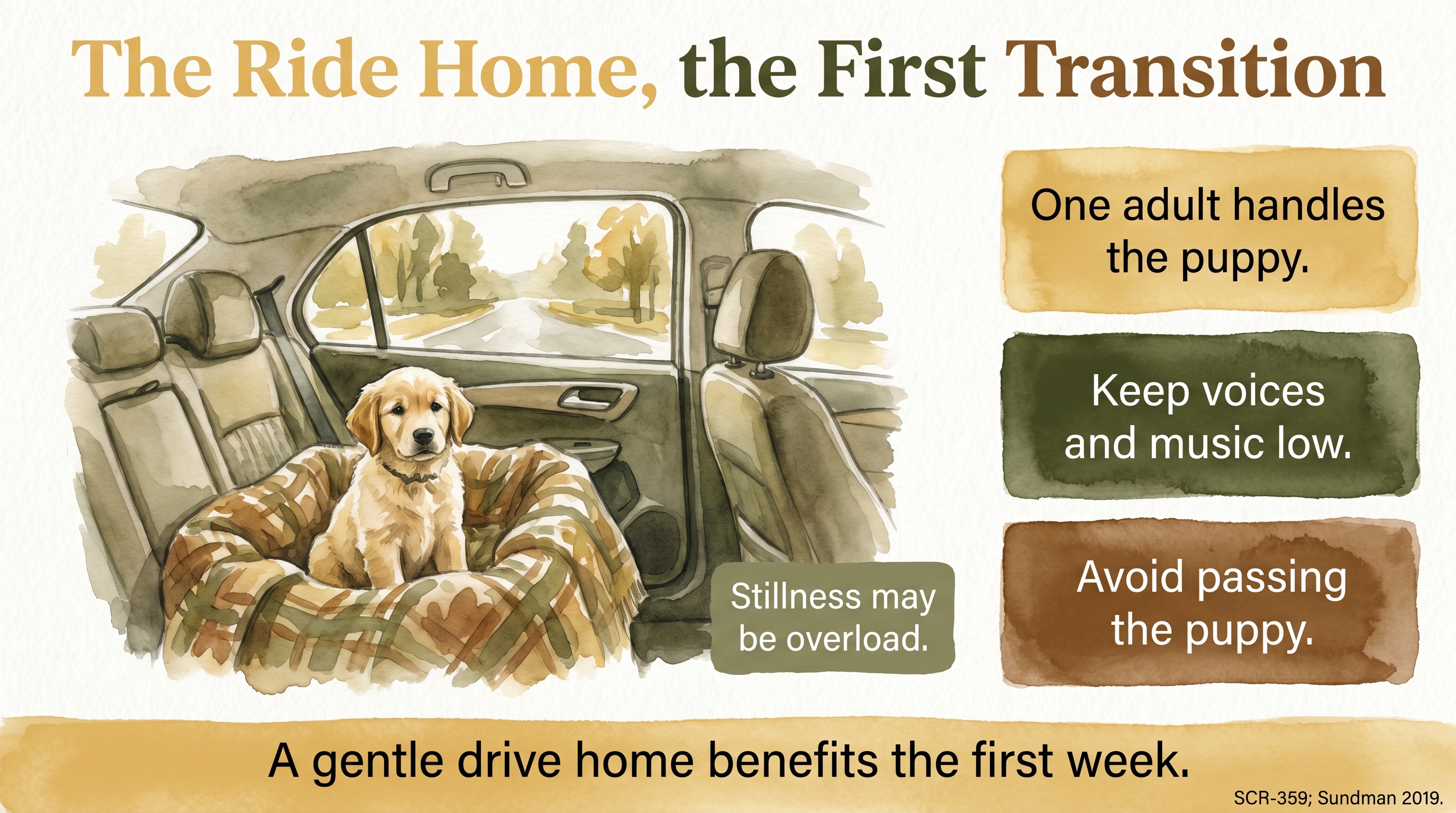
A gentle drive home does more for the first week than a memorable one.
Key Takeaways
- The ride home is the puppy's first major transition event, not just the trip before the real transition begins.
- Stillness during the drive should not automatically be read as calm; puppies can freeze or shut down under overload.
- The soft-landing version of the ride keeps touch, voices, and stimulation low so the puppy reaches the house in the lowest-arousal state possible.
- A gentle drive home does more for the first week than a memorable one because it protects the state the puppy arrives in.
The Evidence
- Sundman et al. (2019); Hoglin et al. (2021); Beerda et al. (1999); Hennessy et al. (2009)domestic dogs
Novel, socially significant, and arousing contexts produce measurable changes in canine stress markers and behavior, even when the exact emotional reading requires caution. - Mariti et al. (2020); Fallani et al. (2006); Topal et al. (2005); Cannas et al. (2010)domestic dogs
Abrupt environmental and social transitions are real stressors for dogs, making lower-input transition handling a biologically plausible protective strategy.
- JB transition practicefamily-raised puppies
A calm ride home with one quiet handler or a secure transport setup produces a lower-arousal arrival than a celebratory, high-handling ride in which the puppy becomes the emotional center of the car.
No published study directly tests the specific Just Behaving guidance on ride home within a breeder-to-family transition, so this entry relies on broader canine evidence, breeder observation, and practical synthesis rather than a direct trial of the full protocol.
SCR References
Sources
- Sundman, A.-S., Van Poucke, E., Svensson Holm, A.-C., Faresjo, A., Theodorsson, E., Jensen, P., & Roth, L. S. V. (2019). Long-term stress levels are synchronized in dogs and their owners. Scientific Reports, 9, 7391. https://doi.org/10.1038/s41598-019-43851-x
- Hoglin, A., Van Poucke, E., Katajamaa, R., Jensen, P., Theodorsson, E., & Roth, L. S. V. (2021). Long-term stress in dogs is related to the human-dog relationship and personality traits. Scientific Reports, 11, 8612. https://doi.org/10.1038/s41598-021-88201-y
- Beerda, B., Schilder, M. B. H., van Hooff, J. A. R. A. M., de Vries, H. W., & Mol, J. A. (1999). Chronic stress in dogs subjected to social and spatial restriction. I. Behavioral responses. Physiology & Behavior, 66(2), 233-242. https://doi.org/10.1016/S0031-9384(98)00289-3
- Hennessy, M. B., Voith, V. L., Mazzei, S. J., Buttram, J., Miller, D. D., & Linden, F. (2009). Behavior and cortisol levels of dogs in a public animal shelter, and an exploration of the ability of these measures to predict problem behavior after adoption. Applied Animal Behaviour Science, 113(4), 798-810. https://doi.org/10.1016/j.applanim.2008.06.004
- Mariti, C., Lenzini, L., Carlone, B., Zilocchi, M., Ogi, A., & Gazzano, A. (2020). Does attachment to man already exist in 2 months old normally raised dog puppies? A pilot study. Dog Behavior, 6(1), 1-11. https://doi.org/10.4454/db.v6i1.96
- Fallani, G., Previde, E. P., & Valsecchi, P. (2006). Do disrupted early attachments affect the relationship between guide dogs and blind owners? Applied Animal Behaviour Science, 100(3-4), 241-257. https://doi.org/10.1016/j.applanim.2005.12.005
- Topal, J., Gacsi, M., Miklosi, A., Viranyi, Z., Kubinyi, E., & Csanyi, V. (2005). Attachment to humans: A comparative study on hand-reared wolves and differently socialized dog puppies. Animal Behaviour, 70, 1367-1375. https://doi.org/10.1016/j.anbehav.2005.03.025
- Cannas, S., Frank, D., Minero, M., Godbout, M., & Palestrini, C. (2010). Puppy behavior when left home alone: Changes during the first few months after adoption. Journal of Veterinary Behavior, 5(2), 94-100. https://doi.org/10.1016/j.jveb.2009.08.009