Arrival at the New Home
The first fifteen minutes in the house often decide whether the puppy's nervous system rises or settles. By the time the family reaches the front door, the puppy has already absorbed separation, travel, and novelty. What happens next should therefore reduce input, not increase it. JB treats arrival as choreography, not improvisation. The family should already know where the puppy goes first, who is involved, what room is open, where the water is, where the potty area is, and what not to do. The point is not to create a perfect scene. The point is to prevent the house from becoming one more overwhelming event layered onto an already loaded nervous system. Observed-JB
What It Means
Families often think of the front door as the end of the transition.
For the puppy, it is the beginning of a second transition.
The ride home asked the puppy to tolerate separation and motion. Arrival asks the puppy to orient inside a new territory with new smells, new acoustics, and new social arrangements. That means the family should not think, "Finally, now the puppy can relax." The family should think, "The puppy is entering the next layer of novelty, so we need to make that layer as small and clear as possible."
The Basic Arrival Sequence
JB's preferred first-fifteen-minute choreography is very simple:
- Arrive quietly.
- Move directly to the designated potty area.
- Then bring the puppy into one prepared, low-stimulation room or small section of the house.
- Provide access to water and a defined resting place.
- Keep the social circle tiny.
That sequence matters because it answers the puppy's most immediate needs in the right order: elimination, orientation, water, and rest.
It does not ask for performance.
It does not ask for sociability.
It does not ask for "meeting the family."
It asks only for safe landing.
Why Potty Comes First
The potty stop is not a symbolic ritual. It is a practical one.
A puppy that has just been through a car ride may need to eliminate from: ordinary physiology, stress, motion, and recent water intake.
If the family skips this step and brings the puppy straight into the center of the home, then one of the first things the puppy may do is urinate, defecate, freeze, or panic in the middle of an audience. Observed-JB Families often narrate that as misbehavior or anxiety "showing itself." In reality, the adults simply skipped the first obvious physical need.
The potty-area-first rule also begins house training in the only way JB believes it should begin: through arrangement, not correction. Observed-JB
Small Territory Is Kinder Than Full Access
Another common mistake is total-house access on day one.
It feels generous. People think: let the puppy explore, let the puppy get used to everything, and let the puppy see where it lives now.
But the puppy does not need an entire floor plan in the first fifteen minutes. The puppy needs one manageable piece of it.
A few rooms with clear boundaries do more for adjustment than a whole house with no organizing logic. A small initial world allows: faster orientation, less aimless wandering, fewer accidents, fewer opportunities for over-stimulation, and easier transitions into rest.
This is another place where the soft landing differs from the crash landing. A crash landing assumes more exposure equals more adaptation. A soft landing understands that adaptation improves when exposure is digestible.
The Audience Problem
Many first-day difficulties are audience problems.
The puppy comes in and the household forms a ring: parents, children, resident dog, and maybe grandparents or neighbors.
Everyone watches. Everyone talks. Everyone interprets every movement.
This immediately turns the puppy into a performance subject.
A puppy under observation often responds in one of a few predictable ways: freezing, frantic exploration, repeated elimination, whining, zooming, and clinging.
None of these responses tell you who the puppy is. They mostly tell you that too many eyes and too much social pressure have landed at once.
The remedy is simple and underused: reduce the audience.
One or two calm adults are enough. The rest of the family can participate later when the puppy has already begun to downshift.
The First Room Should Have a Job
The initial room should not be chosen for sentiment. It should be chosen for function.
The ideal first room is: quiet, easy to supervise, not a hallway for household traffic, not full of toys, noise, or competing pets, and large enough to move, small enough to feel bounded.
The puppy should be able to: drink, orient, rest, and receive a small amount of calm handling.
That room is doing the work of translation. It tells the puppy what this household sounds like when it is not performing.
Arrival Is Not the Time for Resident-Dog Pressure
This page separates arrival from resident-dog introduction on purpose.
Families often want the whole household unified in the first five minutes: puppy arrives, resident dog rushes in, children sit down, and adults kneel around.
That creates four or five social tasks at once in a puppy who has not yet even exhaled from the car ride.
Even in homes with excellent adult dogs, it is often better to let the puppy arrive first, eliminate first, and settle first before the dog-to-dog introduction happens under its own calmer conditions. Resident dogs get their own page because they deserve their own handling logic.
What a Crash Landing Looks Like Here
The crash-landing version of arrival is extremely common: the puppy is placed in the middle of the living room, everyone surrounds it, the resident dog is allowed to rush in immediately, kids get down on the floor, toys appear, and the household interprets franticness as joy.
Then the adults are surprised when the puppy: pees on the rug, cries, zooms, hides, nips at moving hands, and will not settle afterward.
Again, the point is not blame. The point is sequence. The crash landing overwhelms the puppy because it mistakes emotional display for welcome.
Calm Is Not Passivity
JB should always say this clearly. A calm arrival is not an emotionally blank one.
You may hold the puppy.
You may speak softly.
You may reassure.
You may offer water, gentle touch, and your presence.
What you do not do is demand sociability, novelty tolerance, or visible happiness from a puppy that has been in your world for less than an hour.
The puppy is allowed to arrive in pieces.
The family just has to keep the pieces from scattering further.
Why It Matters for Your Dog
The first fifteen minutes in the house matter because they form the bridge between transport stress and home rhythm. Heuristic
If that bridge is noisy, crowded, and improvisational, the puppy enters the home already escalated. If that bridge is quiet, bounded, and predictable, the puppy has a chance to make the house its first place of recovery.
The goal of arrival is not to show the puppy the whole house. The goal is to re-establish the calm floor in one small part of the house as quickly as possible.
This page also matters because it helps families stop misreading the puppy. People often decide too much about a new puppy in the first minutes: he is shy, she is wild, he is clingy, and she is fearless.
Those judgments are almost always premature. What you are usually seeing is transition physiology, not stable personality.
That is why the best arrival protocol is modest. It makes fewer claims on the puppy and gives the adults fewer chances to misinterpret normal transition behavior as character. Observed-JB
The calmer arrival also protects the next steps: first drink, first nap, first nighttime setup, and first meal.
Each of those becomes easier when the puppy's entry into the house was legible rather than explosive.
Families often want the puppy to feel "at home" immediately. The quieter truth is that feeling at home is what begins when the first fifteen minutes are small enough to survive.
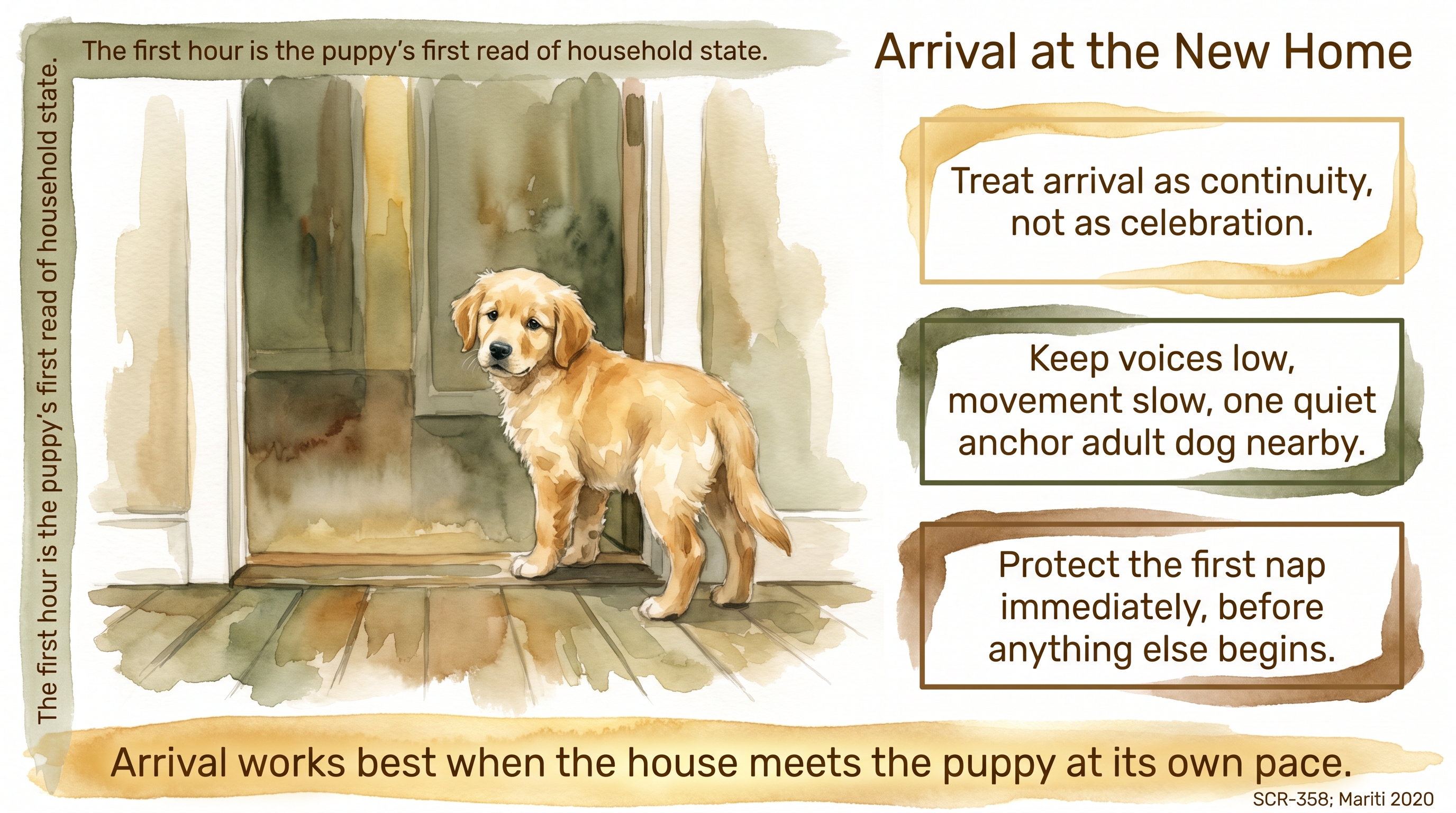
Arrival works best when the house meets the puppy at its own pace.
Key Takeaways
- Arrival at the house is the beginning of a second transition layer, not the end of the first one.
- Potty first, then one small calm room, is a better first-fifteen-minute sequence than full-house access and a social audience.
- A crash landing at the front door usually happens when families confuse excitement and exposure with welcome.
- The quieter the first room is, the sooner the puppy can start treating the new house as a place of recovery rather than another event to survive.
The Evidence
- JB first-week practicefamily-raised puppies
A quiet potty-first arrival into one prepared area of the home leads to lower arousal and easier settling than a whole-house, audience-centered welcome. - JB first-week practicefamily-raised puppies
Reducing the audience and environmental scope in the first minutes prevents the puppy from turning ordinary transition stress into frantic home-entry behavior.
- Transition synthesisdomestic dogs
Because abrupt novelty and social pressure elevate transition stress, smaller and more predictable first exposures are a biologically plausible application of calm-first transition logic.
No published study directly tests the specific Just Behaving guidance on arrival at the new home. This entry relies on broader canine evidence, breeder observation, and practical synthesis.
SCR References
Sources
- Mariti, C., Lenzini, L., Carlone, B., Zilocchi, M., Ogi, A., & Gazzano, A. (2020). Does attachment to man already exist in 2 months old normally raised dog puppies? A pilot study. Dog Behavior, 6(1), 1-11. https://doi.org/10.4454/db.v6i1.96
- Fallani, G., Previde, E. P., & Valsecchi, P. (2006). Do disrupted early attachments affect the relationship between guide dogs and blind owners? Applied Animal Behaviour Science, 100(3-4), 241-257. https://doi.org/10.1016/j.applanim.2005.12.005
- Topal, J., Gacsi, M., Miklosi, A., Viranyi, Z., Kubinyi, E., & Csanyi, V. (2005). Attachment to humans: A comparative study on hand-reared wolves and differently socialized dog puppies. Animal Behaviour, 70, 1367-1375. https://doi.org/10.1016/j.anbehav.2005.03.025
- Cannas, S., Frank, D., Minero, M., Godbout, M., & Palestrini, C. (2010). Puppy behavior when left home alone: Changes during the first few months after adoption. Journal of Veterinary Behavior, 5(2), 94-100. https://doi.org/10.1016/j.jveb.2009.08.009
- Vaterlaws-Whiteside, H., & Hartmann, A. (2017). Improving puppy behavior using a new standardized socialization program. Applied Animal Behaviour Science, 197, 55-61.
- Stolzlechner, L., Bonorand, A., & Riemer, S. (2022). Optimising Puppy Socialisation-Short- and Long-Term Effects of a Training Programme during the Early Socialisation Period. Animals, 12(22), 3067. https://doi.org/10.3390/ani12223067
- Howell, T. J., King, T., & Bennett, P. C. (2015). Puppy parties and beyond: The role of early age socialization practices on adult dog behavior. Veterinary Medicine: Research and Reports, 6, 143-153. https://doi.org/10.2147/VMRR.S62081
- Freedman, D. G., King, J. A., & Elliot, O. (1961). Critical period in the social development of dogs. Science, 133(3457), 1016-1017.