The First Night
The first night is the moment most families fear most, and much of the standard advice they receive makes that fear worse. The puppy has, for its entire life, slept in proximity to the mother and littermates. Then on night one the puppy is expected, by many ordinary recommendations, to sleep alone in a strange room and to learn that crying will not be answered. JB rejects that starting point. The first night should begin from proximity, not from isolation. The puppy does not have to sleep on a person, but it should sleep near a person, inside a protected setup that lets it hear breathing, smell presence, and experience the new family as safe haven rather than as a source of sudden disappearance. Observed-JB
What It Means
The first-night question is not really about where the puppy sleeps.
It is about what the family wants the puppy to learn about nighttime, separation, and safety.
That distinction matters because there are two very different first-night scripts in ordinary dog culture.
The first says: the puppy must learn independence immediately, the crate or pen should go downstairs or in another room, if the puppy cries, let it cry, and answering distress will spoil the puppy. Observed-JB
The second says: the puppy has undergone a real developmental rupture, proximity matters, nighttime should preserve contact, not sever it, and sleep quality matters more than symbolic toughness.
JB stands firmly in the second camp.
Why Night One Is Different
Night one is not just another nighttime routine.
It is the puppy's first experience of darkness, fatigue, separation, and unfamiliar home cues without the mother and litter physically present. That matters biologically and socially.
Up to that point, the puppy has never needed to ask: Where are the bodies I sleep beside? What does this house sound like when everything goes quiet? If I feel disoriented in the dark, who answers?
Those are not manipulative questions. They are developmental questions.
This is why JB frames the first night as attachment continuity rather than as a test of character. Observed-JB A puppy who cries on night one is not trying to dominate the household or exploit the family. The puppy is expressing the most ordinary mammalian response possible: I am tired, displaced, and alone in a strange place. Where is the group?
The Bedroom Matters
The JB position is simple. The puppy sleeps in the caregiver's bedroom on the first night, within a few feet of a human, in one of several protected arrangements: crate, pen, gated sleep area, and protected floor bed near the human bed.
The exact container is flexible. The proximity is the important part.
That setup does several things at once: it preserves social contact, it lowers the threshold for the puppy to settle, it allows the family to hear early waking before distress escalates, it makes potty timing easier, and it turns the first night into a continuation of care rather than a sudden severing of it.
The puppy is not being taught dependence here. The puppy is being taught that this new caregiver can be used as a nighttime safe haven.
Why the Cry-It-Out Model Confuses the Issue
The cry-it-out model usually sounds practical because it frames the problem as one of habit: if you answer crying, you reward crying and if you do not answer crying, the puppy will stop.
There is some narrow behavioral logic inside that statement, which is why families find it persuasive. But it omits the developmental frame.
A puppy can stop crying for more than one reason: because it settled, because it exhausted itself, because it shut down, and because it learned that distress does not change anything.
Those are not equivalent outcomes.
The evidence on the long-run developmental consequences of cry-it-out style crate acclimation in puppies is not clean enough to support sweeping certainty. That is exactly why the broader crate page in this dispatch keeps the cross-industry evidence tagged carefully. But JB does not need perfect randomized evidence to refuse an unnecessarily harsh first-night script. The burden should be on the method that asks a newly separated puppy to experience full-night isolation immediately, not on the method that preserves proximity in the first days.
Why Proximity Is Not Spoiling
Families often hear one phrase over and over: "Do not let the puppy get used to it."
Used to what?
To sleeping near the caregiver during the first night after leaving its social group?
That is not spoilage. That is continuity.
Spoilage would imply the puppy is being overindulged in a way that harms later competence. JB argues the opposite. Starting from proximity creates the physiological and relational safety from which competence can later grow.
A soft landing does not say the puppy must sleep beside the bed forever.
It says forever-rules should not be established through first-night rupture.
That is a very different thing.
The Practical Night-One Sequence
A calm first-night rhythm usually looks like this:
- Late-evening potty outing.
- Quiet return to the bedroom.
- Low lights and low voices.
- Puppy placed in the protected sleep setup close to the caregiver.
- Minimal stimulation once the lights are down.
If the puppy wakes or fusses, the first question is practical: Does the puppy need to eliminate?
If yes, take the puppy out quietly, with no social event attached, then return directly to the same sleep setup.
If no, the family should answer with calm presence, not with emotional flooding. A hand nearby, a quiet voice, a small movement of the crate closer, or simply the sound and smell of the human may be enough.
What JB avoids is turning the first night into either: a war of wills and or a night-long cuddle festival that prevents sleep entirely.
The puppy needs sleep as much as contact. The answer is structured proximity, not chaos in either direction.
What a Crash Landing Looks Like at Night
Nighttime crash landings tend to fall into one of two forms.
The first is hard isolation: crate downstairs, door shut, humans out of sight, and distress treated as something to harden through.
The second is emotional improvisation: puppy gets passed from lap to lap all evening, bedtime happens late, the family keeps the puppy awake because no one wants to stop interacting, and then the exhausted, overstimulated puppy is suddenly expected to settle cleanly.
These are opposite in style but similar in result. Both fail to protect the two things the puppy most needs that night: regulated proximity and uninterrupted sleep.
That is why JB frames first-night success modestly. The goal is not a dramatic proof of independence. The goal is a night that teaches the puppy this new family is physically near, emotionally legible, and not asking for impossible things all at once.
Sleep Quality Is Part of the Transition
Sleep in the first week is not background. It is one of the main developmental tasks.
Puppies need enormous amounts of sleep, and fragmented sleep changes everything else: tolerance for novelty, mouthing intensity, evening regulation, ability to settle after activity, and emotional recovery after stress. Observed-JB
Families often underestimate how much of what they call "behavior" in the first week is actually sleep disruption. Observed-JB An overtired puppy mouths more, zooms more, cries more, eliminates less predictably, and recovers less smoothly from ordinary stimulation.
That makes the first night foundational. If the first night teaches the puppy that nighttime is an isolating, high-distress experience, the whole next day gets harder.
Why It Matters for Your Dog
The first night matters because it often becomes the family's first real story about the puppy.
They wake up saying: he was impossible, she was clingy, he cried all night, and she was so easy.
Those stories can shape the entire first week. JB tries to keep the story smaller and more truthful. The puppy had a huge developmental transition. Night one should be judged by whether the family protected safety, sleep, and proximity as well as it could, not by whether the puppy performed emotional self-sufficiency on command.
The first night is not the time to prove independence. It is the time to teach the puppy that this new family can be used as a safe haven when the world goes dark and unfamiliar.
This matters in the long arc because nighttime is one of the clearest recurring opportunities to build or erode trust. A puppy who learns that nighttime proximity exists, that needs are answered calmly, and that the adults do not disappear into indifference is starting from a very different baseline than a puppy who learns that nighttime distress happens alone.
It also matters for the family. Parents and children often sleep worse when they are anxiously listening for a puppy they have been told not to help. Proximity simplifies that too. It reduces guesswork, lowers emotional conflict, and helps the adults behave more coherently.
The soft-landing version of the first night is not sentimental. It is simply developmentally honest.
You cannot spoil a puppy by refusing to turn its first night away from everyone it knows into an exercise in forced isolation.
You can, however, make the whole first week harder by asking for that too soon.
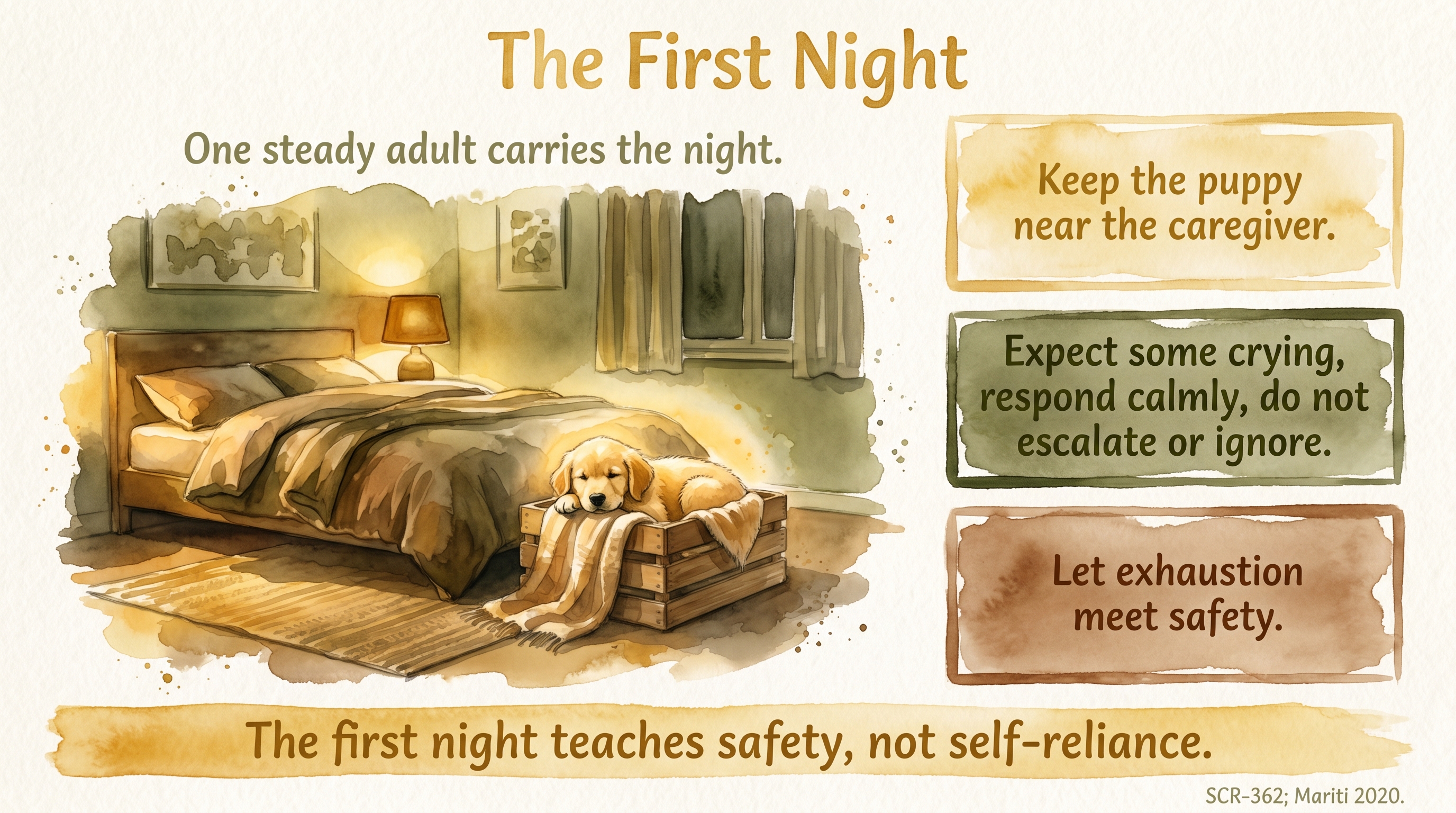
The first night teaches safety, not self-reliance.
Key Takeaways
- The first night should begin from proximity, not from isolation, because the puppy has never before slept alone after full separation from its group.
- A bedroom sleep setup preserves contact, improves practical nighttime care, and protects the puppy's chance to settle instead of escalating.
- Cry-it-out advice often confuses silence with regulation and ignores the developmental meaning of first-night distress.
- The goal of night one is not to prove independence. It is to establish nighttime as safe, quiet, and emotionally legible.
The Evidence
- Adams & Johnson (1993); Kis et al. (2014, 2017); Reicher et al. (2021)domestic dogs
Puppies require substantial sleep for recovery and regulation, and interrupted sleep interacts with irritability, arousal, and reduced settling. - Mariti et al. (2020); Fallani et al. (2006); Topal et al. (2005); Cannas et al. (2010)domestic dogs
Abrupt caregiver transition is a real stressor, while proximity and predictable caregiving are relevant to early adjustment.
- JB first-week practicefamily-raised puppies
The most humane and stabilizing first-night arrangement places the puppy in the caregiver's bedroom inside a protected sleep setup so proximity is preserved while sleep remains structured.
No published study directly tests the specific Just Behaving guidance on the first night. This entry relies on broader canine evidence, breeder observation, and practical synthesis.
SCR References
Sources
- Adams, G. J., & Johnson, K. G. (1993). Sleep-wake cycles and other night-time behaviours of the domestic dog (Canis familiaris). Applied Animal Behaviour Science, 36(2-3), 233-248.
- Kis, A., Szakadat, S., Kovacs, E., Gacsi, M., Simor, P., Gombos, F., Topal, J., Miklosi, A., & Bodizs, R. (2014). Development of a non-invasive polysomnography technique for dogs (Canis familiaris). Physiology & Behavior, 130, 149-156.
- Kis, A., Szakadat, S., Gacsi, M., Kovacs, E., Simor, P., Torok, C., Gombos, F., Bodizs, R., & Topal, J. (2017). The interrelated effect of sleep and learning in dogs (Canis familiaris); an EEG and behavioural study. Scientific Reports, 7, 41873.
- Reicher, V., Bunford, N., Kis, A., Carreiro, C., Csibra, B., Kratz, L., et al. (2021). Developmental features of sleep electrophysiology in family dogs. Scientific Reports, 11, 22760. https://doi.org/10.1038/s41598-021-02117-1
- Mariti, C., Lenzini, L., Carlone, B., Zilocchi, M., Ogi, A., & Gazzano, A. (2020). Does attachment to man already exist in 2 months old normally raised dog puppies? A pilot study. Dog Behavior, 6(1), 1-11. https://doi.org/10.4454/db.v6i1.96
- Fallani, G., Previde, E. P., & Valsecchi, P. (2006). Do disrupted early attachments affect the relationship between guide dogs and blind owners? Applied Animal Behaviour Science, 100(3-4), 241-257. https://doi.org/10.1016/j.applanim.2005.12.005
- Topal, J., Gacsi, M., Miklosi, A., Viranyi, Z., Kubinyi, E., & Csanyi, V. (2005). Attachment to humans: A comparative study on hand-reared wolves and differently socialized dog puppies. Animal Behaviour, 70, 1367-1375. https://doi.org/10.1016/j.anbehav.2005.03.025
- Cannas, S., Frank, D., Minero, M., Godbout, M., & Palestrini, C. (2010). Puppy behavior when left home alone: Changes during the first few months after adoption. Journal of Veterinary Behavior, 5(2), 94-100. https://doi.org/10.1016/j.jveb.2009.08.009