Sleep Arrangements in the First Week
The first week goes better when the family stops thinking about sleep as the thing that happens after the real work and starts treating sleep as one of the real tasks. Young puppies need extraordinary amounts of rest, often in short repeating cycles rather than long adult-style blocks. That means first-week sleep is not only about where the puppy spends the night. It is about the whole architecture of the day: wake, potty, brief activity, rest, and then back again. JB's sleep-arrangement logic is simple. Nights happen near the caregiver. Daytime naps happen in protected low-stimulation spaces. The awake windows are smaller than most families expect. The point is not to keep the puppy busy. The point is to keep the puppy regulated. Heuristic
What It Means
Many families accidentally organize the first week around the wrong assumption: a tired puppy is a good puppy. Heuristic
That sounds practical, but it becomes destructive quickly because it confuses fatigue with regulation. A puppy can become physically tired and still be neurologically over-aroused. Heuristic In fact, many of the hardest first-week evenings are exactly that combination: exhausted body and activated nervous system.
The result is the cluster of behaviors families often call "bad": zooming, nipping, refusing to settle, whining, wild post-dinner behavior, and overtired house-training accidents.
In other words, the family concludes the puppy needs more activity when the puppy often needs more sleep protection.
First-Week Sleep Is a Whole-Day Pattern
The sleep-arrangement question therefore has to be larger than: Crate or no crate? Bedroom or downstairs?
It also includes: where naps happen, who interrupts naps, whether the puppy is expected to stay awake through busy household periods, and whether the house has an actual rest rhythm or just a series of collapses after over-stimulation.
JB wants a rhythm that looks roughly like this: quiet wake-up, potty, brief calm activity, back to rest, short wake window, midday rest, afternoon rest, evening wind-down, and nighttime sleep near the caregiver.
This does not run by a stopwatch. It runs by respect for the puppy's developmental limit.
Why Naps Need Protection
Families usually protect nighttime more than daytime, which is understandable but incomplete.
The puppy also needs protection from: daytime visitors, children repeatedly waking it, adults checking on it every few minutes, and falling asleep in the busiest room and being treated as available.
An overtired puppy is not simply sleepy. An overtired puppy becomes harder to interpret. Every small challenge starts producing bigger behavior. The family can then misread the whole dog: he is stubborn, she gets crazy at night, and he is impossible after dinner.
Often the simpler truth is that the puppy is chronically under-rested because the house has not yet accepted that first-week naps are not optional.
The Best Sleep Arrangement Is the One That Protects Regulation
This is why JB resists turning the page into ideology.
The family may use: a bedroom crate, a pen in the bedroom, a gated sleep corner, and a quiet nearby resting spot.
The exact form matters less than the function: proximity at night, low stimulation during naps, and rest windows protected from audience behavior. Heuristic
The puppy does not need novelty during every waking period. The puppy needs enough recovery to process the novelty it is already getting.
What a Crash Landing Looks Like Here
The crash-landing version of first-week sleep is not only a bad night.
It is a bad rhythm.
It looks like: the puppy naps in noisy rooms because nobody wants to miss time with it, children wake the puppy because "it was already awake a little", visitors arrive during recovery windows, evening play is used to "wear the puppy out", and the puppy goes from stimulation to stimulation until it crashes.
The family then interprets the crash as proof the system works: see, now he's finally tired.
But that pattern creates the exact dysregulation the family later wants to solve. The puppy is not being taught how to move between activity and calm. The puppy is being taught how to run until collapse.
That is the industry-default inversion JB talks about so often. The house begins in sympathetic activation and hopes sleep will repair it afterward. JB wants the reverse: a parasympathetic baseline with brief bursts of activity inside it.
Bedrooms at Night, Quiet Spaces by Day
This is where the quiet bedroom principle and the sleep-arrangement page overlap.
At night, proximity matters most.
By day, the relevant question is often: where can the puppy rest without being enrolled in household life?
Sometimes the answer is still the bedroom. Sometimes it is a nearby quiet office, laundry-adjacent gated nook, or another low-traffic rest space. The important thing is not that every nap happen in one sacred room. It is that naps happen in spaces that reliably cue: less traffic, less touching, less narration, and more nervous-system descent.
The more often the puppy experiences that descent in the first week, the more normal calm becomes.
Sleep Supports Everything Else
Families often compartmentalize first-week topics: house training, greeting behavior, nipping, feeding, and crate setup. Observed-JB
In dogs, and across other mammals, sleep is tied to recovery and memory consolidation. Documented-Cross-Species
A better-rested puppy is easier to house train, easier to feed on rhythm, easier to settle after greetings, and less likely to tip into mouthy evening chaos. That is why this page is not a side issue. It is one of the pages that makes the rest of the category work.
Why It Matters for Your Dog
The first week's sleep arrangement matters because it determines whether the puppy lives inside a rhythm or inside a series of overstimulated accidents.
The puppy should not spend the first week learning to stay awake through the household's busiest hours. It should spend the first week learning that rest is protected and that calm is the baseline it keeps returning to.
For the family, this page often produces relief. Many people feel as if they are failing when the puppy seems harder every evening. In reality they may simply be running an overtired puppy through too much wakefulness. Once naps are protected, many "behavior problems" shrink back into ordinary developmental management.
It also matters because first-week sleep becomes first-month rhythm. The house begins teaching the dog when mornings rise, when evenings wind down, and where calm lives. Those rhythms are never built perfectly, but they are built much more easily when the first week takes rest seriously.
A soft landing therefore treats sleep as part of relationship. The family is saying: you do not have to be available all the time, you do not have to stay awake because we are excited, and you are allowed to disappear into recovery and come back softer.
That is not indulgence. It is one of the purest forms of regulation support the family can give.
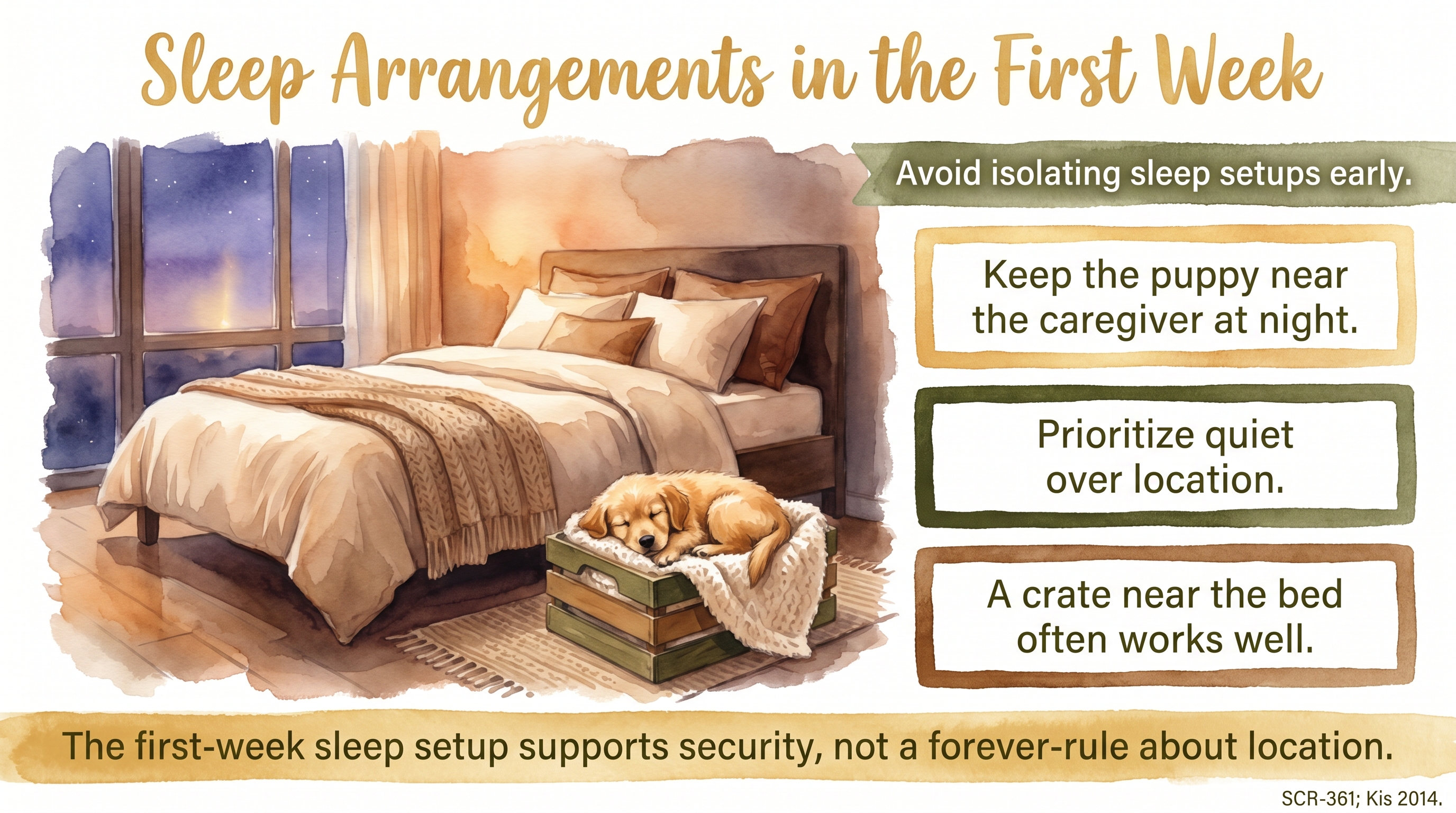
The first-week sleep setup supports security, not a forever-rule about location.
Key Takeaways
- First-week sleep is a whole-day pattern, not just a nighttime location decision.
- Many so-called bad first-week behaviors are actually overtired behaviors produced by too much wakefulness and too little protected rest.
- A crash landing at the sleep level happens when the puppy is treated as socially available during every wake and nap window until it collapses.
- The best first-week sleep arrangement is the one that protects proximity at night and real low-stimulation recovery during the day.
The Evidence
This entry uses documented cross-species claim-level tags beyond the dedicated EvidenceBlocks below. Species and application scope should be checked during the next evidence-chain authoring pass.
This entry uses observed claim-level tags beyond the dedicated EvidenceBlocks below. These tags mark JB program observation or practice-derived claims that need dedicated EvidenceBlock coverage in a later content pass.
- Adams & Johnson (1993); Kis et al. (2014, 2017); Reicher et al. (2021)domestic dogs
Young dogs require substantial sleep for recovery, and sleep disruption interacts with irritability, arousal, and poorer settling across the day. - Adams & Johnson (1993); Kis et al. (2014, 2017); Reicher et al. (2021)dogs and other mammals
Sleep contributes to regulation and memory consolidation, which supports treating protected rest as part of developmental care rather than wasted time.
- JB synthesisfamily homes with new puppies
A first-week pattern of bedroom nights and aggressively protected low-stimulation naps is a practical transition architecture built from sleep, attachment, and arousal-regulation principles rather than from a direct comparative trial of household sleep setups.
No published study directly tests the specific Just Behaving guidance on sleep arrangements the first week. This entry relies on broader canine evidence, breeder observation, and practical synthesis.
SCR References
Sources
- Adams, G. J., & Johnson, K. G. (1993). Sleep-wake cycles and other night-time behaviours of the domestic dog (Canis familiaris). Applied Animal Behaviour Science, 36(2-3), 233-248.
- Kis, A., Szakadat, S., Kovacs, E., Gacsi, M., Simor, P., Gombos, F., Topal, J., Miklosi, A., & Bodizs, R. (2014). Development of a non-invasive polysomnography technique for dogs (Canis familiaris). Physiology & Behavior, 130, 149-156.
- Kis, A., Szakadat, S., Gacsi, M., Kovacs, E., Simor, P., Torok, C., Gombos, F., Bodizs, R., & Topal, J. (2017). The interrelated effect of sleep and learning in dogs (Canis familiaris); an EEG and behavioural study. Scientific Reports, 7, 41873.
- Reicher, V., Bunford, N., Kis, A., Carreiro, C., Csibra, B., Kratz, L., et al. (2021). Developmental features of sleep electrophysiology in family dogs. Scientific Reports, 11, 22760. https://doi.org/10.1038/s41598-021-02117-1