The Honeymoon Period
Many new families spend the first week telling themselves, "This is easier than I thought." Sometimes that is partly true. More often, it is the honeymoon period: the stretch in which the puppy is still somewhat muted by novelty, social loss, and environmental calibration. In JB, that softer first phase is not dismissed, but it is interpreted carefully. The exact mechanism remains a heuristic rather than a directly measured canine homecoming effect. Heuristic
What It Means
The honeymoon period is the first-month companion to the second-week regression.
Families often misread week one without this framing. Observed-JB
They see a puppy that: follows closely, sleeps often, does not explore too boldly, startles easily but stays small, and seems "so good". Observed-JB
That behavior can feel like proof the household has already landed perfectly.
Sometimes it is partly that.
But it is also often a sign that the puppy is still in a low-expansion state. The home is not fully known. The social map is not fully trusted. The puppy is not yet pushing into the environment with the confidence it will show later.
Easier Does Not Mean Finished
This is the most important sentence on the page.
The honeymoon period is not the moment the work is complete.
It is the moment when the family has the cleanest chance to build: sleep rhythm, meal rhythm, greeting rules, calm body handling, the first separation habits, and the first household expectations.
If the adults read the honeymoon period correctly, they use its quietness to pour the foundation. If they read it incorrectly, they relax too early and the second week hits harder.
Why Novelty Can Look Like Good Behavior
Young mammals often move differently in truly new environments than they do once those environments become familiar. Observed-JB They watch more. They hesitate more. They conserve more. In puppies, that can look almost identical to easy manners.
Humans then fill in the wrong story: she just has a wonderful temperament, he already knows how to settle, and we probably do not need to be as careful as we thought.
Those may all be partly true, but the timing still matters. The same puppy may look much bolder once the house no longer feels like a total unknown.
What Families Commonly Do Wrong Here
The mistake is not enjoying the week.
The mistake is lowering structure because the week feels easy.
That often looks like: letting more visitors come through, waking the puppy more often because it "seems fine", turning greetings into more affectionate events, widening the environment too quickly, and relaxing meal or potty rhythm. Observed-JB
All of that stacks difficulty right as the honeymoon period is ending.
The Better Use of the Window
JB wants families to treat the honeymoon period as a setup window.
The puppy's relative quiet makes it easier to establish: the calm bedroom, a consistent morning flow, a matter-of-fact greeting culture, brief handling rituals, and short, neutral alone-time moments. Heuristic
Those do not feel urgent when the puppy seems easy.
They become extremely important once the puppy no longer seems easy.
The Foundation Pour, Not the Finished House
That phrase captures the whole page.
When a family pours a foundation, the house is not done. But what happens in that stage determines the strength of everything that comes later.
The honeymoon period works the same way. It is the best moment to establish household grammar before the puppy begins speaking more loudly inside it.
What a Crash Landing Looks Like
Crash landings during the honeymoon period are often made of misplaced confidence.
Because the puppy seems calm, the adults start adding more: more social exposure, more play, more errands, more children on the floor, and more informal rules.
The family tells itself the puppy is ready because the puppy was quiet.
What they often miss is that the puppy was quiet partly because the nervous system was still narrowing itself to cope with transition.
Then week two arrives, and the very structure the family could have built during the quiet days is the structure it now wishes it had.
Why It Matters for Your Dog
The honeymoon period matters because it is easy to waste a good window when you mistake it for the final outcome.
This page is therefore protective. It keeps families from telling the wrong story too soon. The puppy is not giving the adults permission to stop thinking carefully. It is giving them a short opening in which to make later life easier.
The practical message is warm, not severe: enjoy the puppy, love the puppy, and do not confuse early quiet with full adjustment.
When families get this right, the second week still comes, but it does not feel like betrayal. It feels like the next honest phase of a process they were already expecting.
That expectation alone changes the household's emotional temperature. Adults who are not surprised are much less likely to panic, over-correct, or start performing bigger energy around the puppy.
The honeymoon period does not need to be disappointing once it is named honestly.
It can be what it really is: a grace period, a routine-building window, and the foundation pour before the house becomes fully lived in.
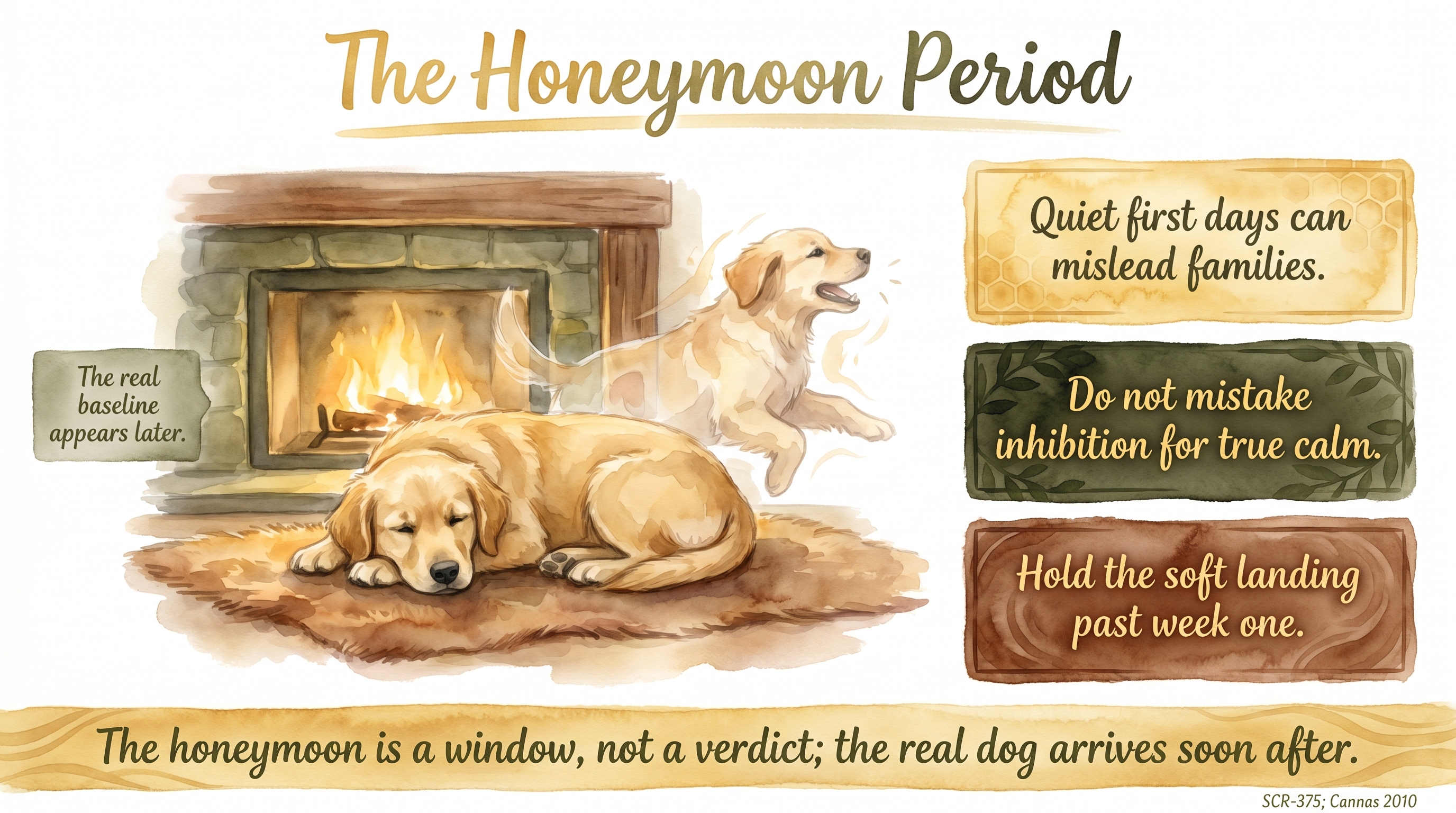
The honeymoon is a window, not a verdict; the real dog arrives soon after.
Key Takeaways
- The honeymoon period is the early stretch when many puppies seem easier than expected because they are still calibrating to a totally new environment.
- Families should not mistake that easier week for proof that all the work is done or that structure can now relax.
- The right use of the honeymoon period is to build sleep rhythm, greeting rules, handling continuity, and calm household habits before the puppy gets bolder.
- When the honeymoon period is read correctly, the later second-week regression feels expected and manageable rather than shocking.
The Evidence
This entry uses observed claim-level tags beyond the dedicated EvidenceBlocks below. These tags mark JB program observation or practice-derived claims that need dedicated EvidenceBlock coverage in a later content pass.
- Mariti et al. (2020); Fallani et al. (2006); Topal et al. (2005); Cannas et al. (2010)domestic dogs
Young puppies are exceptionally responsive to early environmental handling, and adjustment during caregiver transition is developmentally significant even when exact stage labels are not standardized.
- JB synthesisbreeder-to-family transition practice
The easier first week many families report is best understood as a novelty-muted phase in which the puppy is still socially and environmentally calibrating rather than displaying its full settled baseline. - JB synthesisfamily transition coaching
The best use of that quiet phase is to build routine before the puppy begins testing the household more actively.
No published study directly tests the specific Just Behaving guidance on the honeymoon period. This entry relies on broader canine evidence, breeder observation, and practical synthesis.
SCR References
Sources
- Mariti, C., Lenzini, L., Carlone, B., Zilocchi, M., Ogi, A., & Gazzano, A. (2020). Does attachment to man already exist in 2 months old normally raised dog puppies? A pilot study. Dog Behavior, 6(1), 1-11. https://doi.org/10.4454/db.v6i1.96
- Fallani, G., Previde, E. P., & Valsecchi, P. (2006). Do disrupted early attachments affect the relationship between guide dogs and blind owners? Applied Animal Behaviour Science, 100(3-4), 241-257. https://doi.org/10.1016/j.applanim.2005.12.005
- Topal, J., Gacsi, M., Miklosi, A., Viranyi, Z., Kubinyi, E., & Csanyi, V. (2005). Attachment to humans: A comparative study on hand-reared wolves and differently socialized dog puppies. Animal Behaviour, 70, 1367-1375. https://doi.org/10.1016/j.anbehav.2005.03.025
- Cannas, S., Frank, D., Minero, M., Godbout, M., & Palestrini, C. (2010). Puppy behavior when left home alone: Changes during the first few months after adoption. Journal of Veterinary Behavior, 5(2), 94-100. https://doi.org/10.1016/j.jveb.2009.08.009