The Evening Routine in the First Week
Evening is where many first-week households go wrong because adults tend to bring their own relief into it. The workday is ending, the children are home, the family is finally together, and everyone wants more interaction with the puppy. Unfortunately that is often the exact moment the puppy's nervous system is least able to tolerate more stimulation. By late afternoon and evening, most new puppies are not under-engaged. They are overtired. JB therefore treats evening as a wind-down window, not a wind-up window. Observed-JB
What It Means
The most common family reading of first-week evening behavior is: now the puppy has energy to burn. Observed-JB
The more accurate reading is often: the puppy has gone past its regulatory limit.
That distinction changes everything.
An overtired puppy does not present like a sleepy human child. It often presents like a noisy, mouthy, impulsive, hard-to-settle version of itself. Families then try to solve that behavior by: more play, more toys, more stimulation, and more attempts to "tire the puppy out".
In many homes, this simply pushes the puppy farther from the calm floor it was already struggling to find. Observed-JB
The Evening Is a Nervous-System Threshold
By the time evening arrives in the first week, the puppy has already absorbed: morning waking, meals, potty trips, handling, household sounds, introductions, and several wake-sleep transitions. Observed-JB
Even if the day was relatively calm, that is a lot for a new puppy.
So evening should not ask, "How do we make the puppy happier through more action?"
It should ask, "How do we lower demand before the puppy tips into overtired chaos?"
The Basic Evening Sequence
A good first-week evening usually contains: quieter household tone, dinner in the same place as prior meals, a brief, calm post-meal wake window, protected downshift afterward, final potty outings before bed, and lower lights and lower voices as bedtime approaches.
That structure is doing more than convenience work. It is teaching the puppy that the day has a descent phase.
Many families do not realize how teachable this is. If evenings consistently become softer, dimmer, and less socially demanding, puppies begin to anticipate that shift and settle into it more readily.
Why "Wear the Puppy Out" Often Backfires
This is one of the great first-week myths.
An already tired puppy does not need a long evening play session to become more sleep-ready. More often, the opposite happens: more arousal, more cortisol, more difficulty settling, more fragmented sleep, and harder next morning.
Families then repeat the same mistake the next day because the evening felt difficult, not realizing the difficulty was largely produced by the very strategy they used to solve it.
JB's objection is not to play itself. Puppies should play. The objection is to using late-day arousal as a sleep intervention.
It is a poor one.
What a Crash Landing Looks Like Here
The crash-landing evening often has a recognizable shape: the adults are finally free to engage, children want their time with the puppy, the puppy is passed into the household's busiest hour, dinner prep, talking, television, and movement all stack together, and then the puppy gets frantic and the family decides it needs more exercise.
The puppy may: zoom, bite clothing, grab at hands, lose bathroom control, bark, and melt down in ways the family labels as personality. Observed-JB
In truth, the puppy is often telling the household the day has been longer than its nervous system can hold.
The crash landing here is subtle because it looks affectionate and ordinary. It feels like family time. But if family time consistently lands as late-day over-arousal, the puppy learns that evening is the least regulated part of the home.
The Household's Tone Counts More Than People Think
One of the reasons this page sits in the transition category rather than only in a future lifestyle category is that the puppy is reading the emotional weather of evenings immediately.
Some homes get louder at night.
Some get faster.
Some fragment into several overlapping conversations and tasks.
That does not make them bad homes. It just means they need more deliberate puppy architecture.
If the household's natural evening rhythm is busy, the puppy may need even more protection: earlier rest window, quieter bedroom time, fewer simultaneous people involved, and fewer expectations to be present in the center of it all.
Wind-Down Is Not Withdrawal
Families sometimes fear that a softer evening means withdrawing affection.
It does not.
A wind-down evening can still contain: calm petting, short companionship, quiet sitting nearby, and final potty trips.
What it removes is the assumption that the puppy should participate fully in the loudest and most stimulating part of family life during the week when the puppy is still calibrating to the house itself.
That is not exclusion.
It is good pacing.
Why It Matters for Your Dog
Evening matters because many of the behaviors people later call "bad habits" begin as overtired evening behaviors that were misunderstood and repeatedly rehearsed.
The goal of evening is not to spend the puppy's last energy. The goal is to lower demand early enough that the puppy can find its way back to calm before bedtime.
This has enormous practical consequences. A better evening routine often improves: nighttime settling, fewer bedtime battles, fewer indoor accidents, less late-day nipping, and better next-morning regulation.
In other words, the evening routine is not merely a response to the day. It helps determine the quality of the next one.
It also teaches the puppy something deeper about the household. Homes are not only known by how they welcome excitement. They are known by how they end the day. A family that can dim the house, soften the voices, shorten the stimulation, and lead the puppy toward rest is teaching one of the most valuable long-arc lessons in the whole first week:
we know how to come down.
That is a life skill, not just a bedtime trick.
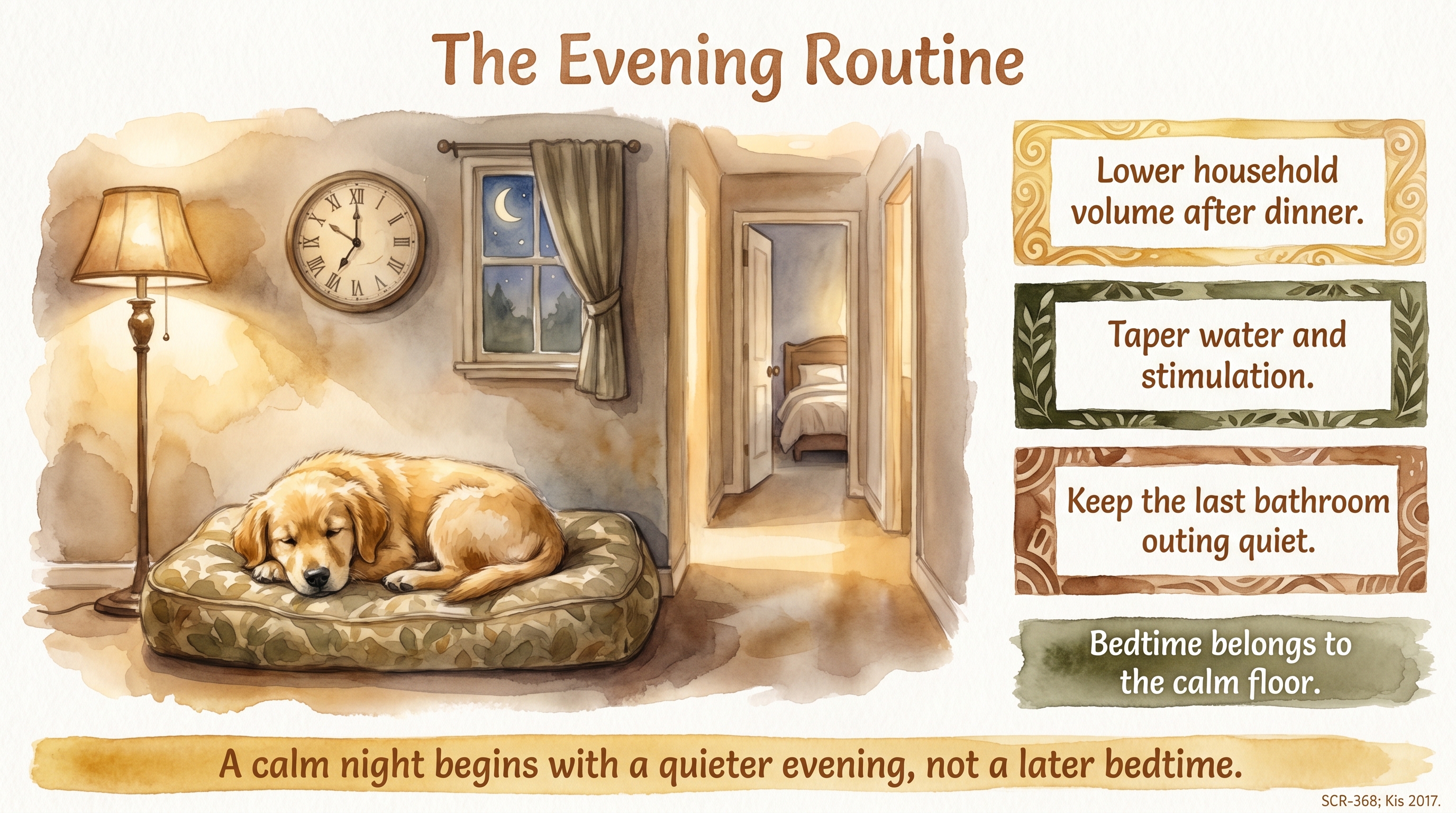
A calm night begins with a quieter evening, not a later bedtime.
Key Takeaways
- First-week evening behavior is often overtired behavior, not proof that the puppy needs more stimulation.
- A wind-down evening should lower lights, voices, and expectations so bedtime becomes a descent instead of another activation cycle.
- A crash-landing evening happens when the puppy is folded into the busiest family hour and then pushed even harder in the name of tiring it out.
- Good evening rhythm improves not only the night but the next day because regulation carries forward across sleep-wake transitions.
The Evidence
- Adams & Johnson (1993); Kis et al. (2014, 2017); Reicher et al. (2021)domestic dogs
Sleep disruption and insufficient recovery contribute to irritability, poorer settling, and heightened behavioral difficulty in young dogs.
- JB first-week practicefamily-raised puppies
A lower-light, lower-voice, lower-stimulation evening routine produces steadier settling than late-day play escalation designed to wear the puppy out.
No published study directly tests the specific Just Behaving guidance on the evening routine. This entry relies on broader canine evidence, breeder observation, and practical synthesis.
SCR References
Sources
- Adams, G. J., & Johnson, K. G. (1993). Sleep-wake cycles and other night-time behaviours of the domestic dog (Canis familiaris). Applied Animal Behaviour Science, 36(2-3), 233-248.
- Kis, A., Szakadat, S., Kovacs, E., Gacsi, M., Simor, P., Gombos, F., Topal, J., Miklosi, A., & Bodizs, R. (2014). Development of a non-invasive polysomnography technique for dogs (Canis familiaris). Physiology & Behavior, 130, 149-156.
- Kis, A., Szakadat, S., Gacsi, M., Kovacs, E., Simor, P., Torok, C., Gombos, F., Bodizs, R., & Topal, J. (2017). The interrelated effect of sleep and learning in dogs (Canis familiaris); an EEG and behavioural study. Scientific Reports, 7, 41873.
- Reicher, V., Bunford, N., Kis, A., Carreiro, C., Csibra, B., Kratz, L., et al. (2021). Developmental features of sleep electrophysiology in family dogs. Scientific Reports, 11, 22760. https://doi.org/10.1038/s41598-021-02117-1