The Morning Routine in the First Week
The first thirty minutes of the day often tell you whether the house is training calm or training cortisol. Morning is a vulnerable transition point for everyone. Adults are waking, children may be moving toward school rhythm, resident dogs may already be anticipating activity, and the puppy is emerging from sleep with a full bladder and a nervous system that can be tipped upward very quickly. JB therefore treats the morning routine as one of the most important first-week structures. It should be quiet, immediate, repetitive, and almost boring. Observed-JB
What It Means
Morning is one of the easiest times for a family to accidentally turn ordinary household life into a daily adrenaline script.
The common pattern goes like this: humans wake up late, puppy wakes up urgently, everyone greets the puppy excitedly, the puppy is talked to, touched, and animated before it has even eliminated, breakfast happens amid kitchen traffic and noise, and the puppy becomes increasingly wild while the adults interpret the wildness as normal puppy energy.
By breakfast time, the house is already running on the wrong fuel.
JB wants the opposite sequence.
The Correct Order Matters
The first-week morning order is simple:
- Quiet rise.
- Immediate outside for elimination.
- Quiet return inside.
- Brief settle.
- Breakfast in a structured location.
- Short calm wake window.
- Back to rest.
Every piece of that order matters because each step prevents a common mistake.
Immediate outside prevents the wake-up accident.
Quiet voices prevent the puppy from associating waking with social explosion.
Structured breakfast prevents the kitchen from becoming the first arousal hotspot of the day. Observed-JB
The post-breakfast return to calm prevents families from assuming the puppy is ready for a full morning of engagement. Observed-JB
Wake-Up Is Not Greeting Time
This is one of the strongest JB distinctions in the whole dispatch.
When the puppy wakes, the household's first duty is not emotional expression. Observed-JB It is practical and regulatory support.
That means the first words of the day should not function like applause.
The first movements should not invite jumping, mouthing, or spinning.
The family is simply helping the puppy move from sleep to elimination to food without turning that transition into a spectacle.
Many households do the opposite because mornings feel like reunion: "Good morning!" "Who's awake?" "Did you sleep so well?" Observed-JB
None of this is malicious. It is just much louder than the puppy needs.
Why the First Outing Comes Before Everything Else
A full bladder is one reason. But there is a broader logic too. The outside trip gives the puppy's nervous system a clean sequence: wake, move, eliminate, and return.
That is much more regulating than: wake, excitement, touch, kitchen chaos, and then maybe outside later.
The order itself is doing calmness work.
It is telling the puppy that mornings begin in a narrow track, not in a social free-for-all.
Breakfast Should Not Be Social Theater
Another first-week mistake is treating breakfast as a bonding ceremony.
The kitchen fills.
Everyone watches.
Children talk to the puppy while it eats.
Other dogs circle.
The adults try to combine: breakfast, conversation, routine setting, and maybe some early training.
All of that is too much.
Breakfast should happen in one predictable place, with the household's presence calm and non-hovering. The meal is not a test, not a game, and not a performance. It is part of the body's rhythm.
This is especially important in the first week because food rhythm and bathroom rhythm are so closely linked. The cleaner the breakfast routine is, the easier the rest of the morning becomes.
What a Crash Landing Looks Like Here
A crash-landing morning is usually not dramatic. It is simply noisy.
The household wakes, the puppy becomes the first event, and the whole system gets pushed upward too fast.
Then the family says: mornings are always crazy, the puppy is impossible after waking, and he gets overexcited for breakfast.
Often the puppy is not the cause of the chaos. The puppy is reading it and joining it.
The crash-landing morning teaches: waking means social intensity, breakfast means noise, people moving around fast means I should move around fast, and the day begins in arousal.
That is a very expensive lesson if repeated every day.
The Morning Sets the Household Story
Morning matters because it is the first repeated story the puppy gets about the house after sleep.
Is the house: Orderly? Low and steady? Protective of transitions?
Or is the house: Improvisational? Stimulating? Emotionally loud before the puppy even gets its bearings?
The puppy is building those expectations immediately.
Why This Is Hard for Families
Morning routines challenge adults because adults are often least regulated in the morning themselves. They are rushing, multitasking, and transitioning into work or childcare roles. That is exactly why the routine has to be pre-decided rather than invented on the fly.
The family should already know: who gets the puppy up, where the first outing happens, where breakfast goes, and what happens after breakfast.
If that structure is not decided in advance, the puppy ends up absorbing the household's indecision.
Why It Matters for Your Dog
The morning routine matters because it creates a repeated physiological opening to the day.
The puppy should not start each day by being yanked from sleep into social excitement. A good morning routine protects the transition from sleep into wakefulness so the puppy can stay closer to calm as the day begins.
This also matters for the family because calm mornings create calmer evenings. A day that begins in regulation is easier to keep regulated. A day that begins in cortisol and excitement has to be recovered later.
The morning routine is one of the clearest places where the first week becomes the first month and then the first year. Families often think rituals matter only when they are formal. In reality, the repeated unspoken structure of wake-up, outside, breakfast, settle, and rest is one of the strongest teachers in the house.
That is why JB wants the morning to feel less like an event and more like a track. The puppy should be able to wake into a world that already knows what comes next.
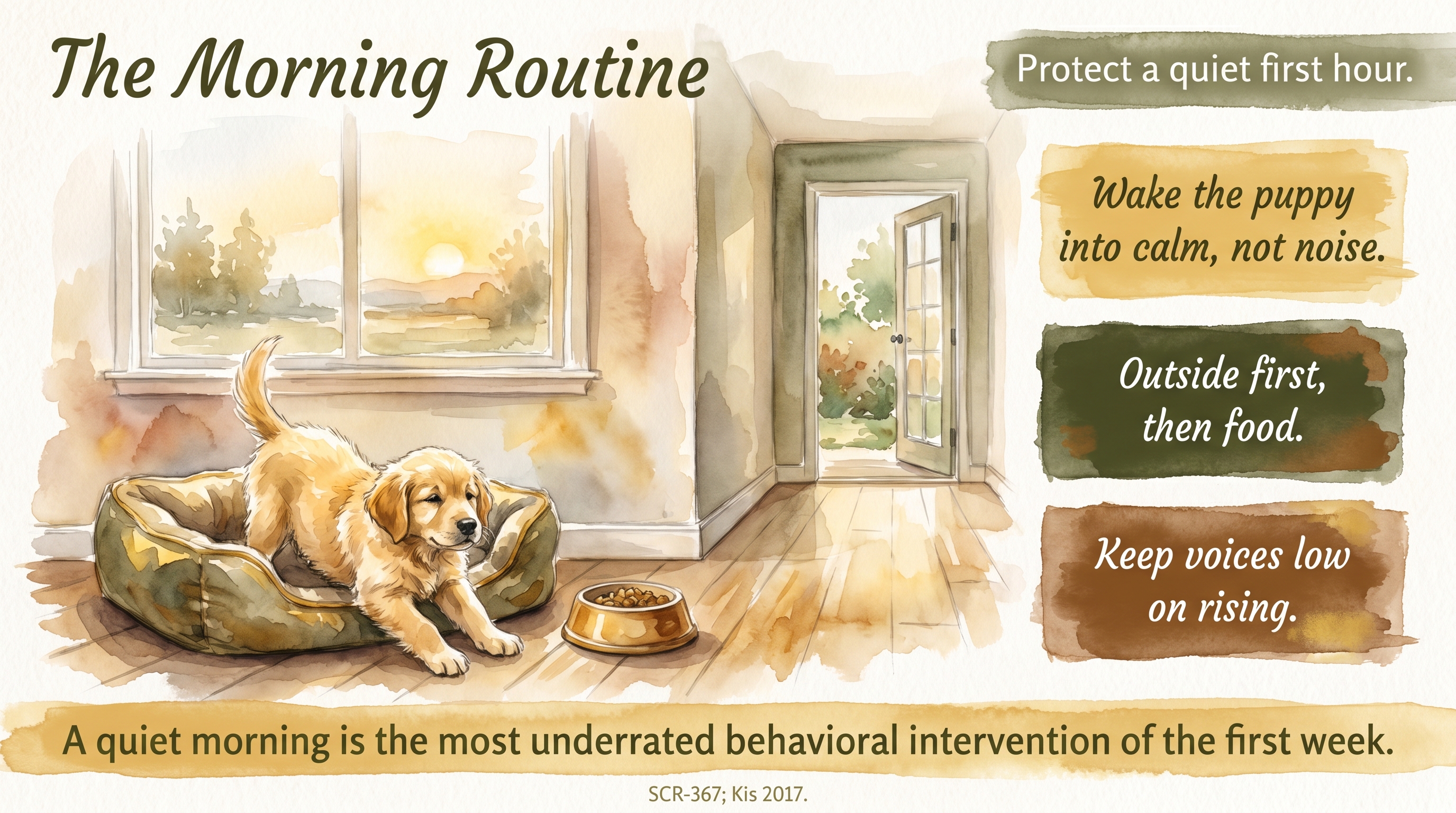
A quiet morning is the most underrated behavioral intervention of the first week.
Key Takeaways
- The best first-week mornings are quiet, immediate, and repetitive rather than socially dramatic.
- Wake-up should lead straight to outside, then structured breakfast, then back toward calm instead of into household excitement.
- A crash-landing morning teaches the puppy that waking is an arousal event rather than an ordinary transition.
- Morning rhythm is one of the earliest ways a family teaches the puppy what kind of nervous system this house runs on every day.
The Evidence
- JB first-week practicefamily-raised puppies
Quiet waking, immediate outside access, structured breakfast, and an early return to rest create a more stable first-week morning pattern than excitement-heavy greeting and chaotic kitchen integration.
- JB synthesisfamily homes with new puppies
Because wake transitions are physiologically sensitive, the morning routine likely influences the puppy's daily arousal baseline far more than families usually realize, even though that specific household effect has not been isolated experimentally.
No published study directly tests the specific Just Behaving guidance on the morning routine. This entry relies on broader canine evidence, breeder observation, and practical synthesis.
SCR References
Sources
- Sundman, A.-S., Van Poucke, E., Svensson Holm, A.-C., Faresjo, A., Theodorsson, E., Jensen, P., & Roth, L. S. V. (2019). Long-term stress levels are synchronized in dogs and their owners. Scientific Reports, 9, 7391. https://doi.org/10.1038/s41598-019-43851-x
- Hoglin, A., Van Poucke, E., Katajamaa, R., Jensen, P., Theodorsson, E., & Roth, L. S. V. (2021). Long-term stress in dogs is related to the human-dog relationship and personality traits. Scientific Reports, 11, 8612. https://doi.org/10.1038/s41598-021-88201-y
- Beerda, B., Schilder, M. B. H., van Hooff, J. A. R. A. M., de Vries, H. W., & Mol, J. A. (1999). Chronic stress in dogs subjected to social and spatial restriction. I. Behavioral responses. Physiology & Behavior, 66(2), 233-242. https://doi.org/10.1016/S0031-9384(98)00289-3
- Hennessy, M. B., Voith, V. L., Mazzei, S. J., Buttram, J., Miller, D. D., & Linden, F. (2009). Behavior and cortisol levels of dogs in a public animal shelter, and an exploration of the ability of these measures to predict problem behavior after adoption. Applied Animal Behaviour Science, 113(4), 798-810. https://doi.org/10.1016/j.applanim.2008.06.004
- Bray, E. E., MacLean, E. L., & Hare, B. A. (2015). Increasing arousal enhances inhibitory control in calm but not excitable dogs. Animal Cognition, 18(6), 1317-1329.
- Affenzeller, N., Palme, R., & Zulch, H. (2017). Playful activity post-learning improves training performance in Labrador Retriever dogs (Canis lupus familiaris). Physiology & Behavior, 168, 62-73. https://doi.org/10.1016/j.physbeh.2016.10.014
- Affenzeller, N. (2020). Dog-Human Play, but Not Resting Post-Learning Improve Re-Training Performance up to One Year after Initial Task Acquisition in Labrador Retriever Dogs: A Follow-On Study. Animals, 10(7), 1235. https://doi.org/10.3390/ani10071235
- Kis, A., Szakadat, S., Gacsi, M., Kovacs, E., Simor, P., Torok, C., Gombos, F., Bodizs, R., & Topal, J. (2017). The interrelated effect of sleep and learning in dogs (Canis familiaris); an EEG and behavioural study. Scientific Reports, 7, 41873.