Sleep and Memory Consolidation in Dogs
Compound evidence detail1 SCR / 2 parts
- Documentedthe EEG measurement of declining NREM delta-power amplitude between 8 and 14 months of canine development (Reicher et al. 2021)
- Heuristicthe cross-species inference that this delta-power decline reflects synaptic pruning in canine cortical development
Sleep in dogs is not just the absence of activity. It is a biologically active state in which the brain consolidates learning, reorganizes information, and supports later regulation. The strongest direct canine evidence shows that post-learning sleep changes EEG patterns, spindle density tracks learning improvement, and disrupted sleep changes later behavior and emotion processing. Documented
What It Means
Sleep in dogs is not just the absence of activity. It is biologically active. Dog sleep includes NREM and REM stages measurable with non-invasive polysomnography. That alone matters because it lets researchers move beyond vague impressions and into actual sleep physiology. Documented The broader scientific point is simple: sleep is not idle downtime. It is a condition in which information is stabilized, affective processing shifts, and the nervous system does work that waking behavior alone cannot substitute.
Post-Learning Sleep Supports Consolidation
SCR-055 is the core entry. Dog studies show that post-learning sleep supports memory consolidation, that sleep EEG changes track learning, and that the post-training window matters. Dogs who sleep after learning do not just rest. Their subsequent performance can improve in ways linked to measurable sleep physiology. Documented This matters because it changes how one should think about training and development. Learning is not finished when the session ends. Part of learning continues after the session, during sleep and protected recovery.
Sleep Spindles and the Magnitude of Learning Gain
SCR-097 adds a more specific mechanistic layer. Sleep spindle density in dogs correlates with how much learning improvement is seen after sleep, and targeted memory reactivation during NREM sleep can increase spindle density and speed later response. Documented That is a very strong result for a dog learning page because it moves the discussion from general intuition to a measurable sleep-dependent mechanism. The practical takeaway is not that families should play auditory cues into sleeping puppies. It is that consolidation is not a metaphor. It has identifiable physiological markers in dogs.
Fragmentation Has Costs
SCR-099 broadens the picture from learning to functioning. Fragmented or disrupted sleep in dogs is associated with measurable next-day changes such as more inactivity and less play or alert engagement. The broader source layer also links sleep disruption with inflammatory and metabolic burden in relevant canine contexts. Documented This is why sleep quality matters as much as the idea of "time in bed." Repeated interruption, unstable conditions, and noisy environments can change what the dog actually gets from the rest period.
Developmental EEG and Ongoing Maturation
SCR-100 adds a developmental note that belongs in neuroscience rather than only in sleep guidance. Between roughly 8 and 14 months, delta power declines progressively and does not appear stabilized even by 14 months. That is direct dog measurement. The interpretation that this reflects pruning-like developmental refinement is more cautious. That reading is consistent with broader mammalian developmental neuroscience, but it remains a heuristic interpretation rather than a fully direct canine proof. This makes sleep relevant to brain-development pages in two ways: sleep physiology itself changes as the dog matures and some of what sleep reveals is ongoing developmental brain change rather than only nightly recovery.
Why It Matters for Your Dog
If sleep supports consolidation, if spindle density tracks learning, and if fragmentation changes later behavior, then rest is part of development rather than a break from development. Documented That does not mean every active household is damaging a dog's brain. It does mean that chronic under-rest and chronically poor sleep conditions are not behaviorally neutral. Protected rest matters. A puppy that is constantly interrupted, living in a noisy or chaotic environment, or denied quiet rest periods is not getting the consolidation window sleep physiology provides. That affects both learning and emotional regulation. On the practical side, this means that providing calm, quiet spaces for sleep is not indulgent. It is supporting the dog's neurological development and emotional functioning.
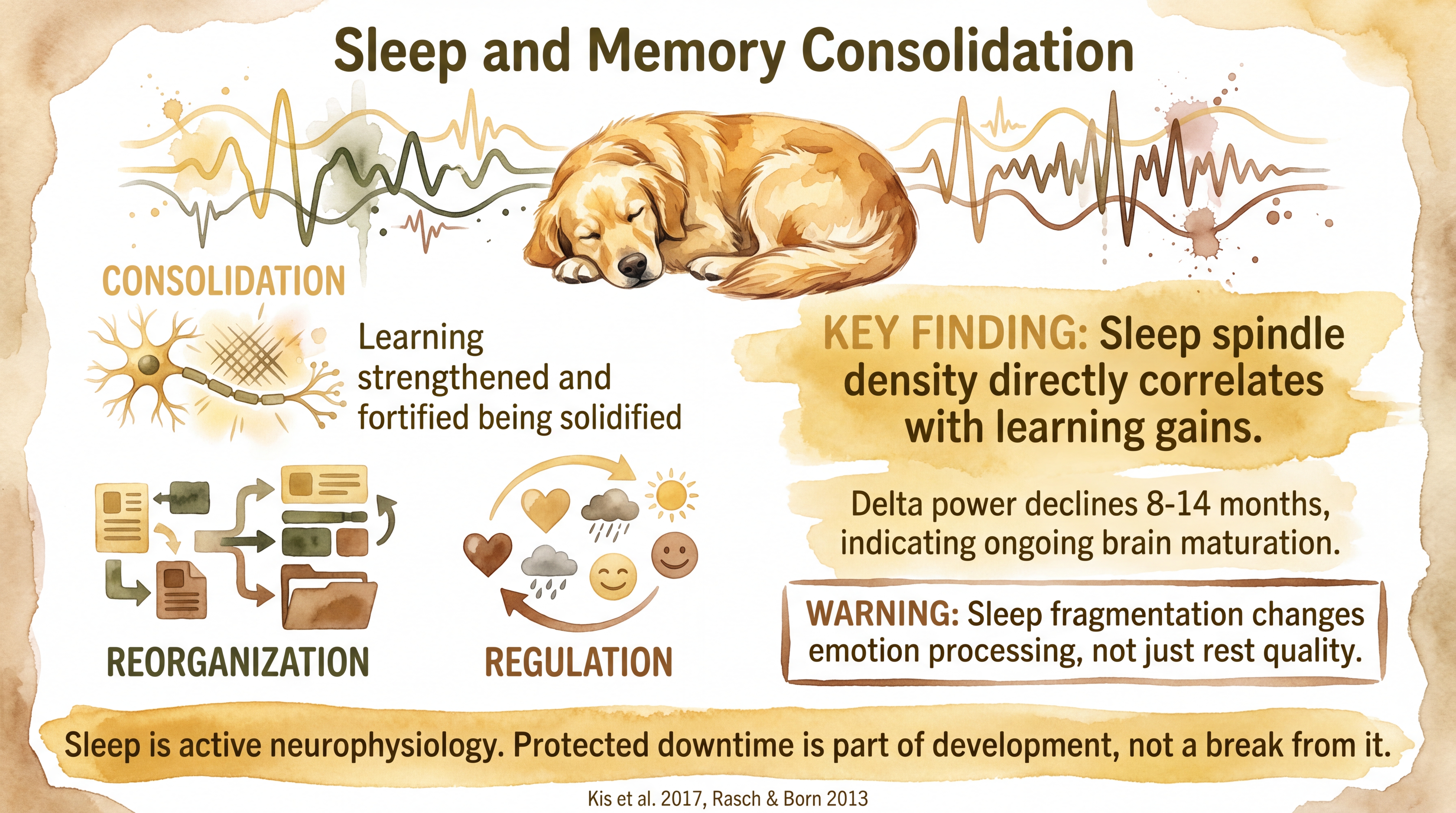
Sleep consolidates learning into long-term memory - puppies that rest after experiences retain them more reliably.
Key Takeaways
- Sleep in dogs is an active neurophysiological process tied to learning and recovery.
- Post-learning sleep and sleep-spindle activity are directly linked to better later performance in dogs.
- Sleep fragmentation changes later behavior and emotion processing rather than functioning as harmless interruption.
- The strongest claims concern sleep quality and consolidation, while universal hourly sleep-number claims remain less settled.
The Evidence
- Kis, A. et al. (2017)domestic dogs
Learning changed canine sleep EEG, and post-sleep performance improvement tracked sleep-related physiology. - Kis, A. et al. (2025)domestic dogs
Targeted memory reactivation during NREM sleep increased spindle density and improved later response speed. - Bollo, H. et al. (2020)domestic dogs
Selective sleep-stage disturbance altered emotion-processing behavior in family dogs. - Schork, I. G. et al. (2022)domestic dogs
Sleep disruption and daytime behavior interacted in kennel dogs, supporting measurable consequences of poor sleep.
- Rasch, B., & Born, J. (2013)multiple mammals
Reviewed sleep as a core mechanism of memory consolidation across species. - Meerlo, P. et al. (2008)humans and rodents
Reviewed links between restricted or disrupted sleep and autonomic and neuroendocrine stress systems.
- SCR-100 boundarydomestic dogs
Delta power decline from 8 to 14 months is documented in dogs, but the interpretation as synaptic pruning remains a careful cross-species inference. - Sleep source boundarydomestic dogs
Strong canine evidence supports sleep quality and consolidation claims more directly than it supports one universal puppy sleep-hours rule in home environments.
The Evidence Boundaries
The sleep literature is strong, but it still has important boundaries. This page does not claim that every puppy has one validated universal hourly sleep requirement, that the popular 16 to 18 hour figure is a fully verified physiological norm, or that one specific nap duration has been proven necessary for every learning outcome. The large practical lesson survives without those overstatements. Sleep quality, protected downtime, and low-interference recovery matter.
The calmness layer often treats protected rest as part of building regulation. The science supports that move directly: sleep is an active learning and recovery process, while exact household sleep-hour rules still need more caution than many popular guides use.
No published study has directly tested whether JB-style protected rest protocols produce measurably better sleep consolidation or behavioral outcomes compared to standard puppy rearing environments.
The Evidence
- Kis, A. et al. (2017)domestic dogs
Learning changed canine sleep EEG, and post-sleep performance improvement tracked sleep-related physiology. - Kis, A. et al. (2025)domestic dogs
Targeted memory reactivation during NREM sleep increased spindle density and improved later response speed. - Bollo, H. et al. (2020)domestic dogs
Selective sleep-stage disturbance altered emotion-processing behavior in family dogs. - Schork, I. G. et al. (2022)domestic dogs
Sleep disruption and daytime behavior interacted in kennel dogs, supporting measurable consequences of poor sleep.
- Rasch, B., & Born, J. (2013)multiple mammals
Reviewed sleep as a core mechanism of memory consolidation across species. - Meerlo, P. et al. (2008)humans and rodents
Reviewed links between restricted or disrupted sleep and autonomic and neuroendocrine stress systems.
- SCR-100 boundarydomestic dogs
Delta power decline from 8 to 14 months is documented in dogs, but the interpretation as synaptic pruning remains a careful cross-species inference. - Sleep source boundarydomestic dogs
Strong canine evidence supports sleep quality and consolidation claims more directly than it supports one universal puppy sleep-hours rule in home environments.
SCR References
Sources
- Bollo, H., et al. (2020). REM versus non-REM sleep disturbance specifically affects inter-specific emotion processing in family dogs. Scientific Reports, 10, 10492.
- Kis, A., et al. (2017). The interrelated effect of sleep and learning in dogs: An EEG and behavioural study. Scientific Reports, 7, 41873.
- Kis, A., et al. (2025). The effect of targeted memory reactivation on dogs' visuospatial memory. eNeuro.
- Meerlo, P., Sgoifo, A., & Suchecki, D. (2008). Restricted and disrupted sleep: Effects on autonomic function, neuroendocrine stress systems and stress responsivity. Sleep Medicine Reviews, 12(3), 197-210.
- Rasch, B., & Born, J. (2013). About sleep's role in memory. Physiological Reviews, 93(2), 681-766.
- Reicher, V., et al. (2021). Developmental features of sleep electrophysiology in family dogs. Scientific Reports.
- Schork, I. G., et al. (2022). The cyclic interaction between daytime behavior and the sleep behavior of laboratory dogs. Scientific Reports.