The Puppy Class Decision in the First Month
Compound evidence detail1 SCR / 2 parts
- Documenteddevelopmental-window science and behavioral outcomes data from structured socialization environments in puppies
- HeuristicJB position that conventional puppy-class environments often conflict with the soft-landing approach during the first month
Almost every new family gets asked the same question quickly: when are you starting puppy class? The question sounds sensible because it usually comes wrapped in a real concern about socialization. JB's answer is more conditional than people expect. Standard puppy class is not something JB generally recommends in the first month, not because early exposure is unimportant, but because most classes are built around the wrong state and the wrong relational frame for a puppy still trying to land. Some rare classes are useful. Many common ones pull directly against the calm floor. Mixed Evidence
What It Means
The family has to separate two issues that are often collapsed together: does early socialization matter and is standard puppy class the right form for it in month one.
The answer to the first question is yes.
The answer to the second question is often no.
Why Standard Puppy Class Often Misses the Mark
Many common puppy classes include some version of: high verbal density, lure-based cue work, marker-heavy training, peer play as a socialization reward, and a novel room full of puppies and anxious humans.
That is already a lot.
For a puppy still decompressing, it can be too much.
The family may leave thinking the puppy had a valuable social experience when what actually happened was: arousal got written upward, other puppies became major events, and the human relationship tilted toward performance. Mixed Evidence
What JB Does Not Recommend
JB does not generally recommend a first-month class built around: off-leash puppy chaos, fast cue acquisition in a stimulating room, and repeated excitement as the engine of participation. Mixed Evidence
The concern is not moral purity.
It is state management.
If the class keeps raising the puppy's arousal every week, it is teaching the opposite of what the transition is trying to stabilize. Mixed Evidence
When a Class Can Help
A rare class can still be a good fit.
The features JB would want are things like: calm observation, quiet handling, tightly managed spacing, no social free-for-all, and an instructor who values neutrality as much as sociability.
At that point, the class is less a performance venue and more an extension of the calm floor into a new place.
That is a different proposition.
Waiting Is Not Wasting the Window
This is the reassurance many families need.
If the home is already giving the puppy: calm human contact, controlled novelty, curated dog exposure, and safe rest.
then socialization is already happening.
Not being in a class by week two does not mean the puppy is missing its only developmental chance. Mixed Evidence
Why It Matters for Your Dog
This page matters because families can get pushed into choices that sound responsible but do not fit the actual puppy in front of them. The socialization window is real. So is overstimulation. Good judgment comes from holding both truths at once.
It also matters because many families feel guilty if they hesitate. JB wants to remove that guilt. Waiting for the settled baseline is often the wiser path, not the lazier one.
The puppy does not benefit from a class simply because it is called socialization.
The puppy benefits from experiences it can actually absorb.
That is the real standard.
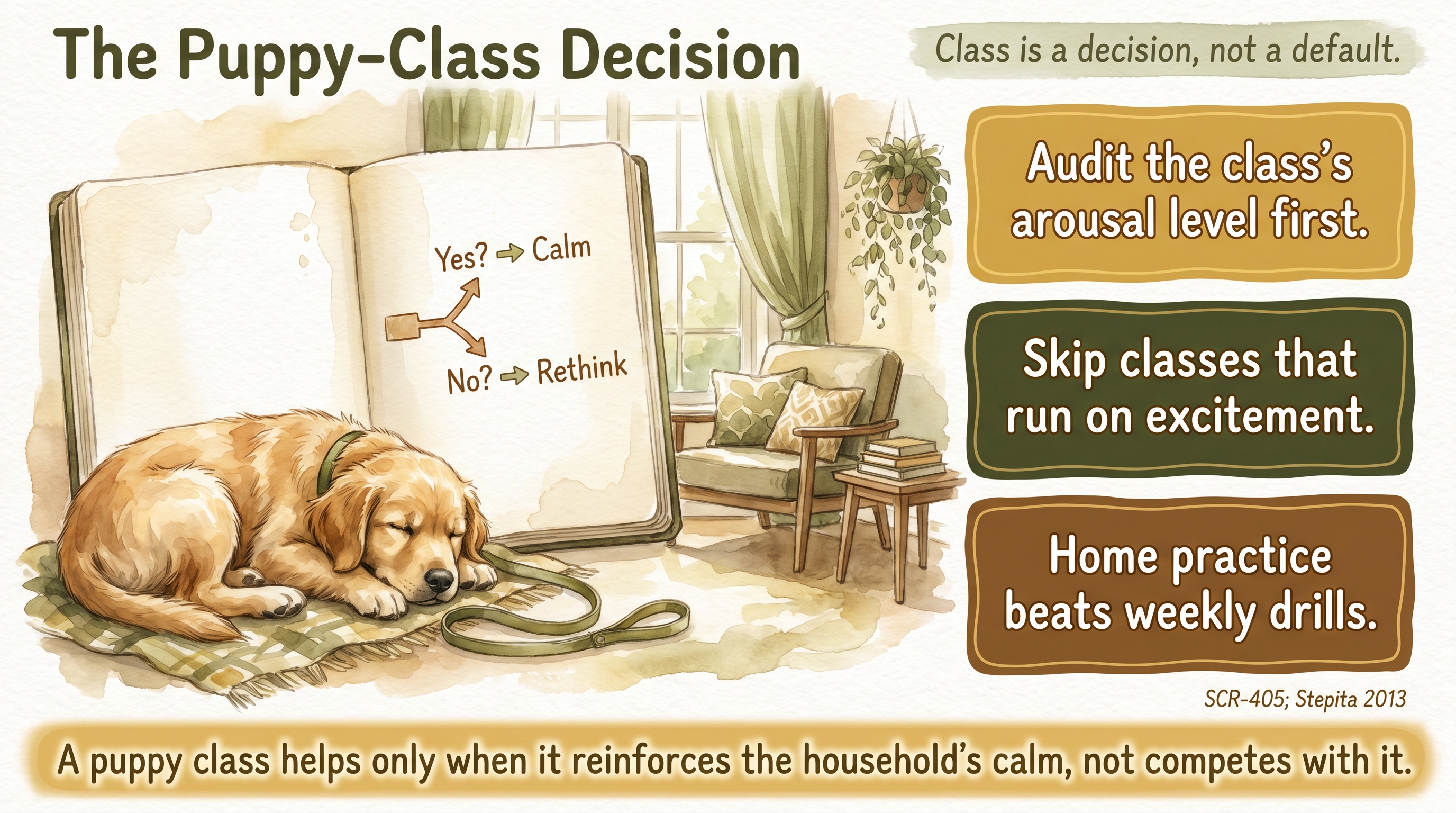
A puppy class helps only when it reinforces the household's calm, not competes with it.
Key Takeaways
- Early socialization matters, but standard puppy class is not automatically the right form for it in the first month.
- Many common classes combine novelty, peer arousal, and performance pressure in ways that conflict with the calm floor.
- A carefully structured low-arousal class can be useful, but waiting is often wiser than enrolling simply because everyone expects it.
- The family is already socializing the puppy at home when it provides calm exposure, curated dog contact, and readable routines.
The Evidence
This entry uses mixed-evidence claim-level tags beyond the dedicated EvidenceBlocks below. These tags mark claims that combine documented findings with observed practice, heuristic application, or unresolved gaps.
- Vaterlaws-Whiteside & Hartmann (2017); Stolzlechner et al. (2022); Howell et al. (2015); Freedman et al. (1961)domestic dogs
Early exposure to people, places, and manageable novelty matters developmentally, but the literature does not require high-arousal class environments as the only or ideal means of providing that exposure.
- JB audit position on common classesmodern companion-dog culture
Puppy class is not a unitary intervention. Calm observational classes and stimulating cue-and-play classes may have very different practical effects on a puppy still in transition.
- JB family-coaching observationfamily-raised puppies
Standard first-month puppy classes commonly destabilize the calm floor, while waiting or choosing a deliberately low-arousal class usually fits the transition better.
No published study has directly compared behavioral outcomes of first-month puppy class attendance versus delayed or home-based socialization in a controlled design. The current position relies on developmental science, clinical observation, and cross-species inference.
SCR References
Sources
- Vaterlaws-Whiteside, H., & Hartmann, A. (2017). Improving puppy behavior using a new standardized socialization program. Applied Animal Behaviour Science, 197, 55-61.
- Stolzlechner, L., Bonorand, A., & Riemer, S. (2022). Optimising Puppy Socialisation-Short- and Long-Term Effects of a Training Programme during the Early Socialisation Period. Animals, 12(22), 3067. https://doi.org/10.3390/ani12223067
- Howell, T. J., King, T., & Bennett, P. C. (2015). Puppy parties and beyond: The role of early age socialization practices on adult dog behavior. Veterinary Medicine: Research and Reports, 6, 143-153. https://doi.org/10.2147/VMRR.S62081
- Freedman, D. G., King, J. A., & Elliot, O. (1961). Critical period in the social development of dogs. Science, 133(3457), 1016-1017.