First Novel Environments
The first month should include new places, but it should not turn into a campaign of constant novelty. JB wants the puppy to meet unfamiliar environments the way it meets everything else in the transition: in small, readable doses that leave room for processing and recovery. The point is not to rack up impressive numbers. The point is to teach the nervous system that new places can be approached with curiosity rather than with overwhelm. Observed-JB
What It Means
Environmental exposure matters.
What JB resists is the idea that exposure only counts when it is frequent, intense, and checklist-driven.
In the first month, a good novel-environment plan is often modest: a different stretch of sidewalk, a quiet porch at a relative's house, a park bench during a low-traffic hour, and the edge of a store entrance without going fully inside. Observed-JB
Those are not tiny accomplishments.
They are exactly the scale a young puppy can often absorb well.
Quality Beats Quantity
Families sometimes feel pressure to make the puppy see everything quickly.
That pressure usually comes from a real concern: the socialization window is limited, early experience matters, and missed opportunities matter too.
All of that is true.
What does not follow is the conclusion that more is always better.
A puppy who sees six places calmly may be learning far more than a puppy who sees thirty places while tired, hungry, carried from event to event, and repeatedly pushed past its threshold. Observed-JB
Observation Counts as Exposure
One of the most helpful corrections here is simple:
the puppy does not need to touch, greet, enter, or fully investigate everything it sees.
Often the best exposure is: arrive, pause, look around, sniff a little, and leave while the puppy is still composed.
That still teaches the brain something important.
It teaches that novelty can exist without demanding immediate immersion.
The Checklist Problem
This is where JB parts company with the wider culture most clearly. Families often encounter socialization checklists urging them to show the puppy a huge number of people, objects, surfaces, and locations before a deadline. Observed-JB The intention is usually good. The risk is that the checklist quietly shifts the family's attention away from the puppy's actual state.
The family stops asking: is the puppy still curious, is the puppy still soft in the body, and is recovery still quick. Observed-JB
and starts asking: what else have we not checked off yet.
That is a dangerous trade.
The puppy is not a project manager. It does not care how complete the spreadsheet looks.
It cares whether the world is arriving in doses it can metabolize.
Follow Exposure With Rest
This matters more than families expect.
A new environment is not over when the family gets home. The nervous system is still sorting what it just experienced. That is why first-month exposure should nearly always be followed by a protected calm period: a nap, quiet time in the bedroom, and a low-key meal and then rest.
If the family stacks one outing on top of another, it loses the very benefit it was trying to create.
Why It Matters for Your Dog
Novel environments matter because they shape the dog's basic orientation to the world. A puppy that keeps meeting new places at a manageable tempo begins to carry a simple expectation forward: unfamiliar does not automatically mean unsafe, and unfamiliar does not automatically mean exciting either.
That middle ground matters.
Confident dogs are not always the dogs who saw the greatest number of things the fastest.
They are often the dogs who learned: I can look before I act, I can pause before I rush forward, and I can recover after something new.
That is the real developmental win.
This page also protects families from underestimating how powerful ordinary exposures can be. A different driveway, a different patch of grass, or a different set of sounds in the distance may not feel dramatic to the human, but to a puppy in the first month they can be enough.
The goal is not to make novelty disappear.
The goal is to make novelty readable.
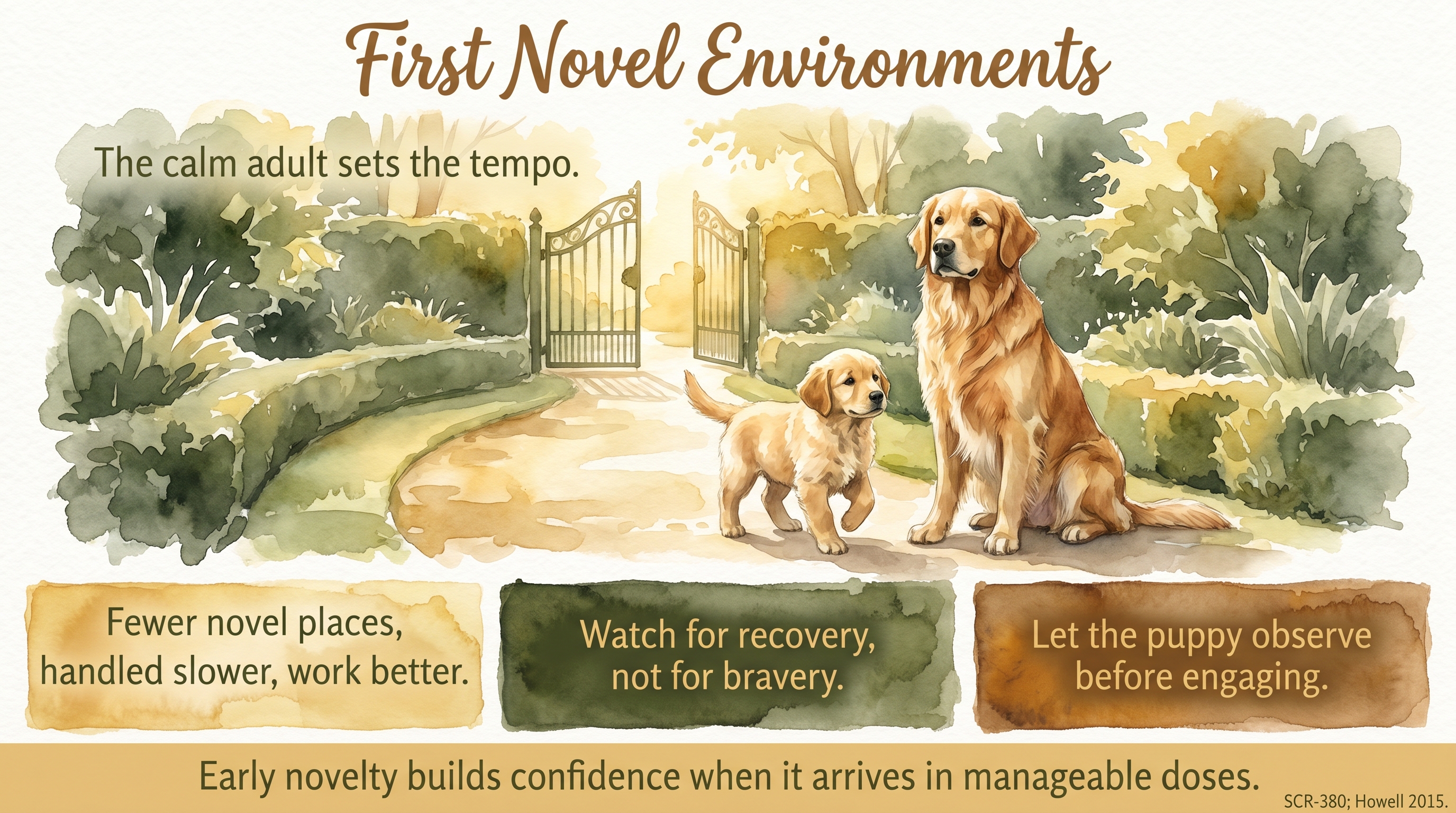
Early novelty builds confidence when it arrives in manageable doses.
Key Takeaways
- The first month should include new places, but those places should be introduced in small, calm doses rather than as a novelty campaign.
- A puppy does not need to fully engage every environment for the exposure to count; calm observation is still meaningful learning.
- The socialization window supports early experience, but quality matters more than raw quantity.
- Rest after a new environment is part of the exposure plan because recovery helps the puppy consolidate what it just experienced.
The Evidence
- Freedman et al. (1961); Scott & Fuller (1965); Morrow et al. (2015); Rankin et al. (2009)domestic dogs
Early controlled environmental exposure during the socialization window has outsized developmental value, even though learning remains possible after the window narrows. - Freedman et al. (1961); Scott & Fuller (1965); Morrow et al. (2015); Rankin et al. (2009)domestic dogs
Repeated low-intensity exposure can reduce reactivity to ordinary environmental stimuli when the exposures occur in forms the animal can actually absorb.
- JB transition observationfamily-raised puppies
Checklist-driven novelty campaigns often produce more arousal and less real confidence than a small number of calm, well-spaced environmental exposures followed by rest.
No published study directly tests the specific Just Behaving guidance on first novel environments within a breeder-to-family transition, so this entry relies on broader canine evidence, breeder observation, and practical synthesis rather than a direct trial of the full protocol.
SCR References
Sources
- Freedman, D. G., King, J. A., & Elliot, O. (1961). Critical period in the social development of dogs. Science, 133(3457), 1016-1017.
- Scott, J. P., & Fuller, J. L. (1965). Genetics and the Social Behavior of the Dog. University of Chicago Press.
- Morrow, M., Ottobre, J. S., Ottobre, A. C., Neville, P., St-Pierre, N., Dreschel, N. A., & Pate, J. L. (2015). Breed-dependent differences in the onset of fear-related avoidance behavior in puppies. Journal of Veterinary Behavior, 10(4), 286-294. https://doi.org/10.1016/j.jveb.2015.03.002
- Rankin, C. H., Abrams, T., Barry, R. J., et al. (2009). Habituation revisited: An updated and revised description of the behavioral characteristics of habituation. Neurobiology of Learning and Memory, 92(2), 135-138.