Parasympathetic Tone as the First-Week Baseline
Compound evidence detail1 SCR / 2 parts
- Documentedcanine and comparative-mammalian autonomic regulation research, and the physiology of parasympathetic dominance as the recovery-and-rest state
- Heuristicpositioning of parasympathetic tone as the operational baseline target during the puppy's first week in the family home
The first week home can be read, at least partly, as a question of baseline. Will the puppy spend most of the week in repeated sympathetic activation punctuated by exhausted sleep, or will the puppy spend most of the week in a more regulated parasympathetic baseline interrupted only briefly by novelty, play, and ordinary activation? JB aims for the second pattern as a practical household target. That does not mean the puppy should never become excited. It means excitement should be a brief excursion from calm, not the primary climate of the homecoming. The autonomic science beneath this is partly direct in dogs and partly drawn from humans and other mammals. The strongest direct first-week household claim remains heuristic, and that boundary matters. Mixed Evidence
What It Means
The autonomic nervous system gives useful language to a process families can already see.
Sympathetic dominance looks like: body tightness, fast breathing, jumpy movement, wide, scanning eyes, poor settling, and jerky bursts of approach and avoidance. Mixed Evidence
Parasympathetic dominance looks more like: softer body, slower breathing, easier lying down, smoother movement, soft eyes, and quicker return after brief arousal.
That does not mean the puppy is either "all one" or "all the other" every moment of the day. Healthy nervous systems move between states. The transition question is about which state the house is making easier to return to.
The Desired Pattern
JB wants the first week to look like this: quiet baseline, brief activation, and quick return.
The crash-landing pattern looks more like this: stimulation, more stimulation, overtired escalation, collapse, and repeat.
These are not only behavioral differences. They are different regulatory patterns.
What the Science Can Support
There is direct dog evidence that autonomic patterns vary meaningfully with behavioral state. Heart-rate variability work in dogs shows that calmer resting states and more activated states can be differentiated physiologically. There is also dog evidence that stress, arousal, and learning interact in important ways, and that lower-arousal cooperative contexts often support better welfare and clearer task performance than high-conflict, high-stress ones.
Across humans, rodents, primates, and other social mammals, the broader claim that parasympathetic regulation supports calmer social engagement and recovery is strong, even where some specific frameworks in the public conversation are debated. Documented-Cross-Species
Where the evidence becomes more interpretive is in the exact first-week homecoming application: no study directly measures JB's soft-landing week against a high-excitement week and tracks autonomic recovery as the main outcome. Heuristic
That is why this page must stay careful. The mechanism language is serious. The household implementation is still a JB heuristic.
Why Baseline Is the Real Question
Families often think the issue is whether a puppy is allowed to become excited.
That is too narrow.
The real issue is where the puppy starts and where the puppy returns.
A puppy can: play, explore, meet something new, and get briefly activated.
and still live inside a generally parasympathetic week if the house consistently guides the puppy back down afterward.
The problem begins when activation becomes the baseline and rest becomes the rare interruption.
That inversion is common in modern homes: loud greetings, constant handling, repeated novelty, overtired evenings, and sleep fragmentation.
Then the family wonders why the puppy cannot settle. Often the puppy is not refusing calm. The puppy has simply not been given enough calm to organize around.
How Families Can Read State Without Gadgets
Families do not need a heart-rate monitor to use this page.
They can look for state markers.
Markers closer to parasympathetic recovery: soft eyes, loose mouth, slower breathing, voluntary lying down, soft blinking, choosing proximity without frantic contact, and easy disengagement after brief curiosity.
Markers closer to sympathetic escalation: hard or very wide eyes, tight mouth, rapid shallow breathing, body held high and tight, jerky fast movement, repeated re-launching after interruption, and inability to stay down.
No single marker is magic. Families are looking for patterns, not one perfect sign.
What a Crash Landing Looks Like Physiologically
The crash-landing pattern is easy to recognize once you know what you are seeing.
The puppy is not merely active. The puppy rarely comes down.
There is: excited wake-up, stimulated meals, too much social pressure, repeated evening over-arousal, irregular naps, and sleep only after exhaustion.
Then the family says the puppy has so much energy.
Sometimes the more accurate statement is that the puppy has very little organized recovery.
This matters because the household may accidentally celebrate the wrong state. High activation can look vivid and emotionally rewarding to humans. But a puppy who lives there too much is paying a cost: poorer settling, less clean learning, more mouthiness, and less flexible coping.
Why the First Week Is the Right Time to Set the Baseline
The first week is not the only time autonomic patterning matters, but it is one of the cleanest times to establish what the household is aiming for.
If the puppy begins life in this family with: quiet greetings, protected naps, predictable meals, gentle handling, low evening stimulation, and proximity-supported sleep.
then the puppy starts with repeated practice returning to calm.
That matters enormously in the long arc because later stressors will still come: adolescence, visitors, travel, and busy holidays.
The dog that has practiced return-to-baseline from the first week has something to return to.
Why This Is Not a Claim About Never Activating the Dog
JB must say this clearly because the calmness argument is often caricatured.
The puppy does not need to live like a sedated object.
Activation belongs in life.
What JB opposes is not activation itself. It opposes using activation as the household's default language. The puppy should meet novelty from a stable floor, not live permanently in the climb.
Why It Matters for Your Dog
This page matters because it gives the family a clearer target than "be nice" or "keep the puppy calm." Those phrases are too vague to guide real first-week decisions.
Parasympathetic-baseline thinking asks a better question: Is what we are doing helping the puppy come back down?
The first week should be organized around a calm baseline with brief, recoverable activations. If excitement becomes the background and sleep becomes the only recovery, the household is building the wrong physiology from the start.
In practice, that one question should change: how greetings happen, how evenings happen, how naps are protected, how many introductions happen in a day, and how adults read "good behavior" versus shutdown or fatigue. Heuristic
It also lowers shame because it gives families something practical to observe. The puppy does not need to be perfect. The puppy only needs to keep finding its way back.
That is the whole principle. Not zero activation. Reliable return.
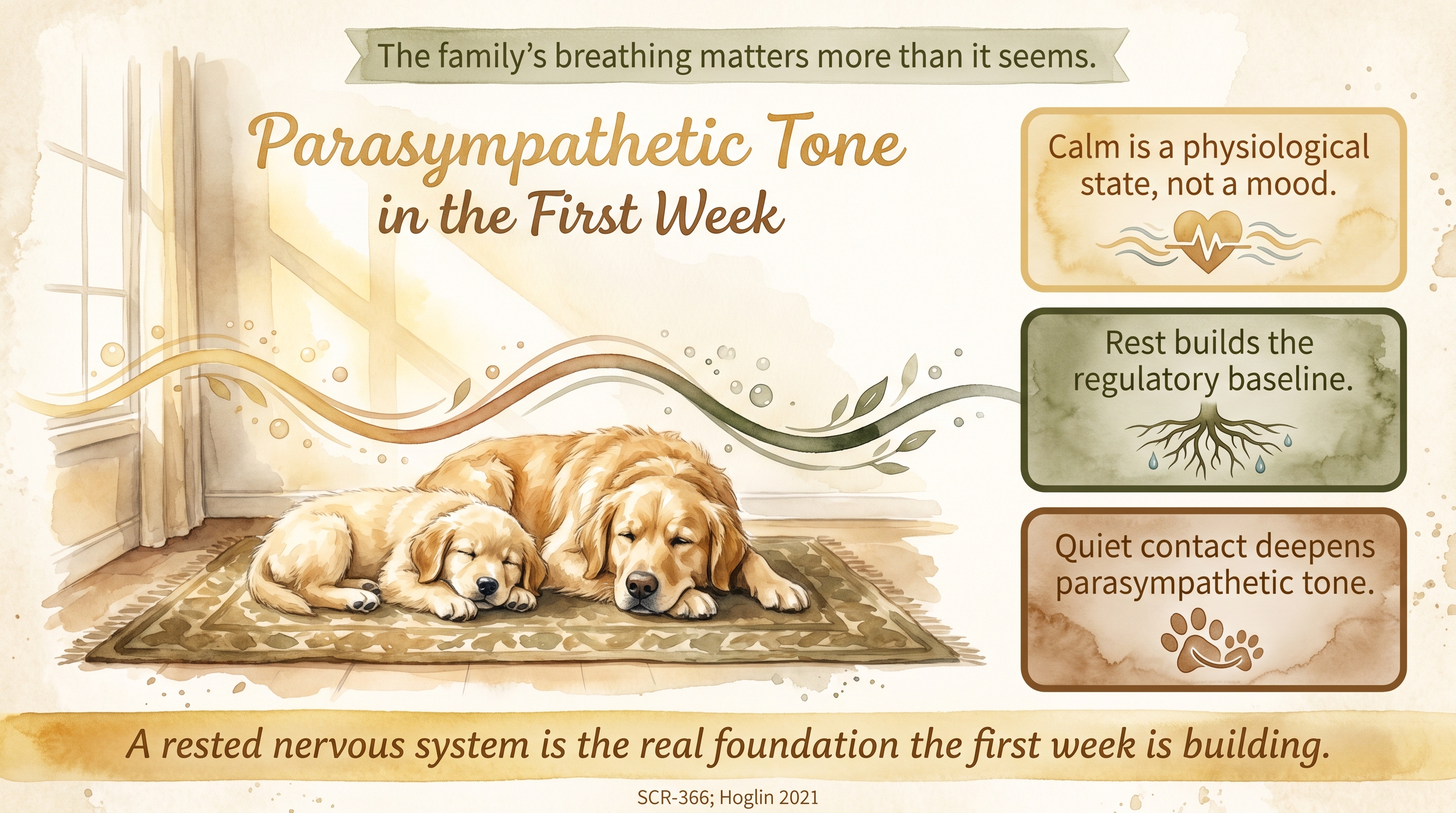
A rested nervous system is the real foundation the first week is building.
Key Takeaways
- The most important first-week physiological question is not whether the puppy ever gets excited but whether the puppy has a calm baseline to return to.
- Families can often read state with ordinary observation by watching breathing, body softness, eye quality, movement, and settling behavior.
- A crash landing happens when activation becomes the household's default and sleep becomes the only recovery mechanism left.
- The autonomic science underneath this page is real, but the exact JB first-week application still needs to be presented as heuristic rather than as a directly tested puppy intervention.
The Evidence
This entry uses mixed-evidence claim-level tags beyond the dedicated EvidenceBlocks below. These tags mark claims that combine documented findings with observed practice, heuristic application, or unresolved gaps.
- Thayer & Lane (2000); Thayer & Sternberg (2006); Hennessy et al. (2009); Hostinar et al. (2013)humans, rodents, primates, and other social mammals
Parasympathetic regulation is associated with calmer social engagement and more efficient recovery after activation, even though different mechanistic frameworks in the public conversation should not be treated as interchangeable.
- Zupan et al. (2016); Sundman et al. (2019); Hoglin et al. (2021)domestic dogs
Heart-rate variability and other physiological markers shift with behavioral state in dogs, supporting the claim that resting and activated states are physiologically distinguishable rather than merely interpretive. - Bray et al. (2015); Affenzeller et al. (2017, 2020); Kis et al. (2017)domestic dogs
High-arousal and stress-linked contexts are associated with poorer welfare and less clean cognitive performance than lower-arousal, more cooperative contexts.
- JB synthesisnewly placed family puppies
The claim that the first week should be organized around a predominantly parasympathetic baseline with brief activations and repeated recovery is a serious physiological heuristic, not a directly trialed homecoming protocol.
No published study directly tests the specific Just Behaving guidance on parasympathetic tone as the first-week baseline within a breeder-to-family transition, so this entry relies on broader canine evidence, breeder observation, and practical synthesis rather than a direct trial of the full protocol.
SCR References
Sources
- Thayer, J. F., & Lane, R. D. (2000). A model of neurovisceral integration in emotion regulation and dysregulation. Journal of Affective Disorders, 61(3), 201-216.
- Thayer, J. F., & Sternberg, E. (2006). Beyond heart rate variability: vagal regulation of allostatic systems. Annals of the New York Academy of Sciences, 1088, 361-372.
- Hennessy, M. B., Kaiser, S., and Sachser, N. (2009). Social buffering of the stress response: Diversity, mechanisms, and functions. Frontiers in Neuroendocrinology, 30(4), 470-482. https://doi.org/10.1016/j.yfrne.2009.06.001
- Hostinar, C. E., Sullivan, R. M., & Gunnar, M. R. (2013). Psychobiological mechanisms underlying the social buffering of the hypothalamic-pituitary-adrenocortical axis: A review of animal models and human studies across development. Psychological Bulletin, 140(1), 256-282. https://doi.org/10.1037/a0032671
- Zupan, M., et al. (2016). Assessing positive emotional states in dogs using heart rate and heart rate variability. Physiology & Behavior.
- Sundman, A.-S., Van Poucke, E., Svensson Holm, A.-C., Faresjo, A., Theodorsson, E., Jensen, P., & Roth, L. S. V. (2019). Long-term stress levels are synchronized in dogs and their owners. Scientific Reports, 9, 7391. https://doi.org/10.1038/s41598-019-43851-x
- Hoglin, A., Van Poucke, E., Katajamaa, R., Jensen, P., Theodorsson, E., & Roth, L. S. V. (2021). Long-term stress in dogs is related to the human-dog relationship and personality traits. Scientific Reports, 11, 8612. https://doi.org/10.1038/s41598-021-88201-y
- Bray, E. E., MacLean, E. L., & Hare, B. A. (2015). Increasing arousal enhances inhibitory control in calm but not excitable dogs. Animal Cognition, 18(6), 1317-1329.
- Affenzeller, N., Palme, R., & Zulch, H. (2017). Playful activity post-learning improves training performance in Labrador Retriever dogs (Canis lupus familiaris). Physiology & Behavior, 168, 62-73. https://doi.org/10.1016/j.physbeh.2016.10.014
- Affenzeller, N. (2020). Dog-Human Play, but Not Resting Post-Learning Improve Re-Training Performance up to One Year after Initial Task Acquisition in Labrador Retriever Dogs: A Follow-On Study. Animals, 10(7), 1235. https://doi.org/10.3390/ani10071235
- Kis, A., Szakadat, S., Gacsi, M., Kovacs, E., Simor, P., Torok, C., Gombos, F., Bodizs, R., & Topal, J. (2017). The interrelated effect of sleep and learning in dogs (Canis familiaris); an EEG and behavioural study. Scientific Reports, 7, 41873.