Heart Rate Variability as a Stress Marker in Dogs
Compound evidence detail1 SCR / 2 parts
- Documentedthe cross-species behavioral principle that parasympathetic-dominant autonomic states support social engagement, with direct canine HRV evidence (Berg 2026, Wormald 2017, Koskela 2024)
- Ambiguousthe polyvagal-theory-specific neuroanatomical mechanism, with the Grossman 2026 critique and Porges 2026 rebuttal active in current literature
Heart rate variability, usually abbreviated HRV, is the beat-to-beat variation in the interval between heartbeats. In stress science, that variation is useful because it reflects how flexibly the autonomic nervous system is regulating the heart. In dogs, HRV is one of the better non-invasive markers of short-timescale regulatory state, especially when compared with slower endocrine markers such as cortisol. Documented
What It Means
What HRV Indicates
High HRV generally reflects stronger parasympathetic influence and better regulatory flexibility. Low HRV generally reflects sympathetic dominance, vagal withdrawal, or reduced flexibility. The point is not that the heart becomes random. The point is that a healthy regulatory system shows dynamic variation rather than rigid uniformity.
This is one reason HRV is so useful in behavioral work. It changes on the scale of seconds to minutes, which makes it well suited to interaction, recovery, and co-regulation questions. Documented
Why Researchers Like HRV
Compared with cortisol, HRV has clear advantages: it changes quickly, can be measured continuously, does not require blood draw or saliva handling, and can capture recovery dynamics in real time. Documented That does not make it perfect. HRV is still influenced by posture, respiration, activity level, artifact, and analytical choices. It is best used as a carefully interpreted physiological signal, not as a magical direct readout of "calmness."
Why It Matters for Your Dog
The Canine Evidence
SCR-013 captures the core conclusion: parasympathetic-dominant autonomic states support social engagement, regulation, and learning capacity. In dogs, HRV is one of the main tools used to observe that state.
The major caution bundled into SCR-013 is theoretical. The broader behavioral principle is strong. The specific polyvagal-theory neuroanatomy often attached to it is more contested. That means downstream writing should not depend on accepting every Porges claim in order to say something solid about HRV. The safer interpretation is through broader autonomic and neurovisceral-integration frameworks. In practical scientific terms, HRV can show that a dog is shifting into more or less flexible autonomic regulation. Documented That is already valuable without any theoretical overreach.
HRV and Dyadic Work
SCR-106 adds a second important piece: HRV coupling in dog-and-human pairs is dyad-specific. Koskela and colleagues found that HRV correlation appeared in real dog-and-human dyads but disappeared when dogs were paired with unfamiliar humans. Documented
That makes HRV especially useful in co-regulation research. Documented It does not only tell us something about the dog's current state. It can also show whether the dog's physiology is moving with the physiology of a specific caregiver.
HRV Is Not a Standalone Verdict
As with cortisol, HRV becomes strongest when used carefully and in context. It should not be treated as a single universal "calm score," proof of a specific emotional label, or a substitute for behavior and context. It is a fast-timescale window into autonomic regulation. That is enough.
The pillar language often talks about parasympathetic tone as the calm floor. This page stays closer to measurement: HRV is one of the best available non-invasive markers of that regulatory side of the autonomic system in dogs, even though broader theory debates remain open.
No published study has directly measured whether JB-style calm environments produce measurably higher HRV or better parasympathetic regulation in puppies compared to standard or high-stimulation environments.
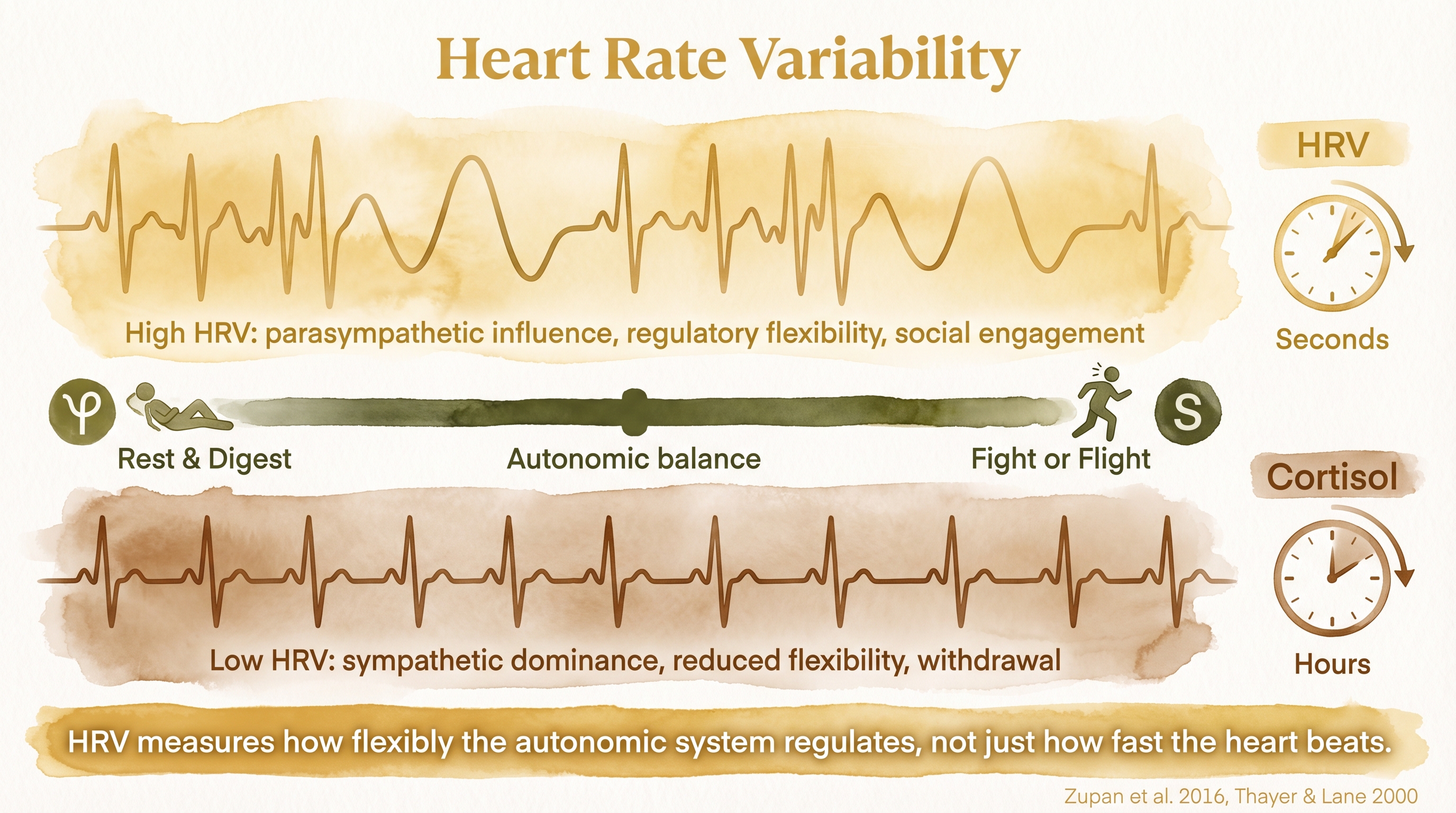
Higher HRV reflects parasympathetic dominance and emotional flexibility - a real-time window into autonomic regulation.
Key Takeaways
- HRV reflects beat-to-beat autonomic flexibility rather than simple average heart rate.
- In dogs, it is one of the better non-invasive short-timescale markers of regulatory state.
- HRV is especially useful when researchers care about moment-to-moment interaction and recovery rather than slow endocrine change.
- The marker is strong even if one remains cautious about broader polyvagal-theory claims.
The Evidence
- Zupan, M. et al. (2016)domestic dogs
Applied HRV analysis to canine emotional-state research and supported its usefulness in assessing positive and regulated states. - Koskela, A. et al. (2024)domestic dogs
Showed that dog-and-human HRV coupling appears in true dyads and disappears with random unfamiliar humans. - Synchrony source synthesisdomestic dogs
HRV changes fast enough to capture baseline, interaction, and recovery dynamics that slower cortisol measures can miss.
- Thayer, J. F., & Lane, R. D. (2000)humans
Linked HRV with self-regulation and central autonomic control through neurovisceral integration rather than relying only on polyvagal framing. - Thayer, J. F., & Sternberg, E. (2006)humans
Framed vagal regulation as important across multiple allostatic systems.
- SCR-013 boundarydomestic dogs
The behavioral principle that parasympathetic regulation supports social engagement is well supported. The more specific polyvagal neuroanatomy often attached to that claim is more contested.
SCR References
Sources
- Koskela, A., et al. (2024). Behavioral and emotional co-modulation during dog-and-human interaction measured by heart rate variability and activity. Scientific Reports.
- Thayer, J. F., & Lane, R. D. (2000). A model of neurovisceral integration in emotion regulation and dysregulation. Journal of Affective Disorders, 61(3), 201-216.
- Thayer, J. F., & Sternberg, E. (2006). Beyond heart rate variability: vagal regulation of allostatic systems. Annals of the New York Academy of Sciences, 1088, 361-372.
- Zupan, M., et al. (2016). Assessing positive emotional states in dogs using heart rate and heart rate variability. Physiology & Behavior.avi