Puppy Feeding Frequency and Schedule
Compound evidence detail2 SCRs / 5 parts
- Documentedpuppy physiology and condition-scoring evidence supporting multiple smaller meals in young dogs and adjustment by growth, appetite, stool quality, and observed condition
- Heuristicthe conventional four-to-three-to-two meal-count progression, treated as practical scheduling rather than a trial-validated developmental protocol
- Observed-JBJB program observation that predictable mealtimes support elimination rhythm and household regulation during the transition-home period
- Documentedthe canonical canine emergency red flags - unproductive retching with abdominal distention (possible GDV), collapse or pale gums (possible internal hemorrhage, hypovolemia, or cardiac disease), repeated vomiting with inability to retain water, suspected toxin ingestion, difficulty breathing or cyanosis, prolonged or cluster seizures, severe trauma, acute limb-use loss, inability to urinate, and heatstroke - each linked in canine emergency-medicine reference texts to a critical underlying problem warranting prompt veterinary evaluation rather than watchful waiting
- Observed-JBthe documented reduction in time-to-care that comes from family preparation in advance - knowing the nearest emergency hospital, a backup hospital, and a poison control number - recognized across emergency-medicine practice but not quantified in a published controlled outcome trial
Meal frequency in puppyhood is one of those topics where the biology is real, the everyday recommendation is practical, and the exact schedule is not backed by a giant randomized-trial literature. That means families should treat feeding frequency as disciplined stewardship rather than as an immutable law. The schedule exists to fit the physiology of a growing puppy and to make body-condition management easier, not to create household superstition. Mixed Evidence
What It Means
Young puppies differ from adult dogs in a few important ways: their stomach capacity is smaller, their energy need per kilogram is higher, their day-to-day intake tolerance is narrower, and their routine stability matters more during transition.
These features are why puppies are usually fed in multiple meals rather than one or two large meals.
There is a regulation benefit here too. Multiple meals make it easier to keep energy delivery steady across the day rather than asking a young puppy to handle long fasting windows followed by very large intake events. Puppies are not miniature adults with adult reserve. They are growing animals with a narrower tolerance for sloppy routine.
The Practical Pattern
The most common stewardship schedule looks like this: about 4 meals per day from weaning to roughly 12 weeks, about 3 meals per day from roughly 12 weeks to around 6 months, and about 2 meals per day from around 6 months onward. Estimated
That progression is not magic. It is a practical response to a puppy who gradually develops more capacity, more reserve, and a more adult-like daily rhythm.
It is also worth naming that the schedule is a practical recommendation rather than a result from giant randomized trials. The biology supports smaller, more frequent meals in young puppies. The exact calendar cutoffs are husbandry guidance built on that physiology rather than a rigid evidence hierarchy.
That is why the page keeps its mixed evidence level. The underlying physiology is solid. The precise calendar transitions are still practical stewardship choices. A puppy who needs an extra week on three meals has not violated science. A family who drops from four meals to three around twelve weeks is not being arbitrary. The schedule is a management tool, not a ritual.
The commonly used sequence can be written even more concretely: before 12 weeks means four smaller meals, from 12 weeks to about 6 months means three meals, and after about 6 months means two meals. Estimated
This is the version many families can actually live with, and it aligns well with the broad developmental logic even though the exact boundaries are not trial-locked.
Why Smaller Meals Help
Smaller meals reduce the burden of asking one sitting to do too much. They help by matching gastric capacity better, smoothing total daily intake, making portion control easier, and reducing the temptation to overfeed one oversized meal.
This is especially helpful in the first weeks after a puppy comes home, when the environment has already changed dramatically.
It also makes total daily intake easier to spread across the day without huge post-meal swings in fullness or energy demand. That matters more in puppies than in adults because their reserve is smaller and their growth demand is higher.
There is also a behavior-management advantage. A puppy receiving several predictable meals each day is easier to observe and easier to settle into a routine around naps, elimination, and activity. That does not turn food into a behavior tool in the simplistic sense. It means the puppy's day gains rhythm, and rhythm is biologically stabilizing during developmental change.
This is one reason meal timing belongs in the same conversation as the rest of the JB transition framework. Regular meals help the puppy's body predict what is coming. Predictability is part of calmness.
Schedule Supports Observation
Scheduled feeding also lets families observe appetite, stool quality, and daily consistency more clearly. With free-feeding, it becomes much harder to know how much the puppy actually ate, whether appetite changed, whether treats displaced the meal, or how to adjust if body condition starts drifting.
This is one reason scheduled meals are usually the better evidence-informed default even if the exact number of meals is partly heuristic.
Free-feeding sounds convenient, but it removes too much information from the family. A puppy grazing from a bowl all day makes it hard to know whether the dog is eating less, eating more, getting picky, or drifting into excess condition. Scheduled feeding makes those changes visible much sooner.
Scheduled feeding also helps when families are trying to keep treats in proportion. In a free-fed puppy, it is easy for training treats, chews, and household extras to blur into the total daily intake without anyone recognizing it. When meals are measured, any added calories become easier to notice and easier to adjust for.
This matters especially for food-motivated breeds. Retrievers often make families feel as though they are perpetually underfed. That is a feature of retriever appetite style, not a reliable instruction to increase the bowl.
The Golden Retriever Context
Goldens are not fragile around ordinary feeding schedules, but they do benefit from routine and measured intake. In the long term, retriever households also need to think about avoiding the general pattern of oversized meals and chronic overfeeding that contributes to later weight gain.
The puppy schedule does not directly "prevent GDV" in a simple proven way, but a lifelong habit of measured meals instead of chaotic feeding fits the broader risk-reduction posture better than feast-style feeding. Documented
That note matters because Golden Retrievers are one of the breeds families worry about in the gastric-dilatation-and-volvulus conversation. No honest page should pretend that an early puppy feeding schedule by itself prevents GDV. But the broader adult habit of feeding at least twice daily rather than one giant meal fits the general risk-reduction posture better than feast-style management. Documented
That distinction between prudent pattern and proven single-cause prevention matters. There is no high-quality randomized trial assigning Golden Retrievers to one-meal versus two-meal lifelong plans and settling the GDV question cleanly. What we do have is a sensible risk-reduction posture: avoid giant bolus feeding, keep meals measured, and favor a twice-daily-or-more rhythm rather than normalizing one huge daily intake event.
That makes the puppy schedule relevant beyond puppyhood. The exact meal count changes, but the habit of structured, measured feeding remains useful across life.
The JB Transition Logic
The first days at home are not the time to improvise with feeding structure. The puppy is already adapting to a new house, new people, loss of littermates, new sleep cues, and new sensory load. Keeping the same meal count and roughly the same timing during the early transition reduces one variable the puppy otherwise has to absorb.
That is a nutrition decision, but it is also a calmness decision.
This is one reason schedule changes should usually come after the puppy has settled rather than on day one. Families often want to normalize the puppy instantly to the household routine. The softer and usually safer approach is to hold continuity first and change later.
This connects directly to the breeder-to-home transition page. If the breeder has been feeding at predictable intervals, the new home should usually preserve that cadence first. The more variables that stay familiar, the easier it is to interpret appetite, stool quality, and general adjustment honestly.
In practice, that means a family does not need to pick up the puppy on Saturday and decide that Monday is the day the puppy learns a totally new meal pattern because it better matches office hours. The body usually handles continuity better than abrupt convenience.
Why It Matters for Your Dog
Families often ask whether they can move their puppy quickly onto a schedule that is more convenient for the household. The honest answer is yes, eventually, but convenience should not be the first organizing principle during the earliest developmental and transition window.
That answer also helps families tolerate the ambiguity honestly. The evidence level here stays mixed because the exact schedule is not a deeply trial-proven protocol. Ambiguous But the physiologic rationale, the management benefits, and the transition logic are all strong enough to support the recommendation.
This page matters because feeding schedule is one of the easiest places for caring people to create preventable noise. A puppy who seems ravenous at noon may not need more total food. The puppy may need the same daily intake divided more intelligently. A puppy who leaves part of breakfast during the first days home may not need an immediate food overhaul. The puppy may need a calmer routine and time to settle.
The schedule therefore becomes part of nutritional literacy. Families stop asking only "How much should I feed?" and start asking "How should the total intake be organized across the day so the puppy can handle it well?"
Soft landing in nutrition means preserving as much continuity as possible while the puppy is absorbing a major life change. Meal timing is part of that continuity. It is one of the easier ways to reduce avoidable stress load in the first two weeks home.
When to See a Veterinarian
Seek veterinary care urgently if a puppy has repeated vomiting, a swollen or painful abdomen, collapse or marked lethargy, weakness after eating, ongoing refusal of meals, or diarrhea severe enough to affect hydration. Meal scheduling questions are routine. Acute abdominal distress is not.
That warning is especially important in a breed family that will hear about bloat and abdominal emergencies over and over again. Most ordinary questions about whether to move from four meals to three are not emergencies. A suddenly painful, distended, retching, or collapsed puppy is a different category entirely and should be treated as urgent.
Young puppies benefit from rhythm at a stage when a lot of other things still feel new. Predictable meals help organize the day, make appetite easier to interpret, and fit better with a body that is still handling growth with relatively small reserve.
That is why schedule matters even when the exact calendar edges remain flexible. The family is not serving the clock for its own sake. The family is using meal structure to fit puppy physiology and make observation cleaner.
An organized day often supports an organized gut. That is one reason meal timing matters beyond convenience. The puppy is easier to observe and usually easier to settle when feeding has rhythm.
In that sense, meal organization is part of transition stewardship as much as it is part of nutrition.
Meal rhythm is one of the easier forms of calm structure a family can give a young puppy.
Structure is part of what makes the puppy easier to read. That is why schedule belongs in the same conversation as appetite, stool quality, and transition stability.
Schedule gives the family better visibility, and visibility is one of the biggest practical strengths of structured feeding.
Structure makes observation easier, and observation makes feeding safer.
Meal rhythm is one of the easiest ways to reduce feeding noise during puppyhood.
A readable puppy is usually easier to feed well, and structure is part of what makes the puppy readable.
Rhythm remains one of the quiet strengths of the schedule.
That makes the schedule more useful than it first appears.
And that makes later feeding adjustments calmer too.
That is part of why the schedule works.
It keeps things legible.
Enough.
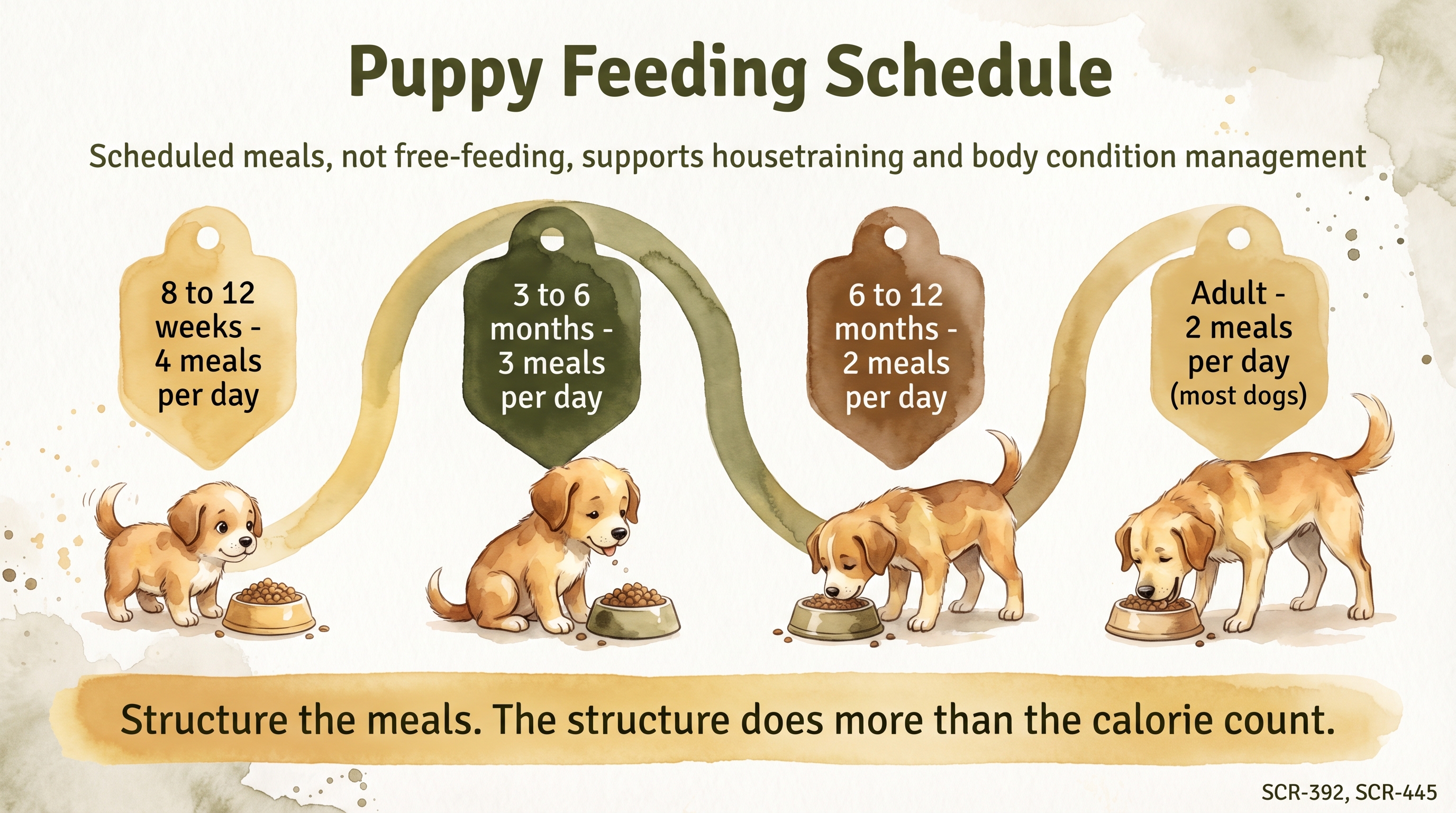
Structure the meals - the structure does more than the calorie count.
Key Takeaways
- Frequent small meals in early puppyhood fit the biology of a growing dog better than one or two large meals.
- Scheduled feeding is usually preferable to free-feeding because it makes portions, appetite, and body condition easier to manage.
- The exact meal-count timetable is practical and evidence-informed, but the physiology is stronger than the precise calendar cutoffs.
- During the first days at home, keeping the breeder meal rhythm intact is part of a softer nutritional landing for the puppy.
The Evidence
This entry uses estimated claim-level tags beyond the dedicated EvidenceBlocks below. These tags mark approximate ranges or timing claims that should remain bounded by the cited sources.
This entry uses ambiguous claim-level tags beyond the dedicated EvidenceBlocks below. These tags mark claims where the literature remains unsettled or multiple interpretations coexist.
This entry uses mixed-evidence claim-level tags beyond the dedicated EvidenceBlocks below. These tags mark claims that combine documented findings with observed practice, heuristic application, or unresolved gaps.
This is a good example of a mixed-evidence page that is still very useful. Young puppies really do have smaller gastric capacity and higher energy demand per kilogram. Scheduled feeding really does make monitoring easier. What is more heuristic is the exact timetable of 4 meals, then 3, then 2. The right family takeaway is not that the schedule is arbitrary. It is that the biology is stronger than the exact calendar line where one schedule becomes the next.
The strongest practical argument for the schedule is therefore cumulative. Physiology supports it. Observation supports it. Transition management supports it. The gap in the literature is not whether scheduled meals make sense. The gap is whether one precise calendar schedule has been proven superior to every nearby variation.
That is why the wording should stay disciplined. We can confidently recommend structured feeding. We should be looser about exact cutoffs and more attentive to the puppy in front of us. A 10-week-old puppy doing beautifully on four meals does not need to be rushed. A robust six-month-old who is thriving on three meals can move toward two when the family can still keep intake measured and the puppy's condition steady.
- Puppy nutrition source synthesispuppies
Young puppies have higher energy needs per kilogram and smaller gastric capacity than adults, which supports the practical use of more frequent meals early in life. - Veterinary stewardship source synthesispuppies
Scheduled feeding supports intake monitoring, stool monitoring, and body-condition management better than free-feeding in growing puppies.
- Operational puppy-feeding traditionpuppies
The exact 4-to-3-to-2 meal progression is a practical husbandry recommendation grounded in physiology and routine management rather than a tightly trial-validated superiority framework.
No published study directly tests the practical implications of puppy feeding frequency and schedule for domestic dog raising programs. The application to household dog raising remains an interpretive synthesis rather than a directly tested intervention finding.
SCR References
Sources
- National Research Council. (2006). Nutrient Requirements of Dogs and Cats. Washington, DC: The National Academies Press.
- AAFCO. (2024). Official Publication. Association of American Feed Control Officials.
- Nap, R. C., & Hazewinkel, H. A. W. (1994). Growth and skeletal development in the dog in relation to nutrition; a review. Veterinary Quarterly, 16(1), 50-59.
- Laflamme, D. P. (1997). Development and validation of a body condition score system for dogs. Canine Practice, 22(4), 10-15.
- WSAVA Global Nutrition Committee. (2011). WSAVA nutritional assessment guidelines. Journal of Small Animal Practice, 52(7), 385-396.