Introducing the Leash Calmly
The leash often enters puppy life carrying too much human agenda. Families buy it with walks, manners, pulling, and control already loaded into the object. JB starts somewhere quieter. In the first month, the leash should arrive as a neutral line between two calm bodies. Before it becomes associated with direction, distance, or public outings, it should first become ordinary. Observed-JB
What It Means
The month-one leash introduction is deliberately boring.
That is the success criterion.
The family is not yet trying to teach: heel, not pulling, formal leash manners, and cue-driven positioning.
It is teaching something simpler: collar and leash exist, they are not alarming, they do not predict a battle, and they do not instantly raise the whole household's energy.
Why Families Often Skip This Step
Adults understandably think the leash is for going outside.
So they wait.
Then the first time the leash matters, it appears: before a walk, before a car trip, and before a vet visit.
In other words, it appears right before something already stimulating.
That makes the leash feel bigger than it is.
The Better Sequence
JB likes a gradual progression: lightweight collar during quiet indoor time, collar plus leash dragging briefly in a supervised calm space, human holding the leash for a few indoor steps, and very short calm movement together before the first real walk. Observed-JB
This lets the puppy experience the leash before novelty, distance, and public exposure get layered on top of it. Observed-JB
Pressure Is the Wrong Opening Language
Families often begin with correction built in: tugging the puppy forward, tightening whenever the puppy hesitates, and using leash tension as immediate instruction. Observed-JB
That sets the wrong tone. The puppy has not even learned that the leash itself is neutral yet.
JB would rather the leash enter life without conflict, so that later guidance is built on familiarity rather than on early resistance. Observed-JB
Prevention Shows Up Here
This page belongs strongly to Prevention. A huge amount of future leash conflict can be reduced if the family avoids making the very first exposures aversive, over-corrective, or too stimulating.
That does not mean the leash will never later communicate boundary or direction.
It means the first association should be: ordinary, calm, and readable.
not: restraint, struggle, and excitement.
Why It Matters for Your Dog
The leash matters because it will become one of the dog's most repeated pieces of equipment. If it enters life attached to rush, tension, and emotional correction, that association can echo for a long time. If it enters life as a neutral feature of ordinary closeness with the human, later walking is built on better ground.
The first job of the leash is not to control the puppy. It is to become a neutral object inside a calm relationship. Prevention here means not turning a simple line into a problem before the puppy even knows what it is.
This page also protects families from trying to solve a future problem before the puppy has the developmental context to understand the task. Pulling, lagging, circling, and chewing can all look like leash issues when really the puppy has only been handed a strange object with too much meaning attached to it.
JB slows that down.
The leash first becomes ordinary.
Then the walk can become relational.
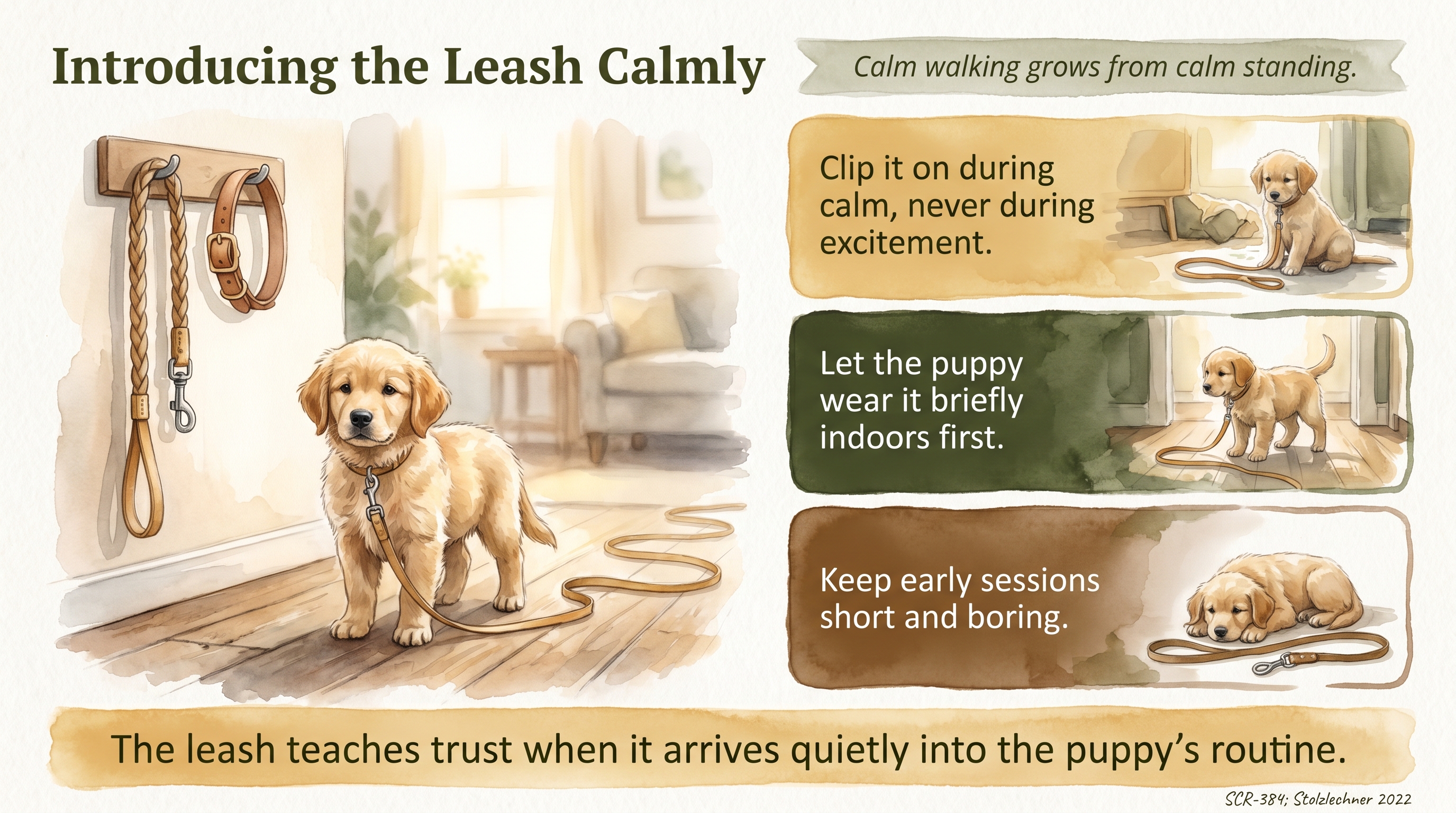
The leash teaches trust when it arrives quietly into the puppy's routine.
Key Takeaways
- The month-one leash should first become ordinary before it becomes associated with public walks, manners, or correction.
- Early indoor exposure in calm moments helps the puppy absorb the leash as neutral equipment rather than as a sudden source of pressure.
- Using tension and urgency too early can create conflict around the leash before the puppy even understands the object.
- A quieter leash introduction is a prevention strategy that makes later walking easier to build relationally.
The Evidence
- Bouton (2002, 2004); Gazit et al. (2005); Hall & Wynne (2016)domestic dogs
Early associations formed around equipment and context influence later behavioral responses, making first exposures important even when formal task training has not begun.
- JB first-month observationfamily-raised puppies
Introducing the collar and leash during calm indoor windows before real outings produces cleaner later walking behavior than attaching the leash only when stimulation is already high.
No published study directly tests the specific Just Behaving guidance on introducing the leash calmly. This entry relies on broader canine evidence, breeder observation, and practical synthesis.
SCR References
Sources
- Bouton, M. E. (2002). Context, ambiguity, and unlearning: Sources of relapse after behavioral extinction. Biological Psychiatry, 52(10), 976-986. https://doi.org/10.1016/S0006-3223(02)01546-9
- Bouton, M. E. (2004). Context and behavioral processes in extinction. Learning & Memory, 11(5), 485-494. https://doi.org/10.1101/lm.78804
- Gazit, I., Goldblatt, A., & Terkel, J. (2005). The role of context in extinction of searching behavior in dogs. Animal Cognition, 8(2), 91-99.
- Hall, N. J. (2017). Persistence and resistance to extinction in the domestic dog: Basic research and applications to canine training. Behavioural Processes, 141(Part 3), 67-74. https://doi.org/10.1016/j.beproc.2017.04.001