First Walks Outside
The first walks outside should not be measured by distance, fatigue, or how much the puppy "got out." In JB, they are brief pieces of calm environmental exposure. The puppy is not leaving the house to burn energy or to survive a socialization checklist. It is stepping into the world with the family as a steady anchor and the leash as a quiet line. Observed-JB
What It Means
Many first walks go wrong because adults bring the wrong purpose.
They think the walk is for: exercise, tiring the puppy out, meeting lots of things, and proving the puppy is social.
That creates too much pressure immediately.
The better month-one purpose is simpler: see the world a little, move together calmly, let the puppy pause and observe, and return home before the nervous system tips upward.
Measured in Yards, Not Miles
That phrase keeps families honest.
Month-one walks are often very short: the yard, a driveway, a quiet stretch of sidewalk, and a low-traffic patch of grass.
That is not underdoing it. It is matching the walk to the developmental task.
The puppy needs digestible novelty, not a big outing. Observed-JB
Pauses Are Part of the Walk
Adults often think walking means forward movement.
Puppies do not.
Many good first walks include: stopping to look, sitting quietly, sniffing, a few steps forward, and another pause.
That is not stalling. It is processing.
If the human keeps pulling for more distance, the puppy loses the very opportunity the walk was supposed to provide. Observed-JB
The Vaccination Tension
This page also needs honesty about a real month-one tension. Older puppy advice often sounded like: do not let the puppy touch the ground until the vaccine series is complete. Modern veterinary behavior guidance is usually more nuanced than that because the developmental cost of extreme under-exposure during the sensitive period can be real too.
The safest position is careful and local: risk depends on environment, controlled, low-exposure settings are different from high-risk public dog areas, and the family should make the final decision with its veterinarian. Heuristic
That means JB does not flatten the issue into a universal slogan.
Low-risk exposure is often reasonable.
High-risk environments are a different question.
Why Tiring the Puppy Out Backfires
Some adults try to solve evening restlessness by walking harder and longer.
In the first month, that often backfires. The puppy becomes: overstimulated, overtired, and less able to settle later.
The walk then gets blamed for not working, when the real problem was the purpose attached to it.
JB's first walks are not an exhaustion strategy.
They are a relationship strategy.
Why It Matters for Your Dog
First walks matter because they teach the dog what walking itself is.
If the first outside experiences are rushed, crowded, tiring, and socially demanding, then walking starts life as a high-arousal project. If the first walks are quiet, brief, and observant, then walking begins as calm companionship in motion.
That difference carries forward.
The walk is one of the daily rituals most families will repeat for years. Starting it correctly matters far more than getting a lot of minutes in during month one. Observed-JB
This page also protects the puppy's body and nervous system at the same time. Young puppies do not need long mileage. They need successful encounters with the outside world that end before they are flooded.
In practice, the best early walk often feels almost too small to count.
That is usually the sign it was scaled correctly.
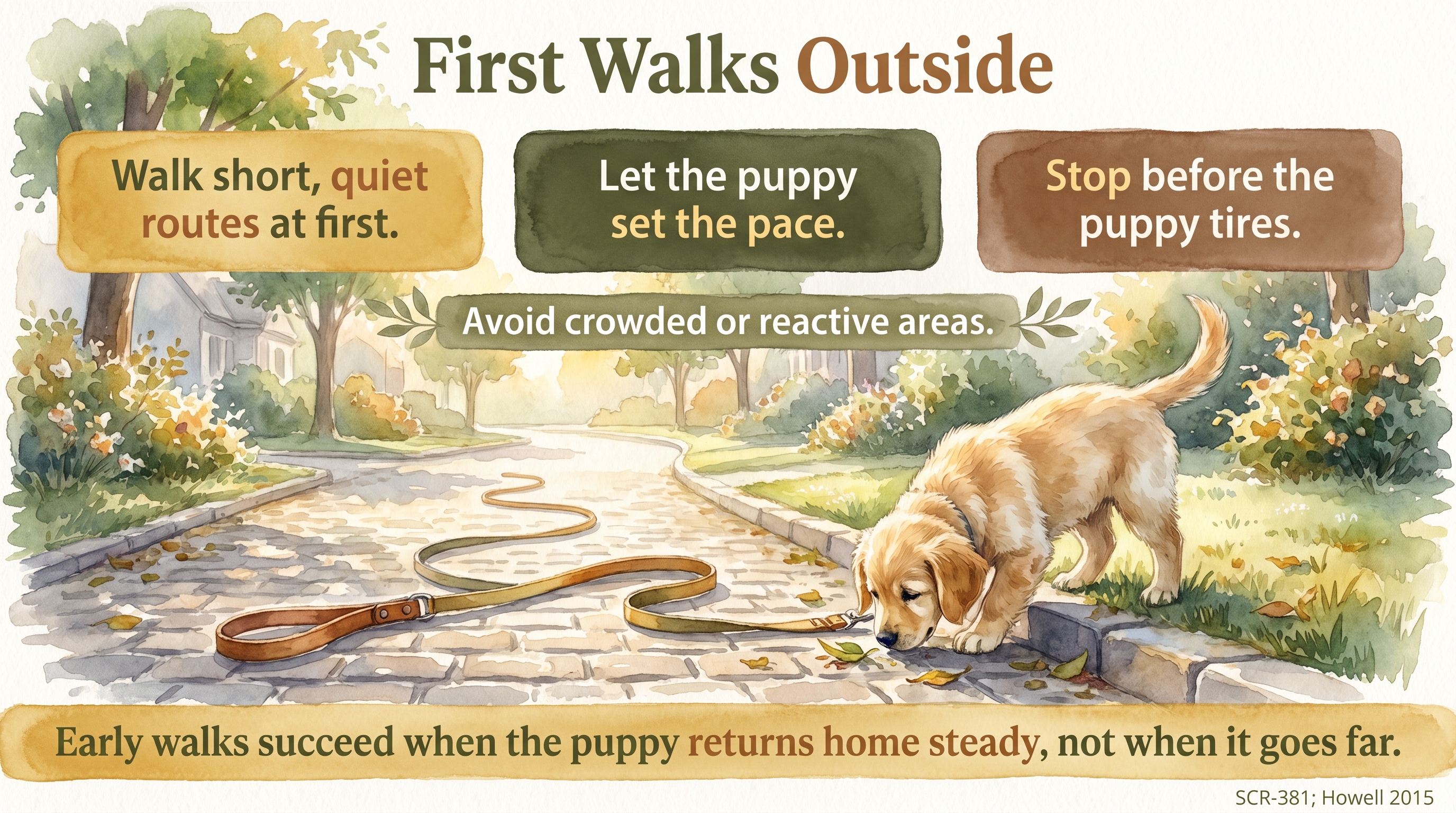
Early walks succeed when the puppy returns home steady, not when it goes far.
Key Takeaways
- First walks outside are for calm environmental exposure and relationship, not for tiring the puppy out.
- Good month-one walks are brief, pause-heavy, and scaled to what the puppy can actually absorb.
- Vaccination and exposure decisions should be handled honestly with local veterinary input rather than with rigid slogans.
- A puppy who learns that walking means calm shared observation begins one of life's main rituals on much better ground.
The Evidence
This entry uses heuristic claim-level tags beyond the dedicated EvidenceBlocks below. These tags mark JB interpretive application rather than direct study findings.
- Vaterlaws-Whiteside & Hartmann (2017); Stolzlechner et al. (2022); Howell et al. (2015); Freedman et al. (1961)domestic dogs
Early controlled environmental exposure matters developmentally, and the socialization window should not be squandered through total avoidance of the outside world. - WSAVA (2024); AAHA (2022); Stepita et al. (2013); Howell et al. (2015)domestic dogs
Vaccinated puppies in carefully controlled socialization settings were not shown to be at greater parvovirus risk than comparable vaccinated puppies not attending those settings.
- Veterinary guidance synthesisdomestic dogs
The question is not whether all ground contact is universally safe before the vaccine series ends, but how to balance developmental need with local disease exposure risk in specific environments.
- JB transition practicefamily-raised puppies
Short, quiet, low-traffic walks followed by rest produce steadier month-one outcomes than longer outings aimed at exercise or heavy social exposure.
No direct canine research located for this specific topic. Current understanding relies on related research, clinical observation, and cross-species inference.
SCR References
Sources
- Vaterlaws-Whiteside, H., & Hartmann, A. (2017). Improving puppy behavior using a new standardized socialization program. Applied Animal Behaviour Science, 197, 55-61.
- Stolzlechner, L., Bonorand, A., & Riemer, S. (2022). Optimising Puppy Socialisation-Short- and Long-Term Effects of a Training Programme during the Early Socialisation Period. Animals, 12(22), 3067. https://doi.org/10.3390/ani12223067
- Howell, T. J., King, T., & Bennett, P. C. (2015). Puppy parties and beyond: The role of early age socialization practices on adult dog behavior. Veterinary Medicine: Research and Reports, 6, 143-153. https://doi.org/10.2147/VMRR.S62081
- Freedman, D. G., King, J. A., & Elliot, O. (1961). Critical period in the social development of dogs. Science, 133(3457), 1016-1017.
- Squires, R. A., Crawford, C., Marcondes, M., & Whitley, N. (2024). 2024 guidelines for the vaccination of dogs and cats - compiled by the Vaccination Guidelines Group (VGG) of the World Small Animal Veterinary Association (WSAVA). Journal of Small Animal Practice, 65(5), 277-316. https://doi.org/10.1111/jsap.13718
- Ellis, J., Marziani, E., Aziz, C., Brown, C. M., Cohn, L. A., Lea, C., Moore, G. E., & Taneja, N. (2022). 2022 AAHA Canine Vaccination Guidelines. Journal of the American Animal Hospital Association, 58(5), 213-230. https://doi.org/10.5326/JAAHA-MS-Canine-Vaccination-Guidelines
- Stepita, M. E., Bain, M. J., & Kass, P. H. (2013). Frequency of CPV infection in vaccinated puppies that attended puppy socialization classes. Journal of the American Animal Hospital Association, 49(2), 95-100. https://doi.org/10.5326/JAAHA-MS-5825