Building Handling Tolerance in the First Month
The breeder has already started the handling foundation by the time the puppy comes home. The family's job in the first month is not to reinvent that work. It is to continue it calmly and specifically so the puppy begins linking ordinary human touch with a lifetime of care. JB treats handling tolerance as one of the quietest and most important month-one projects because every future vet visit, groom, ear check, injury exam, and nail trim will stand on what gets built here. Observed-JB
What It Means
Handling tolerance is not one skill.
It is a collection of small permissions the puppy learns over time: paws can be touched, ears can be checked, the mouth can be opened briefly, the body can be steadied, the belly can be exposed, and the whole dog can be examined without panic. Observed-JB
The first month is where those permissions start becoming routine.
Small Repetitions Matter More Than Big Sessions
Families sometimes assume they need to "get the puppy used to everything" quickly.
That mindset creates long handling sessions with too much ambition packed into them.
JB prefers the opposite: touch a paw, look in an ear, lift the lip, pause, and stop while the puppy is still calm. Observed-JB
Then repeat later.
The cumulative effect of many small calm exposures is usually much better than one large blitz.
Functional Restraint Should Stay Brief
Part of handling tolerance is learning that brief steadiness from human hands is not automatically threatening. That can include: holding the collar for a second, supporting the body on a table or couch, keeping the puppy still for a quick ear look, and pausing movement during a nail clip. Observed-JB
What JB does not want is a wrestling match.
The goal is not to overpower the puppy into acceptance.
The goal is to make ordinary care so matter-of-fact and familiar that resistance never has to become the main story.
The First-Month Trap
Families usually err in one of two directions.
Some avoid handling because they do not want to stress the puppy.
Others handle too much, too long, and too intensely because they have heard the socialization window is closing.
Both mistakes miss the real tempo.
The right tempo is: frequent, brief, calm, and unfinished on purpose.
Stopping before the puppy is overwhelmed is part of the method, not a failure to finish.
Indirect Correction Belongs Here
This page is where the Indirect Correction pillar becomes very concrete. If the puppy escalates during handling, the answer is not force. The answer is to reduce intensity, pause, disengage briefly, and come back later in a form the puppy can succeed with. That does not mean the family never handles the puppy through mild protest. It means the family refuses to turn care into conflict.
The correction is informational: too much, not like this, and we will reset and try again more cleanly.
That keeps the relationship intact while still holding the line that care happens.
Why It Matters for Your Dog
Handling tolerance matters because life keeps requiring touch that is not optional. Dogs need medical care, grooming, body checks, and the occasional uncomfortable examination. Observed-JB A dog who has learned early that human hands are calm, predictable, and readable meets those moments differently from a dog who has only learned that handling means stress.
When the puppy escalates during handling, the family does not need to overpower it to make a point. A pause, reset, reduced intensity, and matter-of-fact re-entry communicate more clearly and protect the relationship better than force does.
This page also helps families understand that good handling work is not flashy. There may be no visible "training session" to post or celebrate. There is just a puppy who gradually becomes easier to care for because month-one touch stayed calm.
That compounds for years.
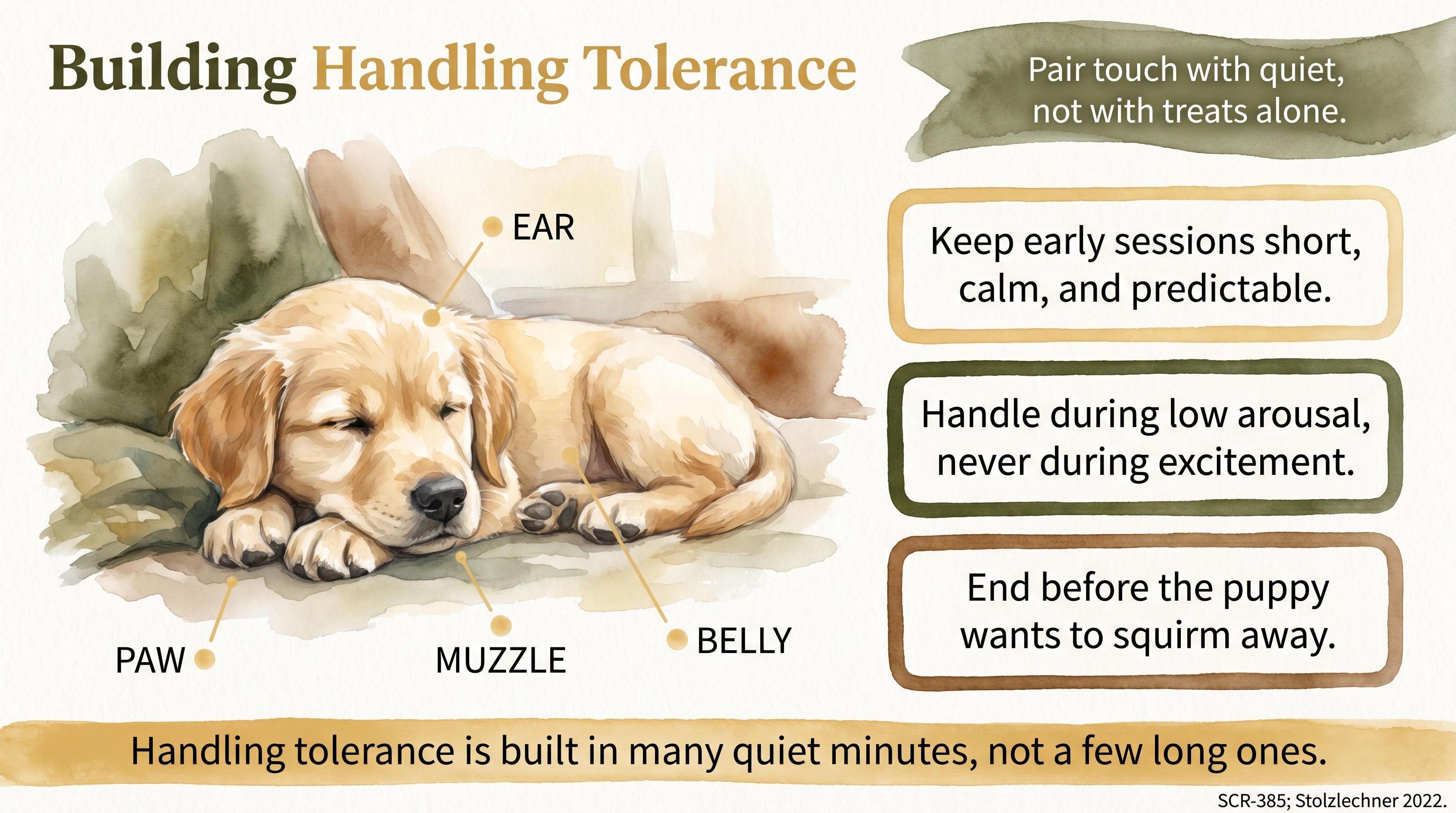
Handling tolerance is built in many quiet minutes, not a few long ones.
Key Takeaways
- Handling tolerance is built from many small permissions over time, not from one big socialization session.
- Short, calm repetitions work better than long ambitious sessions that push the puppy into resistance.
- If the puppy escalates, the goal is to reset and reduce intensity rather than to force a battle through to the end.
- The first month of handling work makes future grooming, veterinary care, and injury checks easier for the rest of the dog's life.
The Evidence
- Vaterlaws-Whiteside & Hartmann (2017); Stolzlechner et al. (2022); Mariti et al. (2020); Freedman et al. (1961)domestic dogs
Early repeated exposure to human handling influences later comfort with body contact and routine care procedures. - Byosiere et al. (2016); Firnkes et al. (2017); Horowitz (2009); Goodwin et al. (1997)domestic dogs
Dogs respond strongly to the tone, pace, and bodily quality of human interaction, which makes low-threat handling style clinically and behaviorally meaningful.
- JB first-month practicefamily-raised puppies
Short, matter-of-fact handling repetitions interleaved with rest produce steadier lifetime-care tolerance than either avoidance of handling or long high-pressure handling sessions.
No published study directly tests the specific Just Behaving guidance on building handling tolerance. This entry relies on broader canine evidence, breeder observation, and practical synthesis.
SCR References
Sources
- Vaterlaws-Whiteside, H., & Hartmann, A. (2017). Improving puppy behavior using a new standardized socialization program. Applied Animal Behaviour Science, 197, 55-61.
- Stolzlechner, L., Bonorand, A., & Riemer, S. (2022). Optimising Puppy Socialisation-Short- and Long-Term Effects of a Training Programme during the Early Socialisation Period. Animals, 12(22), 3067. https://doi.org/10.3390/ani12223067
- Mariti, C., Lenzini, L., Carlone, B., Zilocchi, M., Ogi, A., & Gazzano, A. (2020). Does attachment to man already exist in 2 months old normally raised dog puppies? A pilot study. Dog Behavior, 6(1), 1-11. https://doi.org/10.4454/db.v6i1.96
- Freedman, D. G., King, J. A., & Elliot, O. (1961). Critical period in the social development of dogs. Science, 133(3457), 1016-1017.
- Byosiere, S.-E., Espinosa, J., & Smuts, B. (2016). Investigating the function of play bows in adult pet dogs (Canis lupus familiaris). Behavioural Processes, 125, 106-113. https://doi.org/10.1016/j.beproc.2016.02.007
- Firnkes, A., Bartels, A., Bidoli, E., & Erhard, M. (2017). Appeasement signals used by dogs during dog-human communication. Journal of Veterinary Behavior, 19, 35-44. https://doi.org/10.1016/j.jveb.2016.12.012
- Horowitz, A. (2009). Attention to attention in domestic dog (Canis familiaris) dyadic play. Animal Cognition, 12(1), 107-118. https://doi.org/10.1007/s10071-008-0175-y
- Goodwin, D., Bradshaw, J. W. S., & Wickens, S. M. (1997). Paedomorphosis affects agonistic visual signals of domestic dogs. Animal Behaviour, 53(2), 297-304. https://doi.org/10.1006/anbe.1996.0370