Handling the First Real Nipping Episode
Every family has the moment when puppy mouthing stops feeling manageable and starts feeling real. The teeth land harder. The puppy comes back again and again. Hands become targets. Clothing becomes targets. The adults wonder whether this is aggression, whether they missed something earlier, or whether they now need a bigger intervention than they wanted to use. JB slows that whole interpretation down. The first real nipping episode is usually an arousal problem long before it is a character problem. The family does not need to defeat the puppy. It needs to remove the fuel from the loop and restore the calm floor the puppy lost. Observed-JB
What It Means
Real nipping usually arrives when several things have stacked: the puppy is tired, the interaction got faster, hands stayed available too long, and the adult kept engaging after the puppy tipped upward. Observed-JB
That does not mean the adult caused every episode.
It does mean the episode is easier to understand as dysregulated contact than as aggression.
What JB Does Not Recommend
This page is clearer if it names the common bad advice directly.
JB does not recommend: yelping theatrically, pinning the puppy, clamping the muzzle shut, spraying water, and adding scary consequences to small-breed-size behavior. Observed-JB
Some of those methods interrupt the moment.
That is not the same as improving the relationship or the long-term mouth.
Calm Disengagement First
When the puppy is really nipping, the family usually needs to stop feeding the loop: freeze the hand, withdraw access, stand up or turn away, end the game, and give the puppy a chance to reset.
That sequence often feels almost too simple.
It is still doing real work.
The point is not to win the exchange.
The point is to make the exchange stop being the most stimulating thing in the room.
Rest Is Often the Missing Intervention
Many first real nipping episodes are the evening face of sleep debt.
The family thinks: the puppy needs more training, the puppy needs a stronger interruption, and the puppy is getting pushy. Observed-JB
Often the puppy needs: less interaction, more distance, and a nap. Observed-JB
That does not solve every mouth issue.
It solves far more than families expect.
What Recovery Looks Like
Recovery after a nipping pattern begins is usually a combination of two things: changing the moment and changing the day.
Changing the moment means disengaging faster, protecting skin and clothing from becoming part of the game, and refusing to escalate the exchange into louder movement.
Changing the day means looking backward: was the puppy overtired, were greetings too exciting, was rough play building too much speed, and did the adults miss the early off-ramp.
When families answer those questions honestly, the nipping often becomes far more readable and far less frightening.
Why It Matters for Your Dog
Nipping matters because it is one of the first times families feel truly tested. If they panic, punish, or turn the episode into a major conflict, the puppy learns more than the family intends. If they disengage calmly and re-anchor the day, the puppy learns something different: arousal closes social access, calm restores it.
The first real nipping episode does not require a frightening answer. Calm disengagement, removal of access, and restoration of the calm floor teach more cleanly than escalating the intensity of the encounter.
This page also matters for the long arc of bite inhibition. Soft mouths do not grow out of scary lessons. They grow out of thousands of calm contacts in which the adults stay readable and over-arousal is not allowed to become the main relationship language.
That is the deeper JB point.
The puppy is learning how humans feel when things get hard.
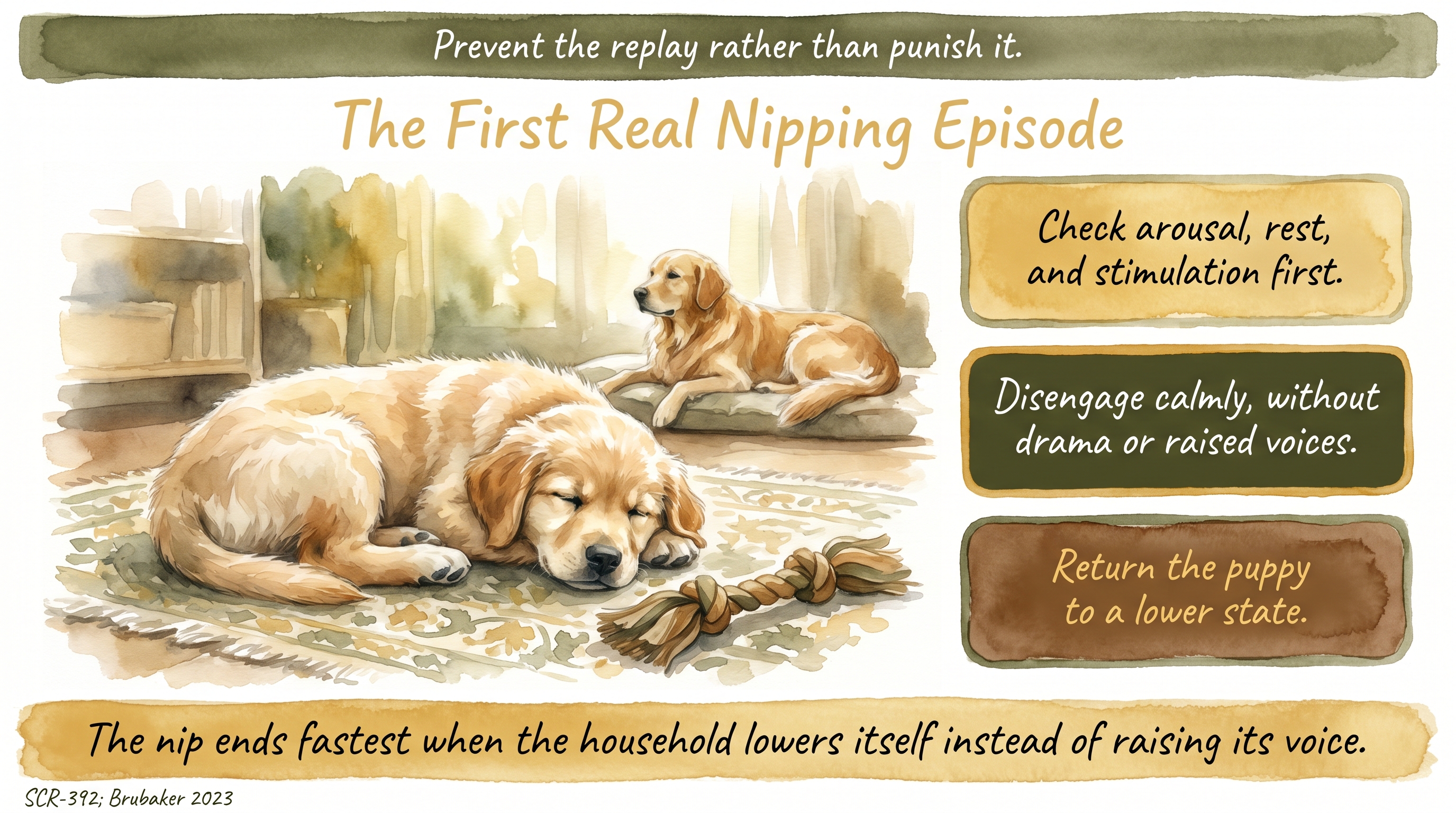
The nip ends fastest when the household lowers itself instead of raising its voice.
Key Takeaways
- The first real nipping episode is usually an arousal problem before it is a character problem.
- JB does not recommend theatrical yelping, forceful muzzle control, or punishment-based interruptions as the main response.
- Calm disengagement and a fast return to rest often do more to resolve the pattern than stronger confrontation does.
- How the family handles early nipping helps shape whether the adult dog develops a softer, steadier social mouth.
The Evidence
- Bauer & Smuts (2007); Rooney et al. (2000); Horvath et al. (2008); Ward et al. (2008)domestic dogs
Play intensity, interruption timing, and partner regulation shape whether social interaction stays coordinated or tips into escalating arousal. - Byosiere et al. (2016); Firnkes et al. (2017); Horowitz (2009); Goodwin et al. (1997)domestic dogs
Dogs use disengagement and cut-off behaviors to lower social intensity, supporting the logic of calm relational withdrawal when interaction has tipped too high.
- JB family-coaching observationfamily-raised puppies
Hard first-month nipping episodes usually improve most when families disengage calmly, reduce the underlying arousal load, and treat the episode as a state problem rather than as proof of aggression.
No published study directly tests the specific Just Behaving guidance on handling the first real nipping episode within a breeder-to-family transition, so this entry relies on broader canine evidence, breeder observation, and practical synthesis rather than a direct trial of the full protocol.
SCR References
Sources
- Bauer, E. B., & Smuts, B. B. (2007). Cooperation and competition during dyadic play in domestic dogs, Canis familiaris. Animal Behaviour, 73(3), 489-499.
- Rooney, N. J., Bradshaw, J. W. S., & Robinson, I. H. (2000). A comparison of dog-dog and dog-human play behaviour. Applied Animal Behaviour Science, 66(3), 235-248.
- Horvath, Z., Doka, A., & Miklosi, A. (2008). Affiliative and disciplinary behavior of human handlers during play with their dog affects cortisol concentrations in opposite directions. Hormones and Behavior, 54(1), 107-114.
- Ward, C., Bauer, E. B., & Smuts, B. B. (2008). Partner preferences and asymmetries in social play among domestic dog, Canis lupus familiaris, littermates. Animal Behaviour, 76, 1187-1199.
- Byosiere, S.-E., Espinosa, J., & Smuts, B. (2016). Investigating the function of play bows in adult pet dogs (Canis lupus familiaris). Behavioural Processes, 125, 106-113. https://doi.org/10.1016/j.beproc.2016.02.007
- Firnkes, A., Bartels, A., Bidoli, E., & Erhard, M. (2017). Appeasement signals used by dogs during dog-human communication. Journal of Veterinary Behavior, 19, 35-44. https://doi.org/10.1016/j.jveb.2016.12.012
- Horowitz, A. (2009). Attention to attention in domestic dog (Canis familiaris) dyadic play. Animal Cognition, 12(1), 107-118. https://doi.org/10.1007/s10071-008-0175-y
- Goodwin, D., Bradshaw, J. W. S., & Wickens, S. M. (1997). Paedomorphosis affects agonistic visual signals of domestic dogs. Animal Behaviour, 53(2), 297-304. https://doi.org/10.1006/anbe.1996.0370