Mouthing and Nipping Prevention
Compound evidence detail1 SCR / 3 parts
- Observed-JBJB program-observed outcome that human-directed bite inhibition develops in puppies raised without mouth play protocols
- Heuristicthe program-wide interpretation that conspecific calibration combined with consistent human boundaries is sufficient to produce that outcome
- Documentedthe maternal and conspecific calibration pathway, supported by Pierantoni 2011 evidence on early-separation effects on bite-related behaviors
Mouthing and nipping prevention is JB's flagship case study for the Prevention pillar. The industry usually assumes mouthing toward human skin is a normal puppy phase that should be allowed and then shaped downward. JB does the opposite. Human-directed mouthing is not initiated, and if it appears, it is interrupted immediately. The strongest support here is mixed: the often-cited prevalence statistic is ambiguous, the maternal and conspecific calibration mechanism is documented, and JB's zero-incidence program outcome is observed. Ambiguous
What It Means
This page works because it asks a question most mouthing advice never asks: what if the behavior does not need to be practiced with humans in the first place?
The mainstream assumption is that puppies must mouth human skin so they can learn bite inhibition with humans. JB challenges that assumption at two levels.
First, dog-dog calibration already exists. Puppies learn bite pressure inside canine social life through littermates, maternal correction, and conspecific interaction. Documented JB is not against bite inhibition. JB is against treating human skin as the training surface for it.
Second, each repetition of human-directed mouthing gives the behavior a rehearsal history. If the puppy mouths hands during play, during greetings, during overstimulation, or because people find it cute, the puppy is not only exploring. Observed-JB The puppy is practicing a social pattern that may then require correction, extinction, and maintenance later.
That is where Prevention changes the framing. Instead of asking, "How do we fix mouthing once it becomes a common interaction pattern?" JB asks, "Why are we helping it become a common interaction pattern at all?"
The page needs one important evidence boundary right up front. The familiar claim that about 80 percent of new puppy owners struggle with mouthing and nipping is not presently verified in the SCR. Ambiguous It may be directionally true. It may also be overstated or based on folklore rather than a confirmed primary source. JB can cite it only with explicit hedging.
The stronger JB point is the observed one: across the program's Golden Retrievers, JB reports zero incidence of mouthing and nipping problems when humans do not initiate mouth play and when early boundaries are kept consistent. That is a meaningful outcome, but it is still program observation, not a published trial.
Why It Matters for Your Dog
This case study shows how Prevention works in the real world. Documented
What JB is preventing is not natural exploration in general. It is a specific cross-species pattern: puppy teeth on human skin as a routine part of play and bonding.
That boundary matters because it lets two things remain true at the same time:
- puppies still get normal bite-pressure calibration from dog-dog interaction
- families do not have to build a human-directed mouthing habit and then spend months managing it
JB's mouthing position is not that puppies should never use their mouths in development. It is that human skin should not become part of the practice field.
This distinction often gets flattened in ordinary advice. The result is that families are told to allow a behavior now because it will supposedly help later, then are handed protocols for stopping the same behavior once it becomes inconvenient. JB reads that cycle as exactly the kind of avoidable rehearsal history Prevention is designed to interrupt.
The case study also forces intellectual honesty. Documented JB's prevention-only position has not yet been tested head-to-head against the graduated mouth-play paradigm in a controlled trial. So the page cannot claim proof of superiority. What it can claim is:
- the usual prevalence statistic is weaker than often presented
- the conspecific calibration mechanism is real
- the no-mouth-play-with-humans protocol is consistent with prevention logic
- JB's observed outcome is unusually strong and worth taking seriously
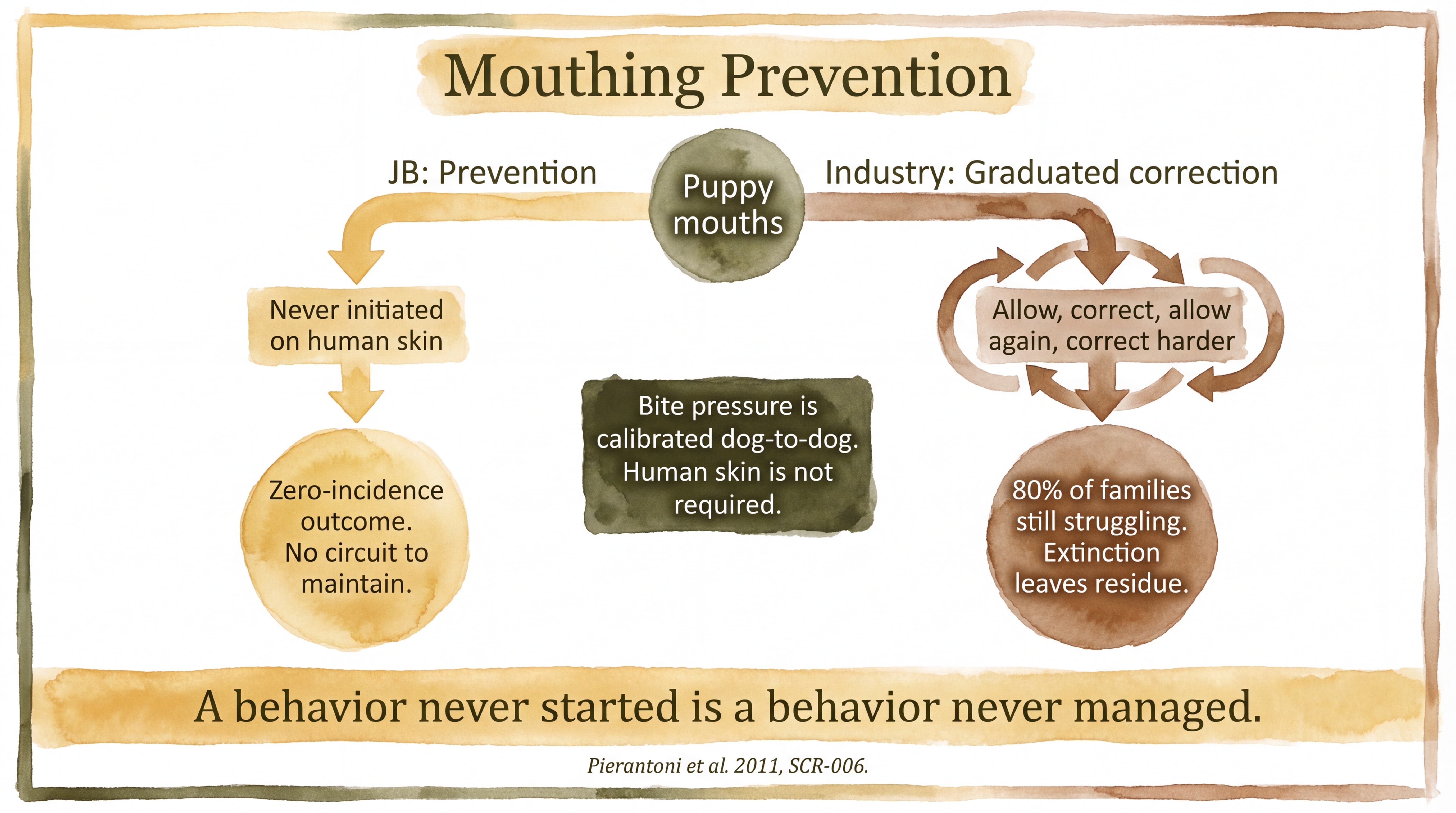
A behavior never started is a behavior never managed - prevention produces zero incidence, not managed incidence.
Key Takeaways
- Puppies learn bite control naturally from playing with littermates and their mother - they do not need human skin as a practice surface to develop bite inhibition.
- Every time a family allows mouth play with human hands or skin, the puppy is practicing a social pattern that may later become an unwanted habit requiring months of correction.
- Just Behaving's approach prevents human-directed mouthing from starting, which means families never have to spend time suppressing it - the behavior never becomes a learned problem.
The Evidence
- domestic dog, owner-reported
The commonly cited claim that roughly 80 percent of puppy owners struggle with mouthing and nipping remains unverified in the SCR and must be presented only with explicit hedging.
- Pierantoni, L. et al. (2011)domestic dogs
Early separation from mother and littermates was associated with higher later play biting and related behavior problems, supporting the importance of maternal and conspecific calibration mechanisms. - SCR-030 synthesisdomestic dogs
No peer-reviewed controlled evidence shows that human-directed mouth play is biologically necessary for bite inhibition. The documented support is for dog-dog calibration, not for human skin as the required training surface.
- Just Behaving program observationGolden Retrievers
JB reports zero incidence of mouthing and nipping problems across its program when humans do not initiate mouth play and early boundaries are maintained. This is meaningful program evidence but remains observational rather than trial-based.
No direct canine research located for this specific topic. Current understanding relies on related research, clinical observation, and cross-species inference.
SCR References
Sources
- Just Behaving program observation: bounded to JB breeder-raised period and program practice, not generalized post-placement outcome proof.
- Pierantoni, L., Albertini, M., and Pirrone, F. (2011). Prevalence of owner-reported behaviours in dogs separated from the litter at two different ages. Veterinary Record, 169(18), 468. DOI: 10.1136/vr.d4967.
- SCR-030 synthesis. Documents early-separation behavioral evidence and program observation. The no-human-mouth-play prevention conclusion remains [Observed/Heuristic] (anchor: SCR-030).