Handling Continuation and Body Acceptance
A well-raised puppy often arrives with the beginnings of body acceptance already in place. The ears have been touched, the paws handled, the mouth opened briefly, the belly felt, the body held and released without drama. That baseline is valuable, and one of the easiest ways for a family to lose it is to stop using it entirely in the name of being gentle. JB's position is that handling should continue in the first week, but continue in the same calm, matter-of-fact vocabulary the puppy already knows. Observed-JB
What It Means
Families often make one of two mistakes with early handling.
The first mistake is too much: long handling sessions, praise-heavy stimulation, turning body work into a game, and doing it while the puppy is already aroused.
The second mistake is too little: avoiding paws, ears, or mouth because the puppy has "been through enough", delaying body handling until a later week, and accidentally allowing the baseline to fade.
JB is trying to hold the middle.
Handling Is a Continuation, Not a Fresh Start
This is the most important idea on the page.
The family does not need to invent a new handling protocol on day one. In fact, doing so is often what creates trouble.
What the puppy already knows should continue: calm touch, brief handling, no drama, no excited narration, and no bargaining with food every second. Observed-JB
This continuity matters because body acceptance is cumulative. It is not one magical session where the puppy becomes "good for grooming." It is the slow building of: nothing bad happened, this is familiar, humans touch my body calmly, and I can stay soft through this.
The first week is a terrible time to interrupt that learning.
Timing Matters More Than Families Realize
Handling should happen during calm windows.
That means: after rest, after settling, and during quiet companionship.
Not: during zoomies, right after exciting play, in the middle of children talking, and while the puppy is already mouthy or over-threshold.
This is a major source of misunderstanding. Families sometimes think the puppy "hates handling" when what the puppy actually hates is being handled during a state that could not absorb any more input. Observed-JB
JB wants handling inserted into moments when the puppy is already closest to the calm floor. Observed-JB That way the body check is simply one more ordinary event inside an already regulated state.
What Handling Actually Includes
In the first week, calm continuation usually means brief checks of: paws, nails, ears, mouth, belly, collar area, and light restraint and release.
The goal is not to finish a full grooming curriculum. The goal is to prevent the puppy from losing the familiarity of being handled.
Why Matter-of-Fact Tone Helps
One of the clearest JB claims around touch is that tone matters as much as contact. Observed-JB
Families often handle in one of two exaggerated tones: highly excited praise and nervous emotional reassurance.
Both can make the moment bigger than it needs to be.
A matter-of-fact tone works better: touch, brief check, release, and move on.
This is one of the places where puppy raising and ordinary parenting overlap most obviously. The more adults act like a task is normal, the easier it becomes for the young organism to treat it as normal too.
What a Crash Landing Looks Like Here
The crash-landing version of body handling usually happens through neglect, not force.
The family is worried about overwhelming the puppy, so it stops: touching paws, looking at ears, opening the mouth, and calmly restraining for a second or two.
Then a week or two later the family tries again during a moment of need: nail trim, ear wipe, collar adjustment, and vet visit.
Now the puppy is less familiar, more reactive, and more likely to resist. The family concludes the puppy has become handling-sensitive, when the simpler truth may be that continuity was interrupted and the baseline eroded.
There is also a more active crash landing: the family handles only during chaotic windows, children crowd in, the puppy squirms, and the humans make it a bigger event with more talk and more movement.
That version teaches the puppy that body contact is arousing and socially charged rather than calm and ordinary.
Handling and Relationship
Handling continuation also matters because body acceptance is relational. The puppy is not only learning about paws and ears. The puppy is learning: what humans do with my body, whether restraint is readable, whether touch arrives calmly, and whether release comes predictably.
That is why this page belongs in the transition category rather than only a future grooming category. The first week is when the puppy is deciding what kind of touch this family uses.
Calm Handling Is an Extension of the Soft Landing
The soft landing principle says the family should keep speaking the puppy's existing language.
If the breeder has already been speaking: slow touch, quiet body checks, and calm restraint.
then dropping that language in the first week is a break in continuity.
JB wants the family to preserve it.
The handling should stay short. It should stay low. It should stay woven into ordinary rest periods rather than inflated into its own event.
Why It Matters for Your Dog
Handling continuation matters because families often only notice body acceptance when they suddenly need it.
They notice it when: nails need trimming, ears need cleaning, the collar catches, the puppy needs to be lifted, and the vet examines the mouth.
By that point, whatever the first weeks taught is already showing.
When handling continues calmly in the first week, the puppy learns that this family touches the body with steadiness and clarity. That lesson travels far beyond grooming.
This page matters in the long arc because body acceptance is one of the most practical forms of trust. A dog who can be handled calmly is easier to care for, easier to examine, and easier to help. A dog who experiences every touch routine as a social event or an unpredictable invasion has a harder life.
The family is therefore not being picky when it continues calm body checks in the first week. It is preserving one of the most useful pieces of developmental work the puppy may already be carrying in.
The soft-landing version is not bigger. It is quieter. That is exactly why it works.
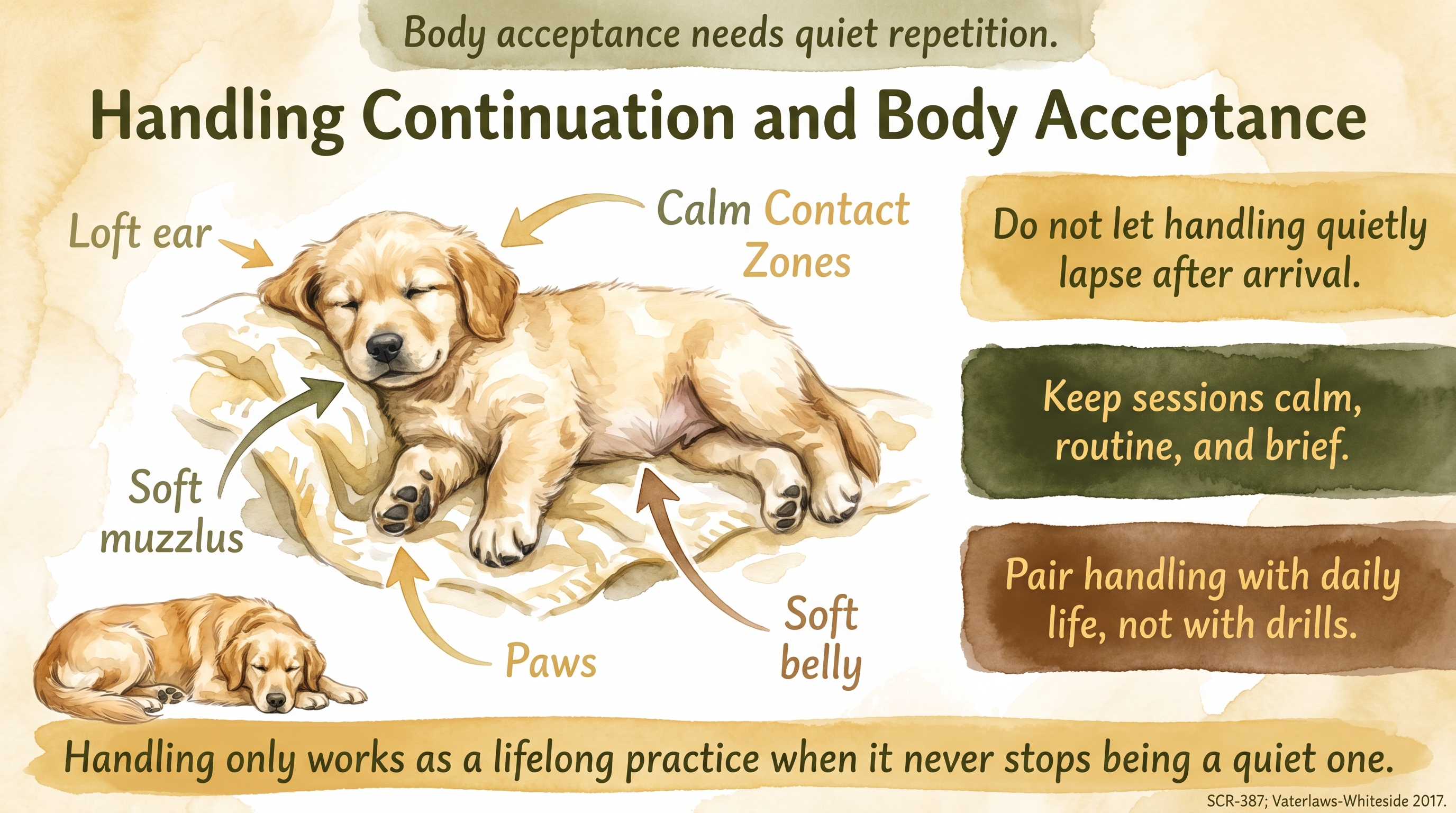
Handling only works as a lifelong practice when it never stops being a quiet one.
Key Takeaways
- A good first-week handling plan continues the calm body-acceptance work the puppy already knows instead of stopping it completely.
- Handling should happen in quiet windows, because timing often explains whether the puppy can absorb the touch calmly.
- A crash landing happens when families either stop handling altogether or turn handling into a noisy, praise-heavy event.
- Body acceptance is relational as well as practical, so first-week handling teaches the puppy what kind of touch this new family uses.
The Evidence
- Vaterlaws-Whiteside & Hartmann (2017); Stolzlechner et al. (2022); Mariti et al. (2020); Freedman et al. (1961)domestic dogs
Early handling contributes to later comfort with human contact and procedures, especially when repeated calmly and predictably across development.
- JB first-week practicefamily-raised puppies
Brief, calm continuation of ear, paw, mouth, and body handling in low-arousal windows preserves the handling baseline the puppy arrived with better than either avoidance or overstimulating sessions.
No published study directly tests the specific Just Behaving guidance on handling continuation and body acceptance. This entry relies on broader canine evidence, breeder observation, and practical synthesis.
SCR References
Sources
- Vaterlaws-Whiteside, H., & Hartmann, A. (2017). Improving puppy behavior using a new standardized socialization program. Applied Animal Behaviour Science, 197, 55-61.
- Stolzlechner, L., Bonorand, A., & Riemer, S. (2022). Optimising Puppy Socialisation-Short- and Long-Term Effects of a Training Programme during the Early Socialisation Period. Animals, 12(22), 3067. https://doi.org/10.3390/ani12223067
- Mariti, C., Lenzini, L., Carlone, B., Zilocchi, M., Ogi, A., & Gazzano, A. (2020). Does attachment to man already exist in 2 months old normally raised dog puppies? A pilot study. Dog Behavior, 6(1), 1-11. https://doi.org/10.4454/db.v6i1.96
- Freedman, D. G., King, J. A., & Elliot, O. (1961). Critical period in the social development of dogs. Science, 133(3457), 1016-1017.