Early Handling and Human Contact
Early handling is the practice of giving puppies regular, calm, predictable human contact during the neonatal and early socialization phases. The broad claim that this matters is well supported. Puppies without adequate early human contact show poorer later human orientation, while puppies who receive structured early handling are generally more prepared for human attachment and everyday family life. The stronger and more careful version is that quality of handling matters at least as much as quantity. Documented
What It Means
Why Handling Matters So Early
Dogs are developing into a human social world. That means human contact is not an optional extra layered on after the puppy becomes otherwise finished. It is part of the developmental process itself.
Handled puppies are learning what human touch means; whether approach predicts calm or chaos; whether human presence is legible and safe; and how to orient toward human social signals. Documented
That is why early handling belongs beside attachment and socialization pages rather than under a narrow care-and-grooming heading.
The Direct Developmental Logic
SCR-025 anchors the timing. The early socialization window is real and unusually high leverage. Human contact inside that window therefore matters more than the same exposure would later. Documented
SCR-051 strengthens the developmental story by showing that very young retriever puppies already use human communicative gestures robustly. That means the human social channel is open early, not only after months of conditioning. Documented
SCR-042 adds the later affiliative physiology piece. The oxytocin-gaze loop is documented in dog-human interaction, which supports the broader claim that dogs are biologically prepared for affiliative human connection, even though that SCR should not be stretched into a full early-handling proof on its own.
Quality Matters More Than Volume
The common mistake is to imagine that more handling is automatically better. The more defensible conclusion is narrower calm, brief, predictable handling is helpful; chaotic, exciting, intrusive handling can work against regulation; and the puppy should experience humans as safe and legible, not overwhelming.
That is one reason this page connects naturally to the soft-landing and calmness ideas even though it stays inside the behavioral-science layer.
Why It Matters for Your Dog
What It Does Not Mean
Early handling does not guarantee perfect later sociability, and poor starts do not make later attachment impossible. Documented The page should not be used to support either overconfidence or fatalism.
The strongest takeaway is that early human contact meaningfully influences later human orientation and bond formation, especially when it happens inside the broader socialization window and inside a calm developmental environment.
Early handling works best when the puppy experiences humans as steady, readable social partners rather than as bursts of stimulation. That is the developmental bridge from breeder care to later family attachment.
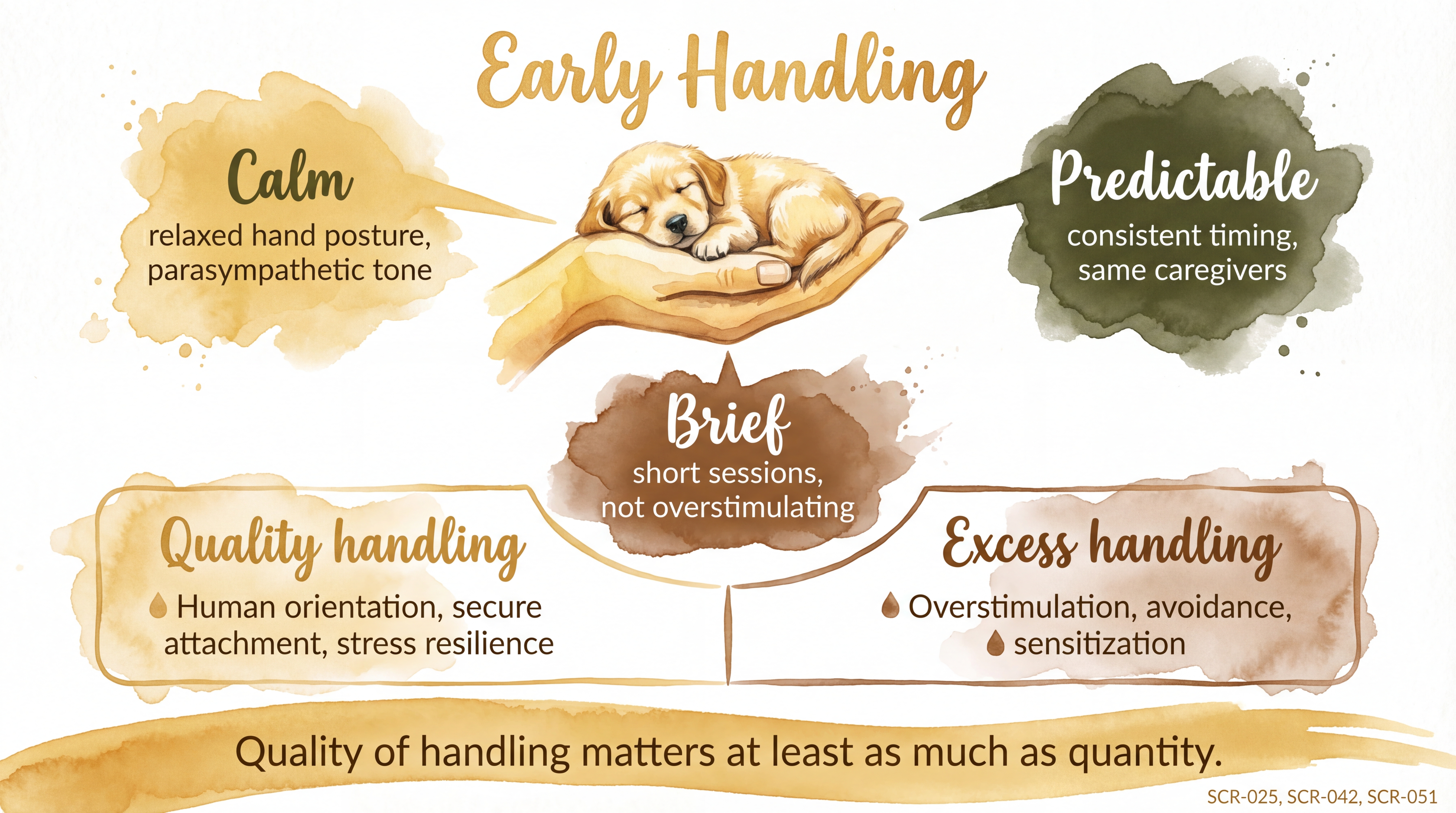
Quality of early handling matters at least as much as quantity - calm, predictable, and brief.
Key Takeaways
- Early handling matters because puppies are developing into a human social environment rather than entering one after development is complete.
- The strongest claim is about calm predictable human contact, not maximum handling volume.
- Very young retriever puppies already use human social information, which helps explain why early human contact has such leverage.
- Early handling is important without being magical: it strongly shapes later orientation and bonding, but does not determine every adult outcome on its own.
The Evidence
- Scott, J. P., & Fuller, J. L. (1965)domestic dogs
Classic developmental work showed that delayed or absent early social contact with humans carries lasting costs. - Gazzano, A. et al. and early-handling literaturedomestic dogs
Regular early human handling is associated with improved human-directed behavioral outcomes and coping in later contexts. - Bray, E. E. et al. (2021)retriever puppies including Golden Retrievers
Very young puppies already use human communicative gestures robustly, showing that the human social channel is open early in development.
- Nagasawa, M. et al. (2015) and SCR-042 synthesisdogs and humans
The dog-human oxytocin-gaze loop supports the broader biological readiness for affiliative human bonding, while not acting as a stand-alone proof of every early-handling claim.
- domestic dogs
No published study directly compares different early-handling styles, durations, and emotional tones in breeder homes with long-term follow-up into family life.
SCR References
Sources
- Gazzano, A., Mariti, C., Notari, L., Sighieri, C., & McBride, E. A. (2008). Effects of early gentling and early environment on emotional development of puppies. Applied Animal Behaviour Science, 110(3-4), 294-304. DOI: 10.1016/j.applanim.2007.05.007.
- Bray, E. E., Gnanadesikan, G. E., Horschler, D. J., Levy, K. M., Kennedy, B. S., Famula, T. R., & MacLean, E. L. (2021). Early-emerging and highly heritable sensitivity to human communication in dogs. Current Biology, 31(14), 3132-3136.e5. DOI: 10.1016/j.cub.2021.04.055.
- Nagasawa, M., Mitsui, S., En, S., Ohtani, N., Ohta, M., Sakuma, Y., Onaka, T., Mogi, K., & Kikusui, T. (2015). Oxytocin-gaze positive loop and the coevolution of human-dog bonds. Science, 348(6232), 333-336. DOI: 10.1126/science.1261022.
- Scott, J. P., & Fuller, J. L. (1965). Genetics and the Social Behavior of the Dog. University of Chicago Press.