First Car Rides Beyond the Ride Home
The ride home is only the first time the puppy learns what a car is. The next few rides matter almost as much because they teach whether the car is a neutral environment, a place of recovery, or a place where the family repeatedly stacks stimulation onto the puppy. JB wants those first extra rides to stay small, calm, and deliberately forgettable. Observed-JB
What It Means
Families often make an understandable mistake after the puppy has been home for a few days. Observed-JB
They think: now that she is settling, let's take her somewhere, he needs to get used to the car, and we should make a fun outing of it. Observed-JB
The intention is usually good.
The timing is often wrong.
The Car Should Become Neutral First
The car is going to be part of the dog's life for years: vet visits, family trips, grooming appointments, hikes, and travel to friends or relatives.
That is exactly why JB does not want early car experience attached too strongly to excitement. The safest early lesson is that getting into the car, riding in it, and getting out again are just ordinary events inside family life.
Keep the First Destinations Quiet
Month-one destinations should usually be simple: a calm driveway visit, a short ride around the block, the breeder for a check-in, and a quiet park edge. Observed-JB
These are not "destination events." They are travel rehearsals.
The family is building: loading calmly, riding calmly, unloading calmly, and returning home calmly.
Transport Safety Is Part of Calmness
Calmness does not mean improvisation.
The puppy should ride: in a secured crate.
or: in another secure transport setup the family can use safely and consistently.
A loose puppy passed from lap to lap is not a calmer puppy. It is a less safe one, often in a more emotionally activated environment.
The Common Mistake
Many puppies get their first extra car rides attached to too much: a pet store, a family gathering, a busy errand, and a highly social parking-lot moment. Observed-JB
Now the puppy is not learning "car." The puppy is learning "car plus stimulation plus handling plus novelty all at once."
That does not make later travel impossible, but it does make month-one travel louder than it needed to be.
What a Crash Landing Looks Like
A car-related crash landing usually begins with adults treating the ride as the exciting part of the day.
They talk more, reach more, check the puppy constantly, and arrive somewhere even busier than the car itself. The puppy's nervous system never gets the chance to experience the car as neutral because every ride becomes a prelude to some larger event.
The soft landing alternative is much simpler: brief rides, low-traffic destinations, same calm voice the home uses, and no need to make travel feel special.
Why It Matters for Your Dog
Car travel matters because it compounds. A dog may take hundreds of rides across its life. If the first pattern is restlessness, noise, and event-thinking, the family will keep working against that baseline. If the first pattern is quiet transport, later rides begin on much better ground.
This page also matters because many future necessities arrive by car. A dog who can ride without emotional flooding is easier to take to the veterinarian, easier to travel with in emergencies, and easier to include in ordinary family life.
The family does not need to teach "love the car" in month one.
It only needs to teach: the car is normal, you are safe in motion, and we still sound like ourselves in here.
That is enough.
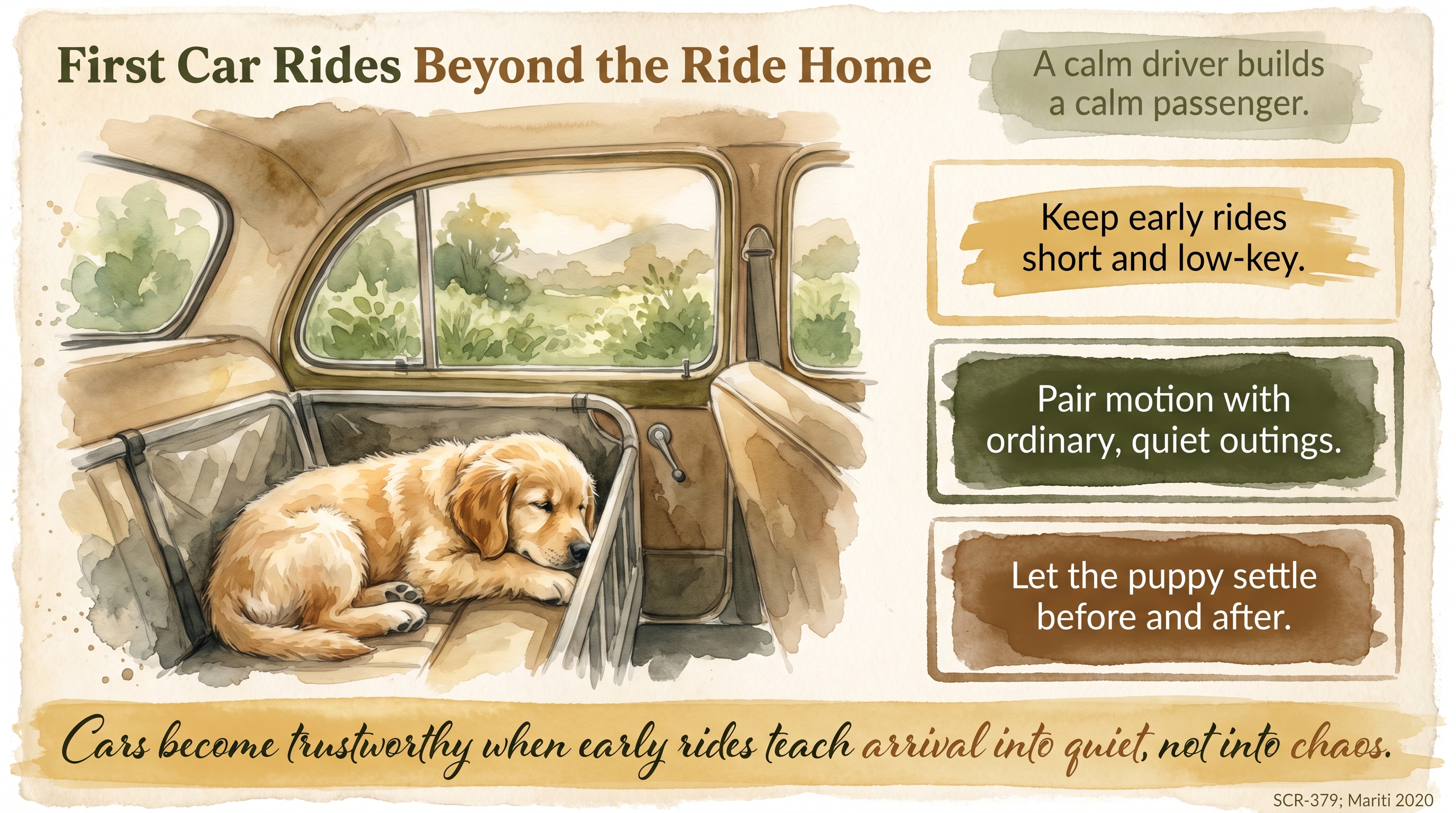
Cars become trustworthy when early rides teach arrival into quiet, not into chaos.
Key Takeaways
- The first additional car rides should be short and quiet so the car itself becomes a neutral environment.
- Month-one rides are better framed as travel rehearsals than as exciting outings.
- Secure transport and calm loading matter because safety and emotional steadiness support each other.
- A dog that learns early that the car is ordinary usually becomes easier to travel with for the rest of its life.
The Evidence
- Freedman et al. (1961); Scott & Fuller (1965); Morrow et al. (2015); Rankin et al. (2009)domestic dogs
Repeated early experiences help establish whether equipment and travel contexts are processed as ordinary or as highly arousing events.
- JB transition observationfamily-raised puppies
Brief rides to quiet destinations create steadier later car baselines than making the first extra rides part of larger, more stimulating social events.
No published study directly tests the specific Just Behaving guidance on first car rides beyond the ride home. This entry relies on broader canine evidence, breeder observation, and practical synthesis.
SCR References
Sources
- Freedman, D. G., King, J. A., & Elliot, O. (1961). Critical period in the social development of dogs. Science, 133(3457), 1016-1017.
- Scott, J. P., & Fuller, J. L. (1965). Genetics and the Social Behavior of the Dog. University of Chicago Press.
- Morrow, M., Ottobre, J. S., Ottobre, A. C., Neville, P., St-Pierre, N., Dreschel, N. A., & Pate, J. L. (2015). Breed-dependent differences in the onset of fear-related avoidance behavior in puppies. Journal of Veterinary Behavior, 10(4), 286-294. https://doi.org/10.1016/j.jveb.2015.03.002
- Rankin, C. H., Abrams, T., Barry, R. J., et al. (2009). Habituation revisited: An updated and revised description of the behavioral characteristics of habituation. Neurobiology of Learning and Memory, 92(2), 135-138.