Early Feeding Transition from Breeder Food
Food changes feel simple to humans and can feel anything but simple to a young puppy. In the first month, JB wants digestive stability to support the soft landing rather than compete with it. That means the default posture is conservative: the puppy arrives on the breeder's food, the family learns the puppy's digestive baseline first, and any change happens gradually and for a reason, not because the adults feel pressure to upgrade immediately. Observed-JB
What It Means
Families often come home with a new puppy and a new plan.
Sometimes the plan is thoughtful.
Sometimes it is driven by urgency: we want a better food right away, we already bought something else, and the breeder's food was only temporary.
The problem is not that families care about nutrition.
The problem is timing.
The Puppy Has Already Changed a Great Deal
By the time the puppy arrives, several major transitions are already underway: it has left the breeder, it is sleeping in a new place, it is drinking new water, it is adjusting to a new daily rhythm, and its gut is still developing. Observed-JB
Adding an abrupt diet change on top of all that is often one variable too many.
Why Sudden Food Changes Cause Trouble
Young puppies are not only eating to maintain energy. Their digestive system and microbiome are still maturing. A rapid switch in food can produce: loose stool, softer stool than normal, mild GI upset, appetite variation, and confusion about whether the problem is stress, parasites, food, or all three. Observed-JB
That makes the first month harder than it needs to be.
It can also interfere with: house training, sleep, appetite confidence, and the family's ability to read what is actually happening.
The Conservative Default
JB's default is simple.
If the puppy is doing well on the breeder's food, stay there first.
If the family and veterinarian later decide a change makes sense, make it gradually. In ordinary cases that means a transition carried over several days to two weeks rather than a same-day replacement. The exact pace can vary with the puppy and the reason for the change, but the principle stays steady: one variable at a time, enough days to watch the stool, and no rush just because the bag in the kitchen is different. Observed-JB
The Family's Practical Job
This page is not asking families to become nutrition experts in week two.
It is asking them to become careful observers.
That means tracking: portion size, appetite, stool quality, frequency of bowel movements, and whether any treats or extras were added.
That information matters much more than vague impressions like "his stomach seems off."
Rich Extras Count Too
Families sometimes keep the main food stable and then accidentally destabilize the puppy with everything around it: multiple treats, rich chews, toppers, scraps, and sudden supplements.
To the puppy's gut, those are still dietary changes.
The calmest month-one feeding plan is usually the least decorated one.
What a Crash Landing Looks Like
Food-related crash landings are common because they look responsible from the outside. The family gets the puppy home, replaces the breeder's food immediately, adds new treats because training culture says they should, offers chew after chew because teething has begun, and then spends the next week trying to solve the loose stool that follows.
Now several things happen at once: house training gets messier, the family wonders about parasites, the puppy may eat unevenly, and everyone becomes more anxious around meals.
The irony is that the family often believes it is upgrading the puppy's care when it is really making the transition harder to read.
The soft landing alternative is slower and less glamorous: keep the base diet steady, add as little as possible, change only when there is a clear reason, and move gradually if a change is needed.
Why It Matters for Your Dog
Digestive stability matters because the gut touches almost every other month-one issue. A puppy with loose stool is not only having a nutrition problem. The family also gets: more interrupted sleep, more urgent bathroom trips, more confusion about what is normal, and a harder time reading appetite and mood.
One of the simplest prevention wins in the first month is not creating digestive instability that did not need to exist. A calm feeding plan protects the puppy's body and keeps the family from chasing avoidable problems.
This page also matters because food has a strong emotional pull for humans. Feeding feels like love. Choosing food feels like good stewardship. JB does not reject that instinct. It simply asks the family to remember that timing is part of stewardship too.
The puppy does not need the most dramatic nutritional change in the first month. Observed-JB
The puppy needs a stomach that keeps making sense.
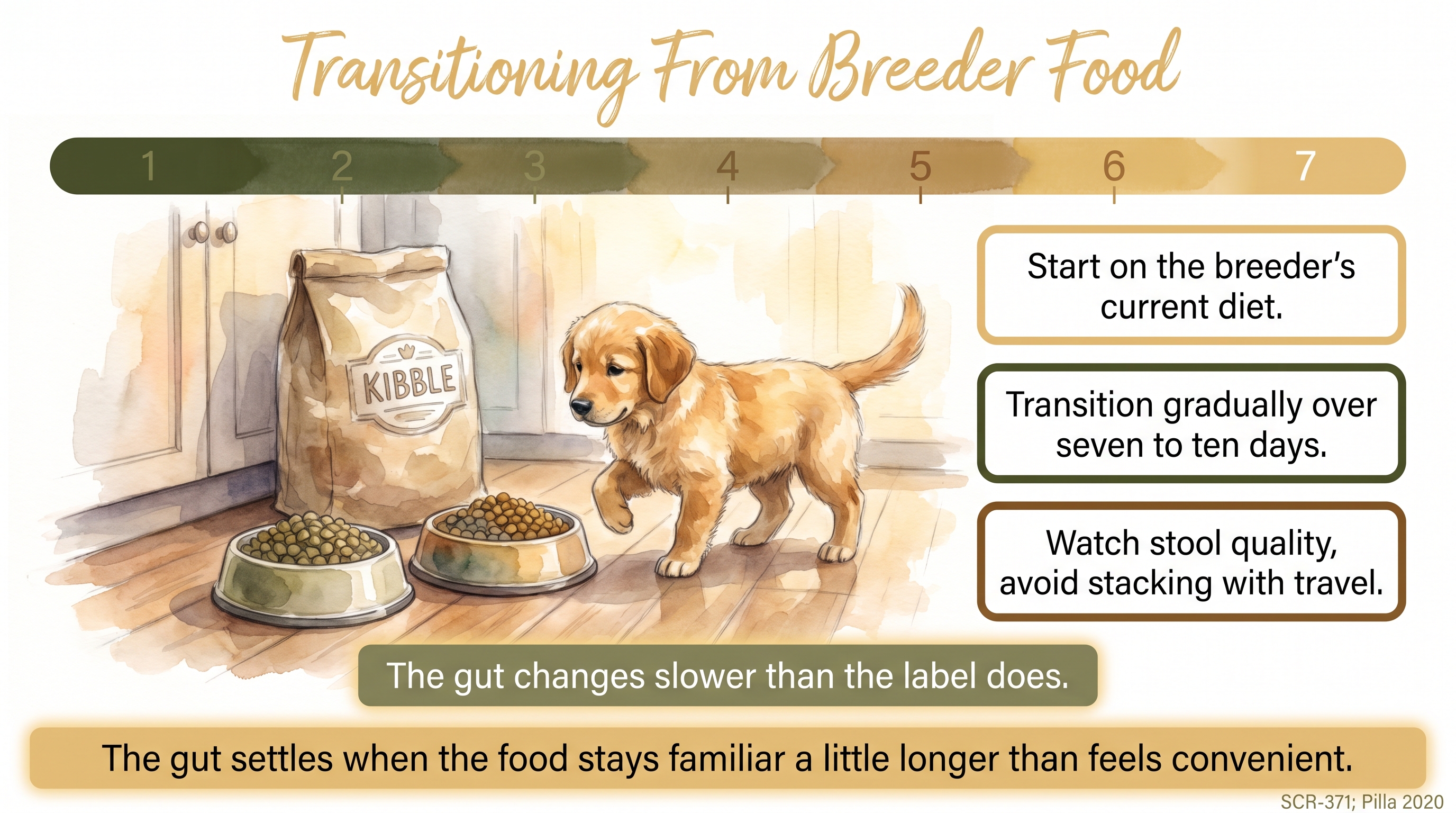
The gut settles when the food stays familiar a little longer than feels convenient.
Key Takeaways
- The first month is usually the wrong time for a fast, elective food change because the puppy is already adapting to many other variables at once.
- Sudden diet changes and rich extras can create loose stool and digestive confusion that complicate house training and overall settling.
- When a food change is needed, the safest general approach is to make it gradually and watch the puppy's stool and appetite carefully.
- A stable stomach is part of a successful soft landing because digestive clarity helps the family read the puppy accurately.
The Evidence
- Freeman et al. (2011); WSAVA; Guard et al. (2017); Liao et al. (2023)domestic dogs
Young dogs have developing digestive and microbial systems, and abrupt dietary changes commonly contribute to loose stool and GI instability. - Guard et al. (2017); Garrigues et al. (2023); Liao et al. (2023); Pilla et al. (2020)domestic dogs
The puppy gut ecosystem is still maturing during and after weaning, which makes unnecessary early perturbation a reasonable management concern.
- JB transition practicefamily-raised puppies
Keeping the breeder's food stable through the first month whenever possible produces cleaner digestive baselines than changing food immediately after the puppy arrives home.
No published study directly tests the specific Just Behaving guidance on early feeding transition from breeder food. This entry relies on broader canine evidence, breeder observation, and practical synthesis.
SCR References
Sources
- WSAVA Global Nutrition Committee. (2011). WSAVA nutritional assessment guidelines. Journal of Small Animal Practice, 52(7), 385-396.
- WSAVA Global Nutrition Committee. (2021). Global nutrition guidelines for companion animals: Nutrient requirements and environmental issues. Journal of the American Veterinary Medical Association, 259(11), 1200-1224.
- Guard, B. C., Mila, H., Steiner, J. M., Mariani, C., Suchodolski, J. S., & Chastant-Maillard, S. (2017). Characterization of the fecal microbiome during neonatal and early pediatric development in puppies. PLOS ONE, 12(4), e0175718. https://doi.org/10.1371/journal.pone.0175718
- Liao, P., et al. (2023). Abrupt Dietary Change and Gradual Dietary Transition Impact Diarrheal Symptoms, Fecal Fermentation Characteristics, Microbiota, and Metabolic Profile in Healthy Puppies. Animals, 13(8), 1300. https://doi.org/10.3390/ani13081300
- Garrigues, Q., Apper, E., Rodiles, A., Rovere, N., Chastant, S., & Mila, H. (2023). Composition and evolution of the gut microbiota of growing puppies is impacted by their birth weight. Scientific Reports, 13, 14717. https://doi.org/10.1038/s41598-023-41422-9
- Pilla, R., Gaschen, F. P., Barr, J. W., Olson, E., Honneffer, J., Guard, B. C., et al. (2020). Effects of metronidazole on the fecal microbiome and metabolome in healthy dogs. Journal of Veterinary Internal Medicine, 34(5), 1853-1866. https://doi.org/10.1111/jvim.15871