Transition Feeding: Breeder to Home
The breeder-to-home food transition is one of the places where JB's broader philosophy becomes very concrete. The standard nutrition advice of "transition foods gradually over 7 to 10 days" is sound as far as it goes. JB's additional preference is even calmer: do not start that transition at all in the first two weeks home unless you truly need to. Keep the food, keep the meal rhythm, and let the puppy land first. Observed-JB
What It Means
Moving homes is already a major physiologic and emotional event for a puppy. At the same time the puppy is processing separation from littermates, a new environment, new people, altered sleep and elimination patterns, and transportation stress.
The gut is being asked to maintain normal function through all of it.
That matters because the gut is not responding only to food ingredients. It is responding to stress load, new routine, altered sleep, travel fatigue, and the simple fact that the puppy's microbiome and digestive-enzyme pattern are still adapting to early life.
That point is easy to miss because families experience the move as a happy event. For the puppy, it is still a full-environment transition. The sleeping place changes. The sounds change. The people change. The handling pattern changes. The elimination surface may change. The social world has narrowed from mother and littermates to unfamiliar humans. Appetite, stool quality, and hydration are all downstream from that stress load.
The food bowl is one of the few variables that can stay familiar. That is the practical logic behind this page. When the rest of life is changing, feeding continuity is not trivial. It is one of the easiest ways to keep the puppy's body from needing to solve two separate adaptation problems at once.
There is also a timing layer. The same food change that would probably be well tolerated in week three may produce loose stool in day two simply because day two includes transport fatigue, novel handling, sleep disruption, and separation from the litter. Observed-JB Families sometimes read that loose stool as proof the breeder food was poor quality when the more likely explanation is that the puppy's gastrointestinal system is trying to absorb too much change all at once.
Why Food Changes Cause Trouble
Diet changes can trigger diarrhea because digestive and microbial systems are adapted to the current food pattern. Change the protein source, fat level, fiber mix, starch pattern, and additives all at once, and the gut needs time to recalibrate.
That is why standard veterinary advice usually recommends a gradual transition rather than an abrupt one.
Part of the reason is microbiome timing. The bacterial community and digestive-enzyme expression pattern adapt over days to weeks, not instantly. When families change protein source, starch source, fat level, and fiber pattern all at once, the gut has to catch up. Observed-JB
That "catch up" process is not abstract. The existing diet has shaped which organisms are thriving in the gut, how much fermentable substrate is arriving in the colon, how much fat is being presented to the upper small intestine, and what stool water balance looks like. A different food can change all of those variables at once. Even when both foods are high quality and complete, the switch can still create a temporary mismatch between what the gut is used to and what it is being asked to process.
Digestive-enzyme expression matters too. Puppies are not static machines. Their intestinal brush-border activity and pancreatic response are still maturing during the months when most of them leave for new homes. Lactase activity is already declining after the early weaning phase, and the gut is moving toward a more mature pattern of handling starches, proteins, and fats from solid food. Adding a big formula shift during that same window can be tolerable, but it is not automatically neutral.
This is why "my puppy did fine on Food A at the breeder and then had diarrhea on Food B at home" does not necessarily mean Food B is bad or Food A was perfect. It often means the transition was faster than the gut wanted, or that the move itself magnified the digestive disruption the new formula might otherwise have caused only mildly.
The Standard 7-to-10-Day Pattern
The usual transition pattern is: 25 percent new food and 75 percent old food for a few days, then 50 and 50, then 75 percent new food, and then full transition.
In more detailed form, the common pattern looks like:
- days 1 to 3: about 75 percent old food and 25 percent new food
- days 4 to 6: about half and half
- days 7 to 9: about 25 percent old food and 75 percent new food
- day 10: fully new food if stool quality remains stable
That method makes sense when a food change is necessary.
It also gives families a useful monitoring framework. If stool quality softens in the 50-50 phase, that is a sign to pause rather than to keep pushing forward on the calendar. The transition protocol is not a test of discipline. It is a way to respect the biologic reality that adaptation is gradual. Some puppies need the full ten days. Some need longer. Some should not be transitioned at all until the external stress of rehoming has settled.
A practical version looks like this: if stools stay formed and appetite stays normal, proceed to the next step on schedule; if stools soften mildly, hold the current ratio for another day or two; if vomiting, marked diarrhea, or reduced appetite develops, pause the change and speak with a veterinarian if signs persist.
That kind of calm pacing is usually more useful than trying to force the transition because the bag on the counter says it is time.
The JB Preference
JB's added step is to ask whether the change is necessary right now. Observed-JB
If the puppy is already managing a huge environmental change, why layer a food change on top of it during the same brief window? The softer landing is to provide the same food, same meal size, same meal count, and similar meal timing for roughly the first two weeks home.
This does not claim that a two-week hold has been proven superior in a randomized trial. It reflects an observed, biologically coherent management preference that aligns with what we know about stress load, GI sensitivity, and transition stability.
That is why the evidence level stays observed rather than being upgraded. The JB two-week stability window is a reasoned operational protocol, not a trial-proven universal law. Its strength comes from fitting what we know about transition stress, not from pretending the exact two-week number has been experimentally proven.
The practical instruction is more specific than "keep the same food." It means keep the same brand, the same formula, the same approximate meal size, the same number of meals, and the same general timing. If the breeder has been feeding breakfast, lunch, and dinner, the new family should not decide that homecoming weekend is the right moment to collapse everything into two larger meals or to start a buffet of toppers, chews, broths, goat milk, and supplements.
This is one of those moments where good intentions can create biologic noise. Families want to celebrate. They want to offer treats. They want to improve the food, add variety, or personalize the routine. From the puppy's point of view, that can feel like a cascade of novel inputs hitting an already loaded system. JB's protocol lowers the total change burden by preserving the food routine while every other part of life is already being renegotiated.
The two-week window is not mystical. It is just long enough for the puppy to sleep in the same place repeatedly, learn the basic meal rhythm, stabilize elimination, and begin to recover from the acute stress of transport and separation. Once that baseline has formed, a family can choose a new food more cleanly and read the puppy's response more honestly.
Why This Fits the Bigger JB Philosophy
Transition feeding is one of the clearest examples of "pretend like it has been there." The puppy is not helped by adults using the arrival home as the moment to reinvent every variable at once. Stability is not glamorous, but it is physiologically kind.
That philosophy is doing more than sounding calm. It is telling the family to stop stacking change. The puppy already has enough to process. Food continuity is one of the few variables families can preserve easily.
It also fits the broader soft-landing framework. JB puppies leave a structured breeder environment where many variables are already coordinated: meal timing, social rhythm, rest, and the general emotional tone around care. The soft landing asks the new family to translate as much of that structure as possible into the home environment instead of replacing it with novelty for novelty's sake.
Nutrition is especially well suited to this approach because food routine is one of the most controllable variables a family has. You cannot give the puppy its mother back. You cannot recreate the entire litter. You cannot make the drive home biologically invisible. But you can make breakfast feel familiar. You can let the gut encounter one stable anchor every day while everything else is still becoming understandable.
That is what "pretend like it's been there" means in feeding terms. Do not force the puppy to interpret arrival as a total rupture. Let home feel like a continuation first. Personalization can come later.
When a Change Is Still Reasonable
After the puppy has settled, a family may decide to change foods for legitimate reasons: veterinary recommendation, availability, long-term household preference, or response to a specific stool or tolerance issue. Observed-JB
At that point, the usual gradual transition approach is reasonable.
It is also reasonable to change sooner when there is a true medical reason. If a veterinarian believes the puppy needs a therapeutic diet, if the current food is unavailable, or if there is a clear ingredient intolerance, the answer is not "never change food." The answer is "change food thoughtfully and recognize that the gut is already under load."
Once the two-week settling window has passed, most families can use the standard 7 to 10 day transition pattern:
- days 1 to 3: 75 percent old food, 25 percent new food
- days 4 to 6: 50 percent old food, 50 percent new food
- days 7 to 9: 25 percent old food, 75 percent new food
- day 10 onward: 100 percent new food if stool quality is stable
Families can make that process even gentler by leaving every other variable alone during the transition. That means no major treat change, no sudden increase in chews, and no pile-on of supplements unless a veterinarian has actually recommended them.
It also helps to remember that a homecoming puppy does not need a dramatic menu. The first nutritional job is tolerance, hydration, and rhythm. Optimization comes after landing.
Why It Matters for Your Dog
This page matters because it turns a broad transition philosophy into one very practical action. Families often want to improve things immediately. But when a puppy first arrives, "improving" the diet can accidentally increase GI upset simply because too many variables changed at once.
That correction is especially useful for conscientious families. The urge to personalize the diet immediately usually comes from care, not neglect. But timing matters. The same food change that is sensible in week three may be disruptive in day three.
The page also helps families interpret common early-homecoming events more calmly. A single soft stool on day one does not automatically mean the puppy needs an urgent food change. Observed-JB Mild appetite hesitation after transport does not automatically mean the food is wrong. Sometimes the most protective move is to narrow the number of variables, watch carefully, and let the puppy's body settle.
That mindset prevents a common spiral. The puppy arrives, has a soft stool, the family changes food, adds pumpkin, adds a probiotic chew, adds treats, and starts hand-feeding different toppers because appetite is variable. Each individual decision seems caring. In the aggregate, the puppy's gastrointestinal system loses every stable reference point it had.
A stable first two weeks makes later decisions easier too. If there is a real tolerance issue, families can identify it more cleanly once the move itself is no longer the dominant stressor. Good data comes from fewer moving parts.
Soft landing in feeding means resisting the urge to optimize instantly. Stability first, then adjustment. That sequence lowers avoidable digestive disruption while the puppy is already adapting to a major life change.
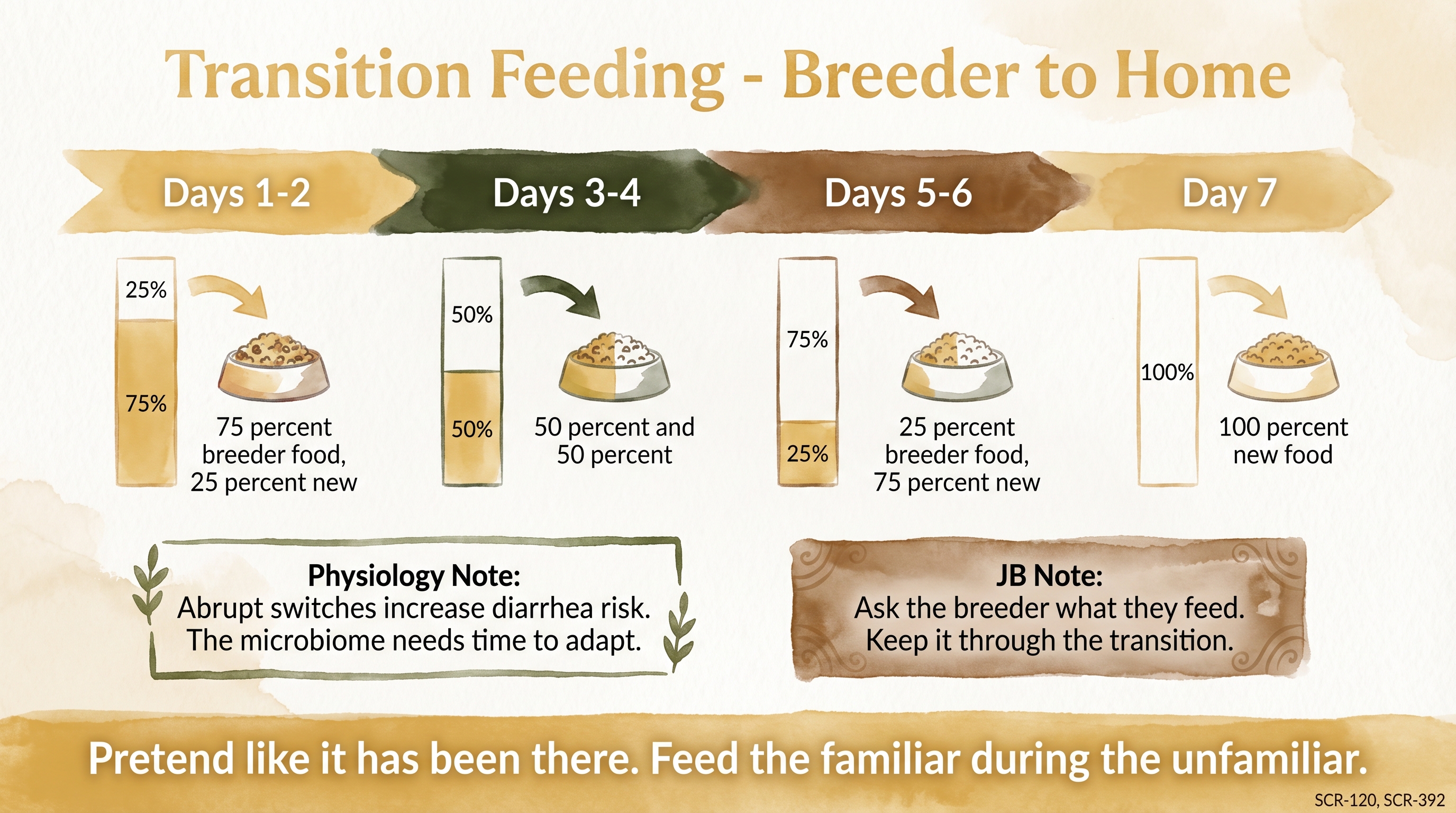
Pretend like it has been there - feed the familiar during the unfamiliar.
Key Takeaways
- Gradual food transition is usually safer than abrupt change when a puppy diet really does need to change.
- JB's added preference is to avoid changing the food at all during the first short homecoming window if it is not necessary.
- Keeping food and meal rhythm stable during rehoming reduces the number of physiologic variables the puppy is forced to absorb at once.
- After the puppy settles, any desired diet change can be made gradually and with much less stacked stress.
The Evidence
The evidence here works in layers. Gradual food transition is supported because abrupt change increases gastrointestinal disruption. Puppy microbiome and enzyme adaptation make that biologically plausible. The stronger JB-specific step, holding the food constant for a short settling window, remains observed rather than trial-proven. That is the right rhetorical ceiling. It is a thoughtful protocol grounded in known physiology and transition stress, not a closed scientific law.
The important distinction is between two claims. Claim one is standard nutrition science: abrupt diet changes can produce diarrhea, and gradual transition is usually better tolerated. Claim two is the JB protocol: when the puppy is entering a new home, avoid changing the food at all for roughly two weeks if there is no pressing reason to do so. The first claim is well aligned with gastrointestinal physiology and clinical experience. The second claim is an operational extension of that science into a specific rehoming protocol.
That extension is still sensible. The gut microbiome adapts over days to weeks. Digestive enzyme patterns do not instantly remodel when the substrate changes. Stress itself can influence appetite, motility, and stool quality. It is therefore biologically coherent that holding the diet steady during a major social and environmental transition would reduce the chance of stacked digestive disruption.
What we do not have is a randomized trial assigning newly placed puppies to "same food for two weeks" versus "gradual transition starting immediately" and measuring all outcomes. That absence matters. It is why the page does not pretend that the exact two-week interval is scientifically settled. The correct evidence ceiling is observed. JB is making a practical stewardship recommendation that fits the known biology better than its opposite, not claiming a finished literature that does not exist.
That distinction is exactly the kind of slippage discipline the wiki is supposed to preserve. We can say the protocol is thoughtful, coherent, and field-tested in the breeder-to-home context. We should not say it has been universally proven as the one best duration for every puppy in every home.
- Puppy nutrition source synthesispuppies
Dietary transitions can perturb stool quality and microbiome-related outcomes, with gradual change producing better GI tolerance than abrupt change. - Liao et al. transition workpuppies
Gradual dietary transition reduced diarrhea and altered microbial and metabolite patterns compared with abrupt change.
- JB transition-feeding protocolGolden Retriever puppies in breeder-to-home context
Holding food constant during the first two weeks home is an observed protocol choice intended to minimize stacked stressors and GI disruption during rehoming.
No published study directly tests the practical implications of transition feeding: breeder to home for domestic dog raising programs. The application to household dog raising remains an interpretive synthesis rather than a directly tested intervention finding.
SCR References
Sources
- National Research Council. (2006). Nutrient Requirements of Dogs and Cats. Washington, DC: The National Academies Press.
- AAFCO. (2024). Official Publication. Association of American Feed Control Officials.
- Nap, R. C., & Hazewinkel, H. A. W. (1994). Growth and skeletal development in the dog in relation to nutrition; a review. Veterinary Quarterly, 16(1), 50-59.
- WSAVA Global Nutrition Committee. (2011). WSAVA nutritional assessment guidelines. Journal of Small Animal Practice, 52(7), 385-396.
- Laflamme, D. P. (1997). Development and validation of a body condition score system for dogs. Canine Practice, 22(4), 10-15.