Closing the Transition Category: The Hand-Off to Daily Life
The Transition category has been building one argument across sixty entries: the first week is calibration, the first month is integration, and the harder moments that follow are still part of the same relationship rather than evidence that the relationship failed. Families needed logistics, then rhythm, then recovery, then a deeper explanation of the language tying breeder and household together. What remains after all of that is simple and demanding at the same time. The first month is not a performance. It is a relationship being built one calm hour at a time. Observed-JB
What It Means
Across the category, three layers have come into focus.
First, the puppy needed a soft landing into the actual house: sleep, greetings, food, handling, and the first calm perimeter. Observed-JB
Second, the family needed help understanding the longer shape of the month: honeymoon, regression, settled baseline, and early integration.
Third, the family needed honesty about difficulty: some transitions are harder, some mistakes are recoverable, support is part of the architecture, and the communication system matters as much as the logistics.
That is what this category has really built.
It has not built a training plan.
It has built an orientation.
The Popular Mnemonic, One Last Time
Families often leave this category still wanting a date on the calendar that says the dog is fully home now. Observed-JB
JB's final answer is still the same.
The later stage people hope for is not best understood as a fixed date.
It is better understood as a shared state: the dog knows the household, the household knows the dog, and both are living inside a calmer ordinary rhythm together.
That state arrives differently across dogs.
What the Family Has Actually Done
By the time a family reaches the end of this category, it has done more than survive puppyhood.
It has learned how to: lower noise, read arousal, pause before reacting, use structure without hardness, and keep the relationship readable under pressure.
Those are not temporary competencies.
They are the opening skills of daily life with the dog.
Why It Matters for Your Dog
This closing page matters because it helps families understand that the transition was never only about the puppy becoming theirs. Observed-JB It was also about the family becoming the kind of adults the puppy could live with well.
The family does not graduate out of calmness once the puppy is more settled. The same relational language that built the transition is the language that carries daily life, adolescence, adulthood, and aging. The work changes shape, but the vocabulary remains.
That is the handoff into what comes next. Dispatch 6 opens the Living With Your Dog category with daily rhythms and core practice. Observed-JB Nothing about that next category is a reset. It is the continuation of the same voice, the same tempo, and the same five-pillar language inside ordinary family life.
The first week was calibration.
The first month was integration.
Everything from here is the life of the relationship.
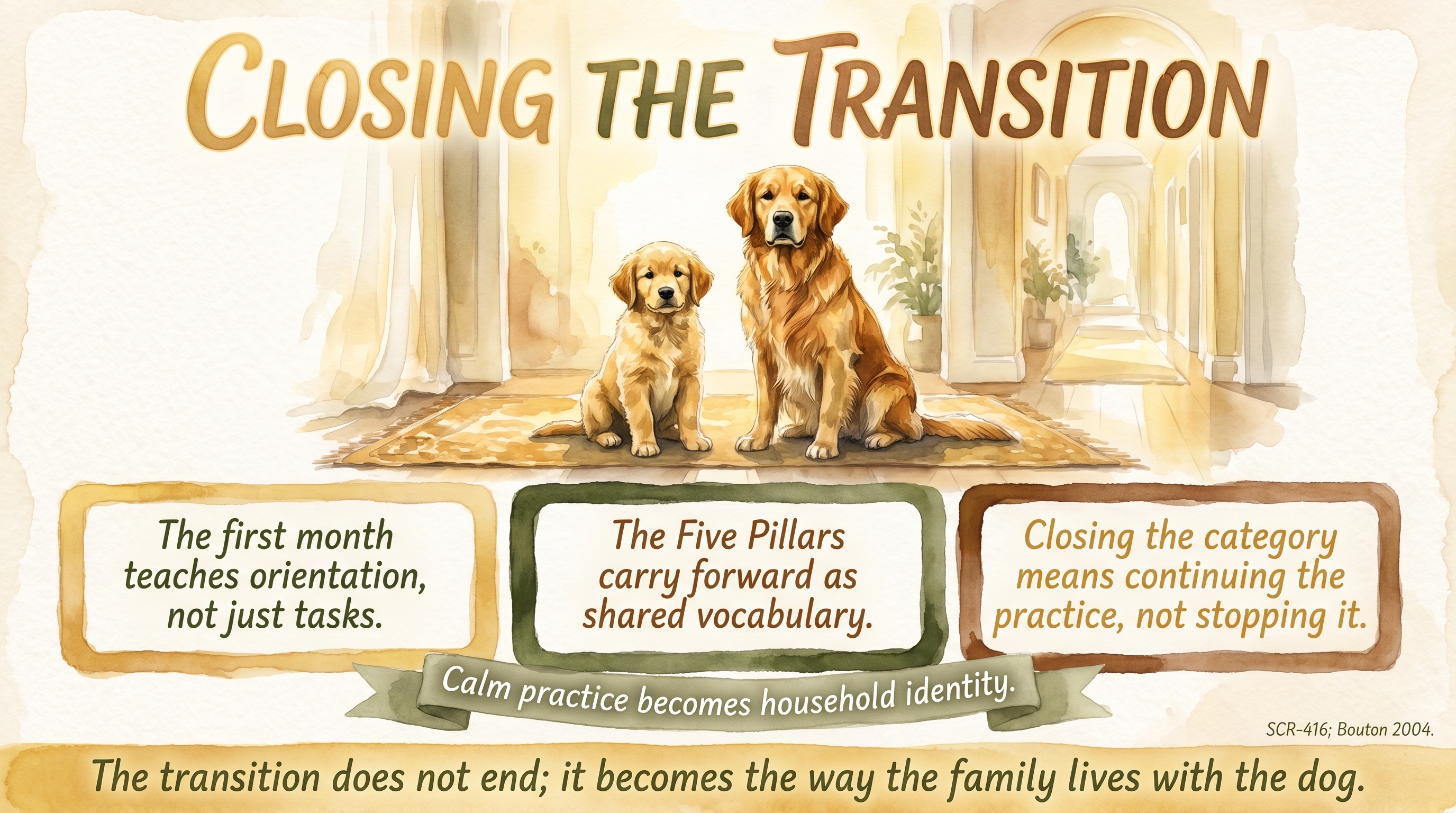
The transition does not end; it becomes the way the family lives with the dog.
Key Takeaways
- The Transition category built logistics first, then integration, then recovery and continuity when life was harder than expected.
- The core lesson is that the first month is not a performance but a relationship built in calm ordinary hours.
- What families learned here is not temporary puppy management but the opening vocabulary of daily life with the dog.
- The next category continues this same language through daily rhythms and core practice rather than replacing it with something new.
The Evidence
- Brubaker & Udell (2023); van Herwijnen et al. (2018, 2020); de Assis et al. (2025)domestic dogs
Readable, responsive, and stable caregiving remains important beyond the first days of transition, supporting the idea that early adjustment patterns feed into later everyday life.
- JB breeder and family observationfamily-raised puppies
Families who learn the calm, structured, prevention-first vocabulary of the transition carry that same language forward more successfully into ordinary life than families who treat the first month as an isolated project.
No published study directly tests the specific Just Behaving guidance on closing the transition category. This entry relies on broader canine evidence, breeder observation, and practical synthesis.
SCR References
Sources
- Brubaker, L., & Udell, M. A. R. (2023). Does pet parenting style predict the social and problem-solving behavior of pet dogs (Canis lupus familiaris)? Animal Cognition, 26(1), 345-356. https://doi.org/10.1007/s10071-022-01694-6
- van Herwijnen, I. R., van der Borg, J. A. M., Naguib, M., & Beerda, B. (2018). The existence of parenting styles in the owner-dog relationship. PLOS ONE, 13(2), e0193471. https://doi.org/10.1371/journal.pone.0193471
- van Herwijnen, I. R., van der Borg, J. A. M., Naguib, M., & Beerda, B. (2020). Dog-directed parenting styles predict verbal and leash guidance in dog owners and owner-directed attention in dogs. Applied Animal Behaviour Science, 232, 105131. https://doi.org/10.1016/j.applanim.2020.105131
- de Assis, L. S., Georgetti, B., Burman, O. H. P., Pike, T. W., & Mills, D. S. (2025). Development of a dog owner caregiving style scale (Lincoln Owner Caregiving Questionnaire, LOCQ) and its relationship with behaviour problems in dogs. Applied Animal Behaviour Science, 287, 106628. https://doi.org/10.1016/j.applanim.2025.106628