Brief Separations, Not Separation Training
The first month should include short periods when the puppy is not physically attached to the family. JB agrees with that. Where JB differs is in the framing. Alone time in a new puppy's life is best introduced as a normal part of household rhythm, not as a dramatic training project. That does not mean separation-distress protocols are wrong. They are evidence-informed and important for dogs who actually need treatment. Documented It means a well-supported new puppy usually does not need its everyday absences turned into a performance from the start. Observed-JB
What It Means
Puppies should learn that humans come and go.
That lesson matters.
But the way the lesson is presented matters just as much.
JB does not want brief absence to feel like: a test, a suspense scene, and a highly managed event. Observed-JB
It wants it to feel ordinary.
The Middle Path
Families often drift toward one of two extremes.
The first is avoiding all separation for days or weeks because the puppy seems too new, too little, or too attached to handle it.
The second is launching a formal protocol immediately: countdown-style departures, elaborate departure routines, highly charged returns, and constant monitoring of every second away.
Both extremes can make absence feel larger than it is.
The middle path is quieter.
The puppy rests in a calm room, bedroom, pen, or other protected setup for a short period while the family does ordinary life: takes a shower, goes outside briefly, works in another room, and leaves the house for a short errand. Observed-JB
The adults return in the same emotional register they left with.
Secure Attachment Is Not Constant Contact
This page matters philosophically because many people confuse attachment with never letting distance happen.
That is not how healthy attachment works.
A securely attached puppy learns: you leave, the environment stays understandable, you come back, and nothing dramatic had to happen in between. Observed-JB
That is much more useful than teaching the puppy that every departure requires a full ceremony.
Why Matter-of-Fact Returns Matter
Adults often put all their emotion into reunions.
They kneel, chatter, hug, and turn the return into a major event.
That can accidentally teach the puppy that the absence really was something huge.
JB prefers a calmer sequence: return, check the puppy quietly, take it out if needed, and resume life. Observed-JB
Warmth is still there.
What disappears is the theatricality.
What a Crash Landing Looks Like
Separation-related crash landings usually develop in one of two ways.
In one version, the family keeps the puppy constantly near them for weeks because it feels loving. Then the first real absence arrives all at once and feels enormous because the puppy has never experienced ordinary distance.
In the other version, the family becomes so worried about future separation problems that every brief absence turns into a ritual: special setup, special departure phrase, special observation period, and special reunion.
The puppy learns that being left is a special thing.
JB is trying to teach the opposite.
Alone time is part of life.
Not punishment.
Not abandonment.
Not a training performance.
Why It Matters for Your Dog
This page matters because many adult separation problems are made worse when absence has too much emotional charge wrapped around it. A puppy who experiences calm, digestible, ordinary moments alone begins building a different expectation. Distance can happen without panic and without spectacle.
Prevention here means not teaching the puppy that every departure is important. The quieter the household makes brief separation, the easier it is for the puppy to absorb alone time as a normal feature of family life.
This also helps the humans. Families often feel guilty about leaving a new puppy, even for a few minutes. The matter-of-fact approach gives them a healthier way to think about it. They are not damaging the bond by allowing short separations. They are helping the bond mature into something stable.
The puppy does not need distance to feel emotionally heavy in order to value closeness.
It only needs closeness to be reliable.
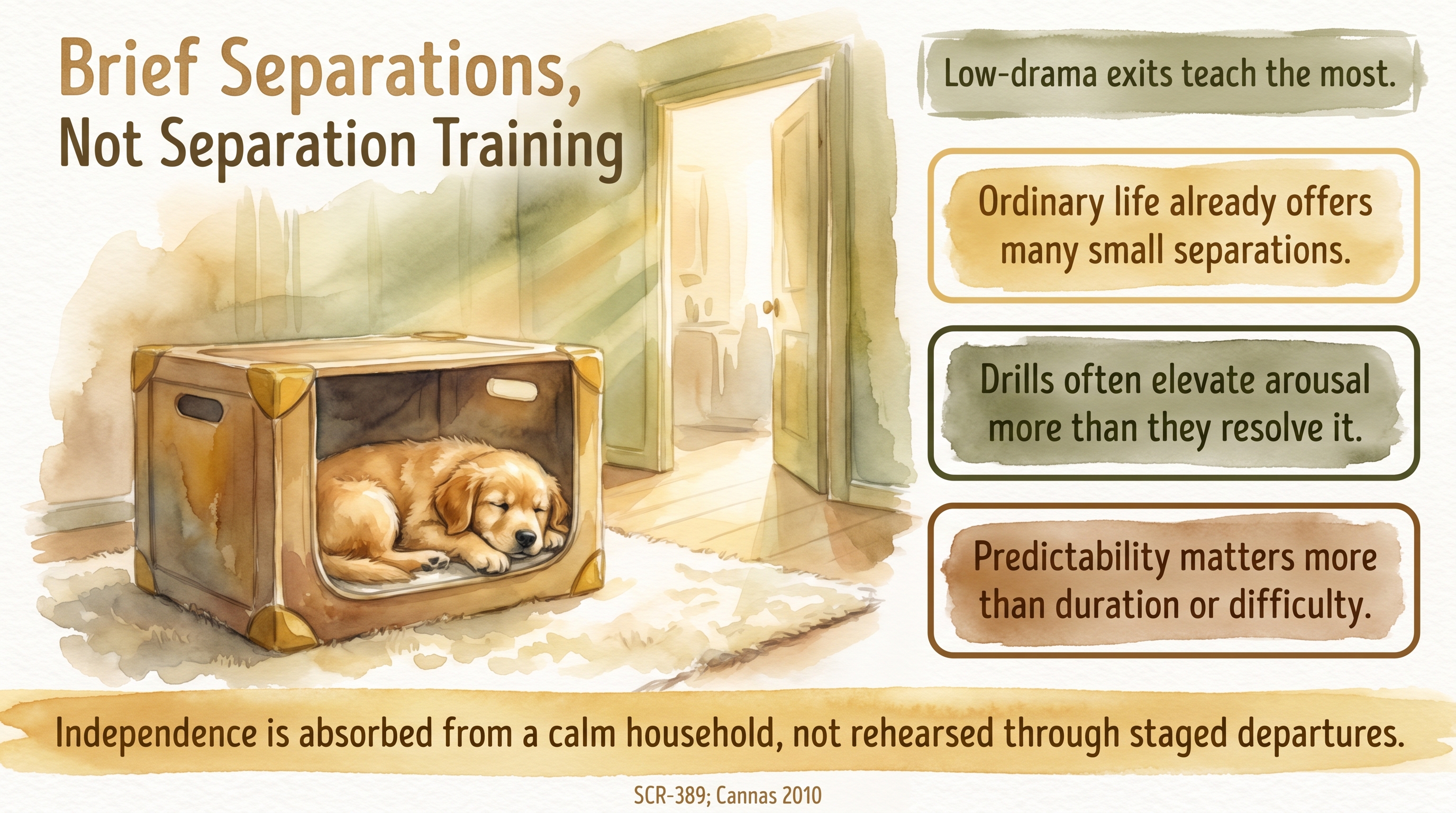
Independence is absorbed from a calm household, not rehearsed through staged departures.
Key Takeaways
- The first month should include brief separations, but those separations are best introduced as ordinary life rather than as a dramatic training project.
- Secure attachment does not require constant contact; it requires predictable distance and reliable return.
- Highly charged departures and reunions can accidentally teach the puppy that absence is a major event.
- Matter-of-fact alone time is a prevention strategy that helps the puppy absorb separation as a normal part of family life.
The Evidence
- Topal et al. (1998); Horn et al. (2013); Dale et al. (2024); Thielke & Udell (2019)domestic dogs
Dogs form meaningful attachment bonds, and clinically distressed dogs can benefit from structured treatment protocols aimed at reducing separation-related panic. - Topal et al. (1998); Horn et al. (2013); Dale et al. (2024); Thielke & Udell (2019)domestic dogs
Healthy attachment is compatible with temporary distance when the broader social environment remains predictable and safe.
- JB transition observationfamily-raised puppies
Brief, ordinary absences woven into household rhythm produce steadier month-one alone-time baselines than either total avoidance of separation or highly ritualized early protocols in otherwise stable puppies.
No published study directly tests the specific Just Behaving guidance on brief separations, not separation training within a breeder-to-family transition, so this entry relies on broader canine evidence, breeder observation, and practical synthesis rather than a direct trial of the full protocol.
SCR References
Sources
- Topal, J., Miklosi, A., Csanyi, V., and Doka, A. (1998). Attachment behavior in dogs: A new application of Ainsworth's Strange Situation Test. Journal of Comparative Psychology, 112(3), 219-229. https://doi.org/10.1037/0735-7036.112.3.219
- Horn, L., Huber, L., and Range, F. (2013). The importance of the secure base effect for domestic dogs. PLoS ONE, 8(1), e65296. https://doi.org/10.1371/journal.pone.0065296
- Dale, F. C., Burn, C. C., Murray, J., & Casey, R. (2024). Canine separation-related behaviour at six months of age: Dog, owner and early-life risk factors identified using the 'Generation Pup' longitudinal study. Animal Welfare, 33, e60, 1-16. https://doi.org/10.1017/awf.2024.56
- Thielke, L. E., & Udell, M. A. R. (2019). Evaluating cognitive and behavioral outcomes in conjunction with the secure base effect for dogs in shelter and foster environments. Animals, 9(11), 932. https://doi.org/10.3390/ani9110932