The Wolf Family Unit
Compound evidence detail1 SCR / 2 parts
- Documentedthe wolf-side scientific record on the dominance model - Schenkel 1947 captive-pack methodology limitations, Mech 1999 wild-pack family-unit field data, and the AVSAB 2008 position statement against dominance-based training
- Heuristicthe JB application transferring the wolf family-unit framing to the dog-human relational architecture, an interpretive bridge that Mech's wolf data does not directly test in training contexts
Wild wolf packs are primarily family units, not permanent rank wars among unrelated adults. That correction matters because so much dog-training culture was built on the older captive-wolf story. The wolf evidence does not tell families to treat dogs as wolves, but it does retire the myth that healthy canid leadership is fundamentally a dominance spectacle. Documented-Cross-Species
What It Means
Mech's field work changed the terms of the conversation. In natural wolf packs, the "alphas" are usually the breeding parents, and the rest of the pack is their offspring from current and previous years. Observed-JB That means the organizing relationship is parental, not gladiatorial. Adults lead movement, food access, den life, and protection because they are the experienced adults in a family system. The young do not need to be crushed into submission for structure to exist.
That family structure has developmental consequences. Wolf pups are not dumped into unrestricted freedom and asked to self-invent maturity. Their access to the wider world changes by stage: den, rendezvous site, supervised excursions, then broader participation. Documented-Cross-Species Food transfer, social buffering, and alloparental involvement are part of the architecture. Older group members matter. Parenting is distributed. That is why the wolf record is relevant to the Foundations category. It supplies an ethological picture of how structured social development can work without reducing leadership to intimidation.
The correction also matters because the older dominance model was not just a minor scientific error. It shaped a whole training culture. Once dogs were imagined through a permanent rank-conflict story, everyday puppy behavior became easy to misread as challenge rather than development. Documented Excitement became defiance. Confusion became manipulation. The family started asking control questions instead of developmental questions. The science now gives a cleaner starting point.
The boundary matters just as much. Domestic dogs are not wolves, and pet dogs in houses are not wild packs. Free-ranging dogs do not build stable multigenerational hunting families the way wolves do. The wolf record therefore functions best as context, not as a direct protocol manual. It shows that parental leadership and graduated development are biologically intelligible canid patterns. Documented It does not prove that every wolf behavior should be imported into family life.
Why It Matters for Your Dog
The practical value of the wolf family correction is that it frees families from a false choice. They do not have to choose between permissiveness and dominance theater. There is a third option: calm adult leadership. That is exactly why this topic belongs in the Foundations layer. It helps explain the logic under Structured Leadership before the philosophy ever starts sounding like a method.
The wolf record supports the idea that social order in canids often grows from parental role, experience, and developmental timing, not from constant status combat.
This changes how people read hard moments. A puppy pushing through a doorway is not automatically making a political statement. An adolescent ignoring a cue is not automatically trying to overthrow the adults. Those behaviors still matter, and adults still need to respond. The point is that the response should look more like mature parental guidance than like rank performance.
It also changes how families think about correction. In wolf parenting, communication is graded. Body position, stare, tension, growl, and contact inhibition all exist inside a social system where full-force aggression is not the organizing principle of raising. That helps explain why JB treats correction as communication rather than as punishment. Heuristic The wolf record does not prove the full JB philosophy. It does show that subtle, proportional social signaling is more ethologically grounded than the culture of domination made it seem.
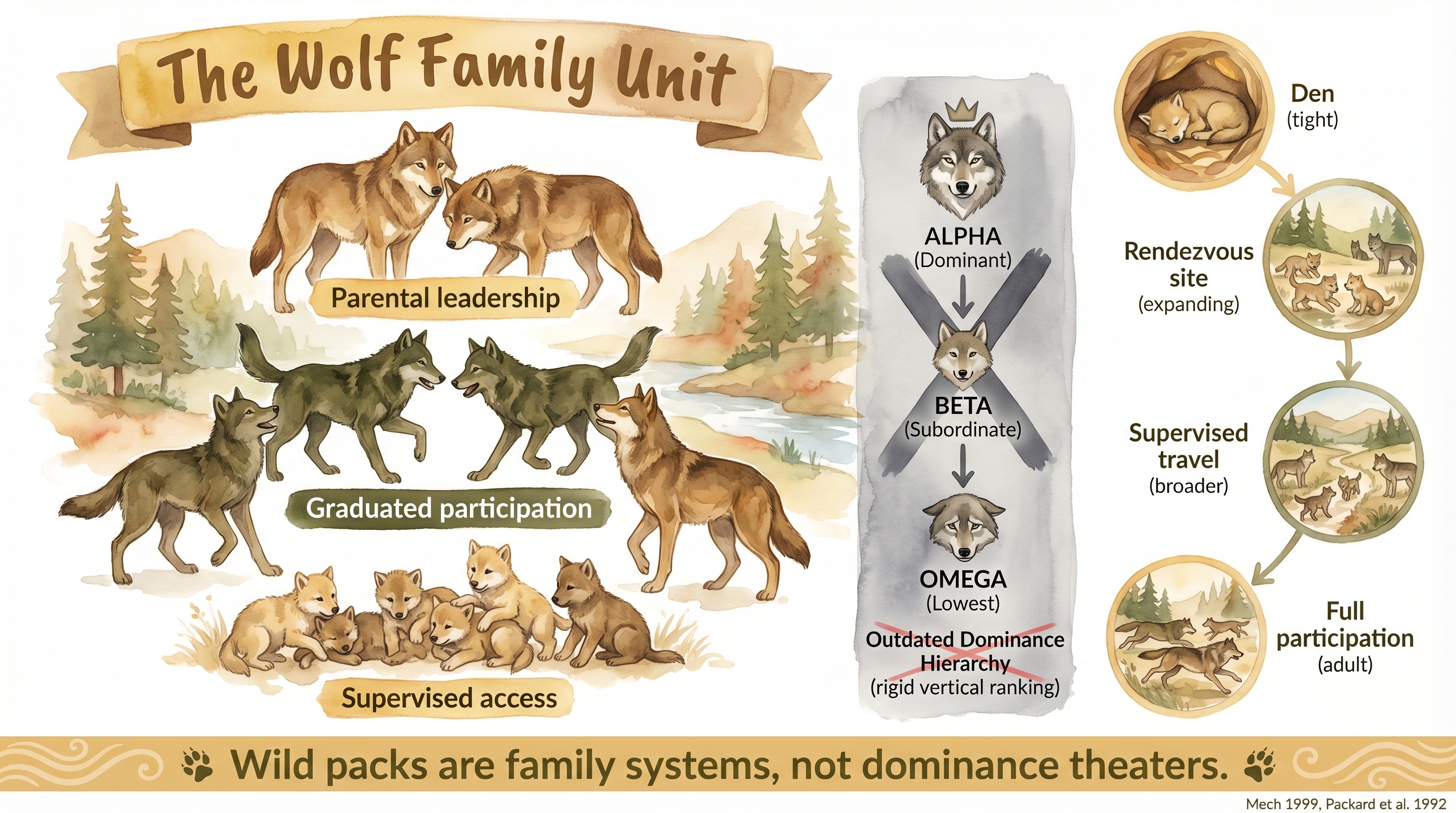
Wild wolf packs are family systems led by breeding parents with graduated developmental access - not the dominance theaters captive-wolf studies originally described.
Key Takeaways
- Wild wolf packs are mainly family units led by breeding parents, not endless dominance contests among unrelated adults.
- That matters because it makes parental leadership a better canid model than alpha theater.
- The wolf record is context, not a household blueprint, but it strongly supports the idea that canid development is structured and staged rather than chaotic.
- For families, the practical lesson is simple: act like the steady adult in a family system, not like a rival trying to win status.
The Evidence
This entry uses observed claim-level tags beyond the dedicated EvidenceBlocks below. These tags mark JB program observation or practice-derived claims that need dedicated EvidenceBlock coverage in a later content pass.
This entry uses heuristic claim-level tags beyond the dedicated EvidenceBlocks below. These tags mark JB interpretive application rather than direct study findings.
- Mech, L. D. (1999)wild wolves
Showed that natural wolf packs are primarily family groups in which the breeding pair functions as parents rather than as dominance champions. - Packard, J. M., Mech, L. D., & Ream, R. R. (1992)wolves
Documented wolf parenting and weaning as staged, structured, and socially regulated rather than as a rank contest. - Ruprecht, J. S. et al. (2012)wolves
Showed that homesite attendance and caregiving involvement shift by sex, breeding status, and helper number, reinforcing the family-system picture.
- SCR-157 synthesiswolves and domestic dogs
The alpha-wolf model popular in training culture came from captive-wolf observations and does not describe natural wild pack structure. - AVSAB position statement (2008, updated guidance thereafter)domestic dogs
Veterinary behavior guidance moved away from dominance-theory applications built on outdated wolf interpretations.
No published study directly compares JB-style structured household leadership to other family management styles using wolf-family structure as the explicit theoretical basis. The wolf-to-household application remains a bounded interpretive bridge rather than a direct experimental translation.
SCR References
Sources
Mech, L. D. (1999). Alpha status, dominance, and division of labor in wolf packs. Canadian Journal of Zoology, 77(8), 1196-1203. https://doi.org/10.1139/z99-099
Packard, J. M., Mech, L. D., & Ream, R. R. (1992). Weaning in an arctic wolf pack: behavioural mechanisms. Canadian Journal of Zoology, 70(7), 1269-1275. https://doi.org/10.1139/z92-178
Ruprecht, J. S., Ausband, D. E., Mitchell, M. S., Garton, E. O., & Zager, P. (2012). Homesite attendance based on sex, breeding status, and number of helpers in gray wolf packs. Journal of Mammalogy, 93(4), 1001-1005. https://doi.org/10.1644/11-MAMM-A-386.1
American Veterinary Society of Animal Behavior. (2008). AVSAB position statement on dominance theory in behavior modification of animals. Journal of Veterinary Behavior, 3(2), 85-86. https://doi.org/10.1016/j.jveb.2008.04.003