Wolf Family Structure
Compound evidence detail1 SCR / 2 parts
- Documentedthe wolf-side scientific record on the dominance model - Schenkel 1947 captive-pack methodology limitations, Mech 1999 wild-pack family-unit field data, and the AVSAB 2008 position statement against dominance-based training
- Heuristicthe JB application transferring the wolf family-unit framing to the dog-human relational architecture, an interpretive bridge that Mech's wolf data does not directly test in training contexts
The wolf-family-structure correction matters because so much dog-training language was built on the wrong wolf story. Documented The popular alpha model came from captive, unrelated wolves placed in artificial groupings. Later field work showed that wild packs are primarily family units: parents and offspring, not a perpetual competition for rank.
What It Means
The old dominance story was compelling because it was simple. Wolves were imagined as locked in constant rank contests, and dog owners were told they had to establish top status or the dog would do it instead. Documented That narrative traveled from captive-wolf observation into dog-training culture, where it became a justification for coercive leadership rituals.
The problem is that the foundational picture was wrong in exactly the way that mattered most. Schenkel's work described captive wolves in a context that did not reflect wild pack life. Mech's later field research showed that wild packs are usually family groups organized around breeding parents and offspring. Documented In that setting, so-called alpha status is better understood as parental role, not a constant violent contest for supremacy.
That distinction changes the developmental lesson entirely. If wolf packs are fundamentally family units, the relevant model for raising young is not domination theater. It is parental guidance. Adults lead because they are the adults. They have experience, they define movement, and they organize group life. The young do not need to be crushed into submission for the structure to exist.
JB uses this correction carefully. It does not claim that wolf and dog life are identical or that every wolf behavior can be imported into a family home. It does say that the old alpha myth is a poor scientific foundation for dog-raising theory.
That matters because Structured Leadership is often misunderstood as a softer version of the same myth. It is not. JB is not saying, "You must be alpha, but kindly." JB is saying the better model is parental authority: calm, experienced, directional, and socially organizing without needing to become adversarial.
There is an important nuance here. Mech did not argue that dominance never exists as a descriptor in canid social life. The correction is narrower and more useful than that. The problem is treating dominance struggle as the master story of pack life and then importing that story into dog-human relationships as though every disagreement is a status contest. That is the real distortion.
Once that distortion takes hold, almost every common puppy issue can be misread. Documented Jumping becomes defiance. Excitement becomes challenge. Confusion becomes status-seeking. The family stops asking developmental questions and starts asking control questions. That shift alone can push households toward harsher handling than the situation actually requires.
AVSAB's formal guidance against dominance-based training strengthens that practical takeaway. Veterinary behavior has moved away from rank-conflict explanations because the science behind the old model does not support the cultural story training popularized. Documented The remaining nuance matters: dominance can still exist as a descriptor of certain social relationships. The problem is turning that into a universal dog-human training script.
This is why the wolf-family correction belongs under Structured Leadership. It removes one of the most common false alternatives. The choice is not between permissiveness and alpha enforcement. There is a third option: act like the stable adult in a family system.
Why It Matters for Your Dog
Families often feel pressure to "show the dog who's boss" as soon as boundaries become hard. Observed-JB The wolf-family correction gives them a better question to ask. Instead of, "How do I dominate this dog?" the question becomes, "How does a stable adult guide a young social mammal?"
The lesson from wolf family structure is not domination. It is that real social order in canids is often organized around parental role, not theatrical contests for rank.
What the corrected model supports:
- guidance rather than intimidation
- parental steadiness rather than rank performance
- boundaries without coercive ritual
- leadership through social organization
What it rejects:
- alpha rolls
- status battles with the dog
- adversarial relationship framing
- using flawed captive-wolf narratives as household philosophy
What families gain from the correction:
- permission to hold structure without aggression
- a better scientific explanation for why parental authority is not the same as dominance theater
- freedom from the false choice between permissiveness and coercion
The deeper value of this correction is conceptual. It lets families hold structure without importing force-based mythology to justify it.
It also returns the conversation to development. If the right model is parent and offspring rather than alpha and rival, then guidance, steadiness, and calm authority make far more sense than ritualized rank contests.
That does not solve every dog problem by itself. It does something just as important first: it keeps families from starting with the wrong story about what the relationship is.
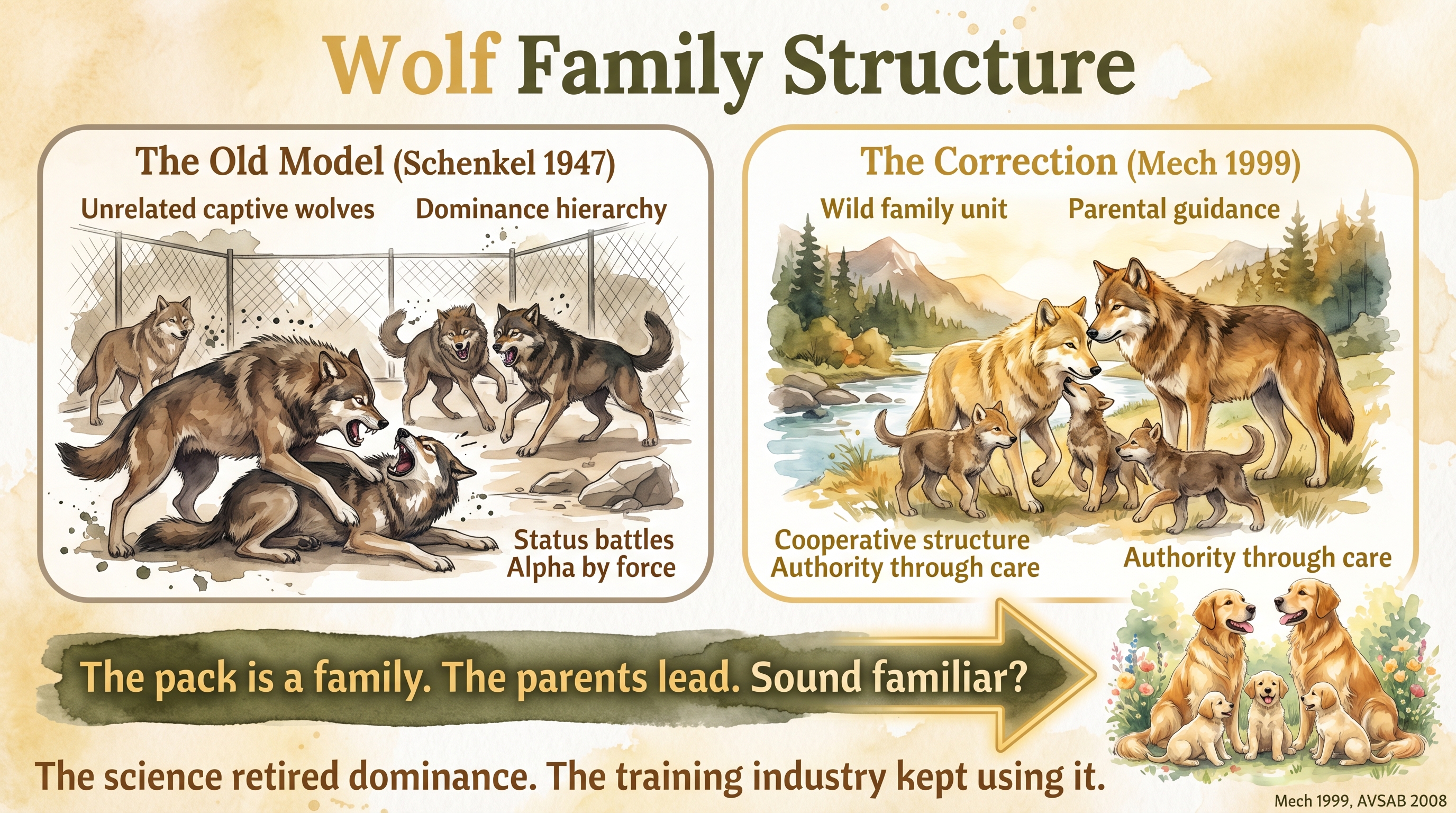
The pack is a family, the parents lead - the science retired dominance, but the training industry kept using it.
Key Takeaways
- The alpha-dominance model was built from captive wolves in unnatural groups, not wild packs where parents guide offspring in family units.
- You do not need alpha rituals or dominance theater to be the adult - real wolf families show that parental guidance and steady leadership work without coercion.
- Structured Leadership is not soft dominance, and it is not permissiveness; it is calm parental authority based on better science than the outdated alpha myth.
- Reject the false choice between dominating your dog and letting the dog run the house - there is a third path where you are simply the steady, experienced adult in a family system.
The Evidence
This entry uses documented claim-level tags beyond the dedicated EvidenceBlocks below. These claims should remain tied to the entry Sources and SCR references during the next evidence-chain authoring pass.
This entry uses observed claim-level tags beyond the dedicated EvidenceBlocks below. These tags mark JB program observation or practice-derived claims that need dedicated EvidenceBlock coverage in a later content pass.
- Schenkel (1947)captive wolves
Observed unrelated captive wolves in artificial groupings, creating the research context from which later alpha narratives were drawn. - Mech (1999)wild wolves
Field observations showed that wild packs are primarily family units in which breeding parents guide offspring. - AVSAB (2008)domestic dogs
Veterinary behavior guidance formally recommended against dominance-based training applications built from outdated wolf interpretations.
- JB synthesisdomestic dogs and wolves
The claim that Structured Leadership mirrors the better lessons of parental canid social organization is a bounded interpretive application, not a direct one-to-one wolf-to-household equivalence claim. - JB synthesisdomestic dogs
JB uses the wolf-family correction mainly to reject coercive alpha rhetoric, not to argue that pet dogs should be treated as literal wolves in a home.
No published study directly tests the specific claims or protocols described in this entry within a controlled canine trial.
SCR References
Sources
- Mech, L. D. (1999). Alpha status, dominance, and division of labor in wolf packs. Canadian Journal of Zoology, 77(8), 1196-1203.
- American Veterinary Society of Animal Behavior (AVSAB). (2008). Position statement on dominance theory in behavior modification of animals. Journal of Veterinary Behavior, 3(2), 85-86.
- Schenkel, R. (1947). Expressions studies on wolves. Behaviour, 1(2), 81-129.