Oxytocin and Bonding in Dogs
Oxytocin is a neuropeptide involved in social bonding, parental behavior, stress regulation, and social attention across mammals. In dogs, the strongest evidence shows that oxytocin is meaningfully involved in affiliation and dog-human interaction, especially in mutual gaze and experimentally altered social orientation. What it does not justify is the popular slogan that oxytocin is simply the love hormone or a guaranteed calmness chemical. Documented
What It Means
Oxytocin is produced primarily in the hypothalamus and can influence both central and peripheral systems. In mammals, it is involved in parental behavior, social attachment, affiliative contact, social salience, and parts of stress regulation. That list already shows why simplification becomes risky. Documented Oxytocin does not do one thing. It shifts how socially relevant cues are processed in context.
The Dog-Human Gaze Loop
SCR-042 captures the main modern dog finding. In at least some dog-human dyads, mutual gaze is associated with increased caregiver oxytocin, and intranasal oxytocin given to dogs can increase gazing and affiliative behavior. That is a documented modern physiological phenomenon. The loop matters because it shows that a dog-human relationship can recruit neurochemical pathways that look meaningfully social rather than purely instrumental. It is one of the clearest reasons dog bonding is discussed in neurobiological rather than only behavioral terms.
Beyond Gaze
The oxytocin literature is broader than one famous gaze study. Documented Experimental dog work shows that intranasal oxytocin can alter affiliation toward the human, proximity-seeking, social play, and use of human social cues. Affiliative interaction can also be associated with oxytocin changes in some protocols. That supports the narrower and safer claim that some forms of positive social contact recruit the canine oxytocin system in measurable ways.
Why Context Matters
One of the most useful lessons from the source layer is that oxytocin is not identical to sedation or softness. Dogs given oxytocin can become more socially engaged, not simply quieter. Documented Social play, orientation, and cue use can all increase. In broader mammalian work, oxytocin is often better understood as shaping social salience than as producing a single emotional tone. That helps correct two common mistakes: oxytocin is not a synonym for love and oxytocin is not always the opposite of arousal. The system can support calming and buffering in some contexts while also amplifying social motivation or attention in others.
Maternal and Affiliative Relevance
Oxytocin belongs in mammalian parenting science for a reason. It is deeply involved in maternal and affiliative processes across species, and the dog literature fits that broad pattern. This does not mean every nurturing event can be reduced to one molecule. It means the bonding system has an identifiable neurochemical component. That is also why oxytocin gets discussed in both attachment and social-buffering contexts. Bonding is not just preference. It is part of the regulatory architecture of social mammals.
Why It Matters for Your Dog
Bonding chemistry is real. When calm, focused attention occurs between the human and dog, their oxytocin systems respond to each other. This is not sentimentalism. It is measurable biology. That said, the science does not support treating oxytocin as a simple magic solution or claiming that any calm interaction automatically produces equal effects. Documented The most robust finding is that sustained, positive social engagement between a human and dog recruits the oxytocin system in both. This supports the philosophy that bonding is not about high arousal or entertainment. It is about quality attention, shared calm, and the kind of focused contact that the oxytocin system is primed to respond to. For families, this means that quiet time together, calm physical contact, and sustained attention on the dog are not peripheral to bonding. They are central to building the neurochemical foundation of the relationship.
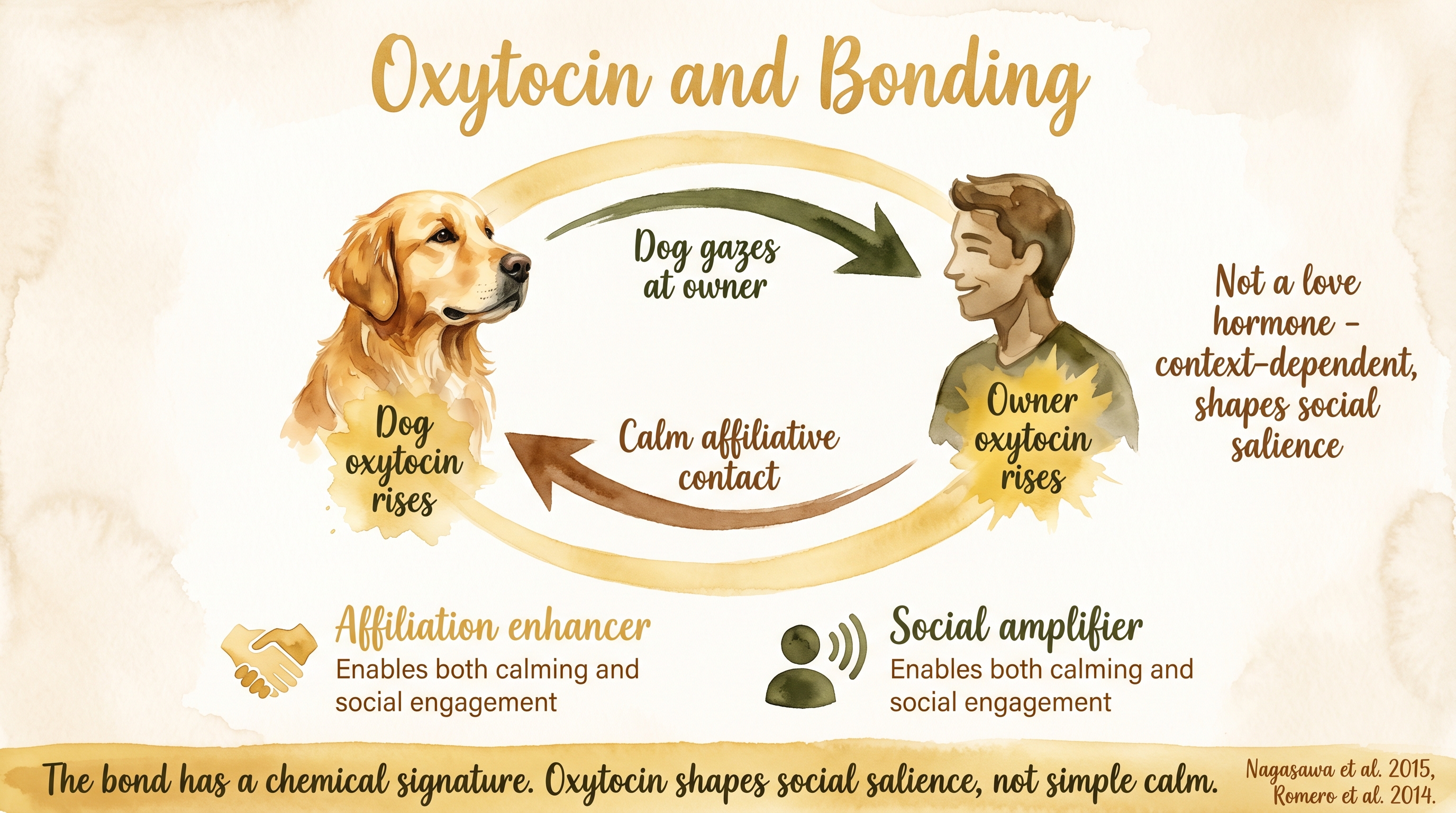
Mutual gaze between dogs and humans triggers oxytocin release in both species - a co-evolved bonding mechanism.
Key Takeaways
- Oxytocin is genuinely involved in dog bonding and affiliation.
- The dog-human mutual gaze loop is a documented modern physiological phenomenon.
- Oxytocin is better understood as a context-sensitive social regulator than as a simple love hormone.
- Modern bonding findings should not be inflated into settled domestication claims.
The Evidence Boundaries
The oxytocin literature is strong enough to support serious bonding claims. It is not strong enough to support every romanticized version of them. This page does not claim that oxytocin rises in every dog-human interaction, that calm interaction always produces the same oxytocin response, or that the documented modern gaze loop proves a specific domestication mechanism. That last point is important. The physiological loop in modern dogs is documented. The stronger evolutionary claim that this loop was itself selected during domestication remains more debated.
The secure-base layer interprets attachment as biologically real rather than sentimental language. Oxytocin helps explain why that framing is more than metaphor, while still requiring caution against one-hormone oversimplifications.
The Evidence
- Nagasawa, M. et al. (2015)domestic dogs and humans
Mutual gaze in some dog-human dyads was associated with increased caregiver oxytocin, and intranasal oxytocin in dogs increased gazing and affiliation. - Romero, T. et al. (2014, 2015)domestic dogs
Intranasal oxytocin increased affiliative orientation and social play in controlled dog studies. - Marshall-Pescini, S. et al. (2019)domestic dogs
Reviewed oxytocin as a real but context-sensitive part of the dog-caregiver relationship.
- Neumann, I. D., & Landgraf, R. (2012)multiple mammals
Reviewed oxytocin as a context-dependent regulator of social and affective behavior rather than a single-purpose bonding chemical. - Onaka, T. (2004)multiple mammals
Summarized pathways involved in central and peripheral oxytocin release during stress and social processing.
- SCR-042 boundarydomestic dogs and humans
The mutual gaze loop is documented in modern dog-owner physiology, but stronger claims that it proves a specific domestication co-selection mechanism remain debated.
No direct canine research located for this specific topic. Current understanding relies on related research, clinical observation, and cross-species inference.
SCR References
Sources
- Marshall-Pescini, S., et al. (2019). The role of oxytocin in the dog-owner relationship. Frontiers in Psychology.
- Nagasawa, M., et al. (2015). Oxytocin-gaze positive loop and the coevolution of human-dog bonds. Science, 348(6232), 333-336.
- Neumann, I. D., & Landgraf, R. (2012). Balance of brain oxytocin and vasopressin: Implications for anxiety, depression, and social behaviors. Trends in Neurosciences, 35(11), 649-659.
- Onaka, T. (2004). Neural pathways controlling central and peripheral oxytocin release during stress. Journal of Neuroendocrinology, 16(4), 308-312.
- Romero, T., et al. (2014). Oxytocin promotes social bonding in dogs. PNAS, 111(25), 9085-9090.
- Romero, T., Nagasawa, M., Mogi, K., Hasegawa, T., & Kikusui, T. (2015). Intranasal administration of oxytocin promotes social play in domestic dogs. Communicative & Integrative Biology, 8(3), e1017157. DOI: 10.1080/19420889.2015.1017157.