Caregiver Sensitivity and Attachment Security
Compound evidence detail2 SCRs / 5 parts
- Documentedthe human attachment evidence base together with the canine-direct secure-base findings (Topal 1998, Horn 2013) and Schoberl-documented physiological effects of secure caregiving in dogs
- Heuristicthe full attachment-theory apparatus transfer to canine relationships, including internal working models and attachment-classification systems
- Documentedthe Baumrind authoritative-parenting literature in human child development
- Documentedthe canine correlational evidence linking dog-directed caregiving styles to attachment, attention, sociability, and problem-solving outcomes (van Herwijnen 2018/2020, Brubaker and Udell 2023)
- Heuristicthe JB inference that one specific caregiving style experimentally produces the best long-term developmental outcomes in dogs
Attachment security does not grow from warmth alone. It grows from warmth that is readable, predictable, and paired with enough structure that the caregiver becomes usable under stress. Human attachment science documented that principle first. Dog research now supports a bounded but meaningful version of the same story. The relationship itself is not background to development. It is part of the mechanism. Mixed Evidence
What It Means
Caregiver sensitivity is a disciplined concept. It means the adult notices signals, interprets them with reasonable accuracy, and responds in a way that fits the situation without flooding, ignoring, or escalating it. That is different from indulgence. A caregiver can be affectionate and still dysregulating. A caregiver can be involved and still be inconsistent. Sensitivity is not maximum involvement. It is calibrated involvement.
In humans, secure attachment from consistent, sensitively responsive care is one of the most replicated findings in developmental psychology. Documented-Cross-Species In dogs, the transfer is not a perfect one-to-one copy, but it is increasingly well supported. Dogs form attachment bonds, show secure-base effects, and vary meaningfully in relationship quality. Solomon and colleagues adapted the Strange Situation framework to dogs with high inter-judge agreement, even while also showing that the canine classification work has more friction and ambiguity than the human version.
The parenting-style literature strengthens the practical point. Documented Van Herwijnen and colleagues showed that dog-directed parenting styles can be measured. Brubaker and Udell (2023) found that authoritative caregiving, high warmth plus high structure, was associated with stronger attachment security and better problem-solving persistence. Asher et al. (2020) then showed that adolescent conflict is worse in dogs whose behavior suggests less secure attachment. That means the relationship is not merely emotional scenery. It predicts real developmental consequences.
The right ceiling is mixed rather than purely documented because the human causal case is stronger than the canine one. Ambiguous Dog studies are richer than they were a decade ago, but many are still correlational or cross-sectional. The direction is strong. The full canine causal map is still being built. That is enough to support a serious Foundations entry without pretending the field has already closed every mechanism question.
Why It Matters for Your Dog
For families, this entry explains why JB keeps talking about being the kind of adult a puppy can trust rather than only about teaching isolated skills. Heuristic The dog is not just learning the rules. The dog is learning whether the adult is a reliable base from which stress, novelty, and challenge can be handled.
Structured Leadership works best when structure and responsiveness stay together. High structure without warmth creates pressure. High warmth without structure creates drift. Security grows in the middle.
This is also why permissiveness can look loving while still producing poorer outcomes. A permissive adult may give comfort, but if the adult never becomes an authority worth orienting to, the dog may become more dependent, more socially juvenile, or more likely to look outside the relationship for guidance. Mixed Evidence The relationship then feels emotionally busy but developmentally thin.
The practical takeaway is not that families must become perfect attachment scientists. It is that relationship quality is part of development. Calm, dependable, responsive structure is not a style preference. It is one of the most evidence-backed ways to become a usable adult for the dog.
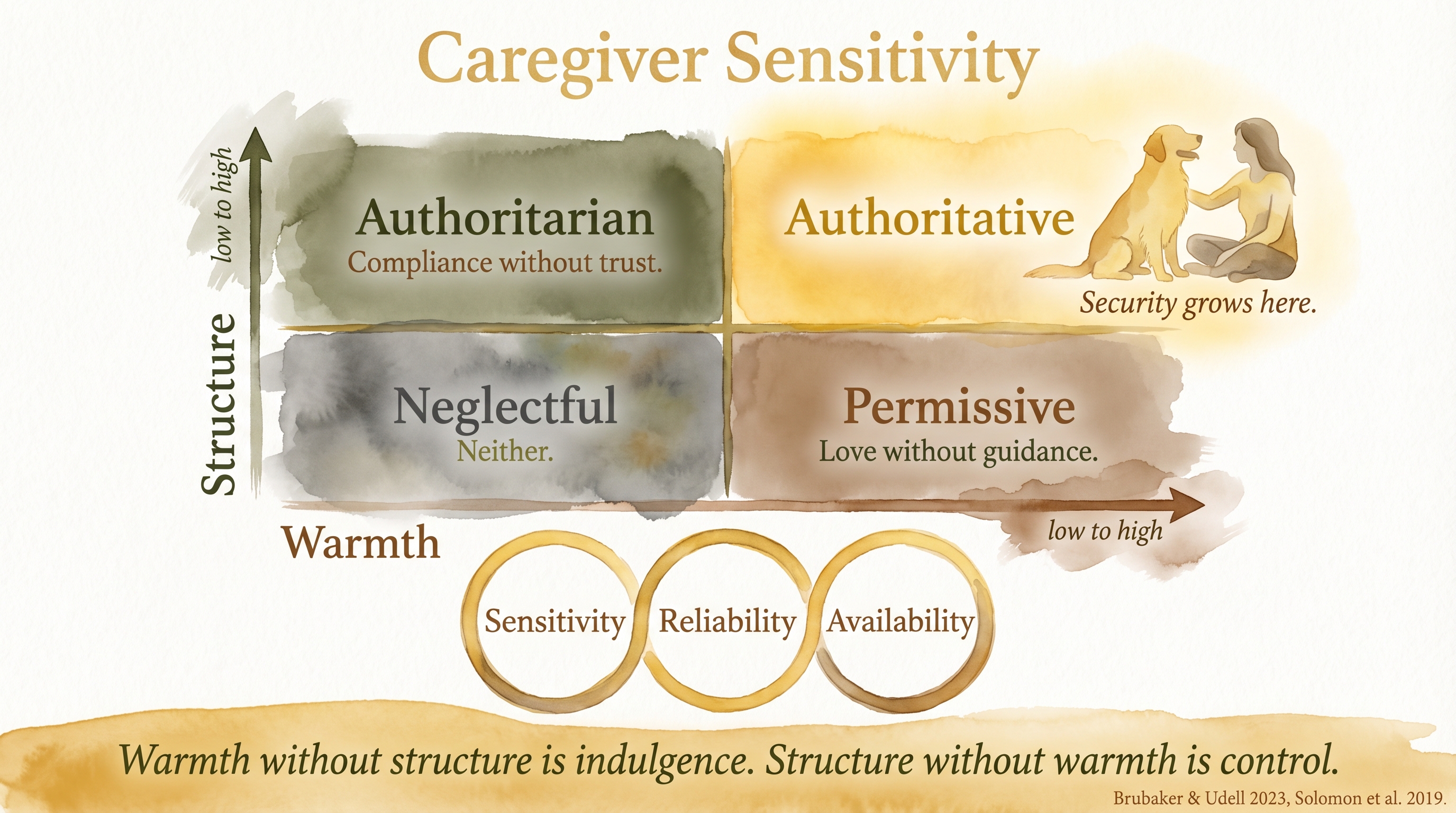
Security grows from warmth paired with structure - the authoritative quadrant predicts the best attachment and developmental outcomes.
Key Takeaways
- Attachment security depends on caregiving that is not only warm, but also readable, responsive, and structured.
- Human developmental science established that principle first, and dog research now supports a meaningful canine version of it.
- Authoritative caregiving, high warmth plus high structure, is associated with stronger canine attachment and better developmental outcomes.
- That is why JB treats relationship quality as part of the mechanism of raising, not as a sentimental add-on.
The Evidence
This entry uses heuristic claim-level tags beyond the dedicated EvidenceBlocks below. These tags mark JB interpretive application rather than direct study findings.
This entry uses ambiguous claim-level tags beyond the dedicated EvidenceBlocks below. These tags mark claims where the literature remains unsettled or multiple interpretations coexist.
This entry uses mixed-evidence claim-level tags beyond the dedicated EvidenceBlocks below. These tags mark claims that combine documented findings with observed practice, heuristic application, or unresolved gaps.
- Solomon, J. et al. (2019)domestic dogs
Adapted the Strange Situation framework to companion dogs and found substantial inter-rater agreement, supporting real canine attachment classification despite methodological friction. - Brubaker, L. & Udell, M. A. R. (2023)domestic dogs
Found that authoritative caregivers had dogs with better attachment security and stronger problem-solving persistence than permissive or authoritarian caregivers. - Asher, L. et al. (2020)domestic dogs
Showed that adolescent conflict is stronger in dogs with behavior suggesting less secure attachment to caregivers.
- Ainsworth, M. D. S. et al. (1978)humans
Established the centrality of sensitive, responsive caregiving to secure attachment. - SCR-017 synthesishumans and dogs
Supports the general claim that secure attachment grows from predictable, responsive care, while the exact canine mechanism remains somewhat less complete than the human one.
No longitudinal canine study has yet isolated the full causal pathway by which specific early caregiving differences create later attachment security, resilience, and problem-solving outcomes. The dog evidence is strong for association and growing for mechanism, but it is not yet final in the way the human literature is.
SCR References
Sources
Ainsworth, M. D. S., Blehar, M. C., Waters, E., & Wall, S. (1978). Patterns of attachment: A psychological study of the strange situation. Erlbaum.
Solomon, J., Beetz, A., Schoberl, I., Gee, N., & Kotrschal, K. (2019). Attachment security in companion dogs: adaptation of Ainsworth's strange situation and classification procedures to dogs and their human caregivers. Attachment & Human Development, 21(4), 389-417. https://doi.org/10.1080/14616734.2018.1517812
Brubaker, L., & Udell, M. A. R. (2023). Does pet parenting style predict the social and problem-solving behavior of pet dogs? Animal Cognition, 26(1), 345-356. https://doi.org/10.1007/s10071-022-01694-6
Asher, L., England, G. C. W., Sommerville, R., & Harvey, N. D. (2020). Teenage dogs? Evidence for adolescent-phase conflict behaviour and an association between attachment to humans and pubertal timing in the domestic dog. Biology Letters, 16(5), 20200097. https://doi.org/10.1098/rsbl.2020.0097