The Genomic Architecture of Tameness
Domestication did not need to rewrite the whole canid genome to make dogs behaviorally different from wolves. It only needed to land on a relatively small set of high-impact regions affecting sociability, stress biology, development, and human orientation. That is the genomic architecture of tameness: targeted biological changes that made life with humans easier long before any modern training culture existed. Documented
What It Means
One reason dog domestication is easy to misunderstand is that whole-genome similarity sounds more important than functional leverage. Dogs and wolves remain close relatives, so people often assume behavior must be mostly a matter of later environment and instruction. Observed-JB Genomics says something sharper. Selection can alter a small number of developmental, regulatory, or social-behavior pathways and still change the species in very consequential ways. The question is not how many letters differ in the abstract. The question is where selection landed.
The most famous social-behavior finding is vonHoldt et al. (2017). They identified structural variants in GTF2I and GTF2IRD1 in the canine region homologous to the human Williams-Beuren syndrome critical region. Documented In humans, disruption in that genomic neighborhood is associated with unusual sociability and reduced social inhibition. In dogs, variants in the homologous region were associated with stereotypical hypersociability. The point is not that dogs "have" Williams-Beuren syndrome. The point is that one of the clearest dog domestication findings sits in a genomic neighborhood deeply tied to social approach behavior.
The stress-regulation side of the story matters just as much. Documented Comparative genomics has identified selection signals in pathways related to adrenaline and noradrenaline biology, which is exactly where a domestication story centered on reduced reactivity would be expected to leave tracks. A calmer animal is not merely one that has been corrected into stillness. It is an animal whose arousal thresholds and recovery tendencies have been shaped by selection. That does not make all dogs calm by default. It does mean that lowered conflict cost with humans became biologically scaffolded rather than merely culturally imposed.
The neuroanatomical complement points in the same direction. The source synthesis notes more cortical regulation and less subcortical fear reactivity as part of the domestication picture. That is the key Foundations-level insight. Dogs did not become socially workable by adding a few tricks onto a wolf template. Selection seems to have nudged the underlying architecture toward greater human orientation, greater social cognition, and more regulatory potential.
The Belyaev fox work helps here, but only as an analog. Selecting foxes for tameness produced cascading behavioral and physiological changes, and Kukekova et al. (2018) showed genomic signatures of that divergence. Documented Lord et al. (2020) then supplied the methodological caution the field needed: foxes were not wild founders in a campside ecological niche, and a universal domestication-syndrome package is not cleanly established across all domesticates. So the scientifically disciplined position is this: selection for tameness can plausibly produce wide downstream change, but the fox experiment is an illustrative analog with real limits, not direct canine proof.
Why It Matters for Your Dog
The genomic story matters because it tells families that the dog is biologically prepared for relationship in a way a wolf is not. Human-directed sociability is not a sentimental overlay. It has genomic and developmental scaffolding. That does not eliminate temperament differences or the role of raising. It does retire the idea that the dog begins as an unchanged predator who must be forced into partnership from the outside.
If domestication selected for human-directed sociability and lower reactive cost around people, then adult human example becomes a biologically meaningful channel of learning rather than an artificial replacement for real canine development.
This is why JB can take human orientation seriously without treating it as fragile theatrics. Goldens, especially, inherit both the deep domestication background of the dog and later breed selection for cooperative social life with humans. Documented That combination helps explain why adult tone, household rhythm, and calm presence matter so much. They are operating inside a lineage already shaped to notice humans closely.
The genomic evidence also strengthens Prevention and Calmness. If domestication moved the species toward reduced reactive aggression and altered stress handling, then a chronically overstimulating home is not showing the dog the species' true nature. It is pushing against part of what selection appears to have prepared the animal to do well. Raising is still required, but it is raising on a domesticated platform rather than training on top of a biologically unchanged wolf.
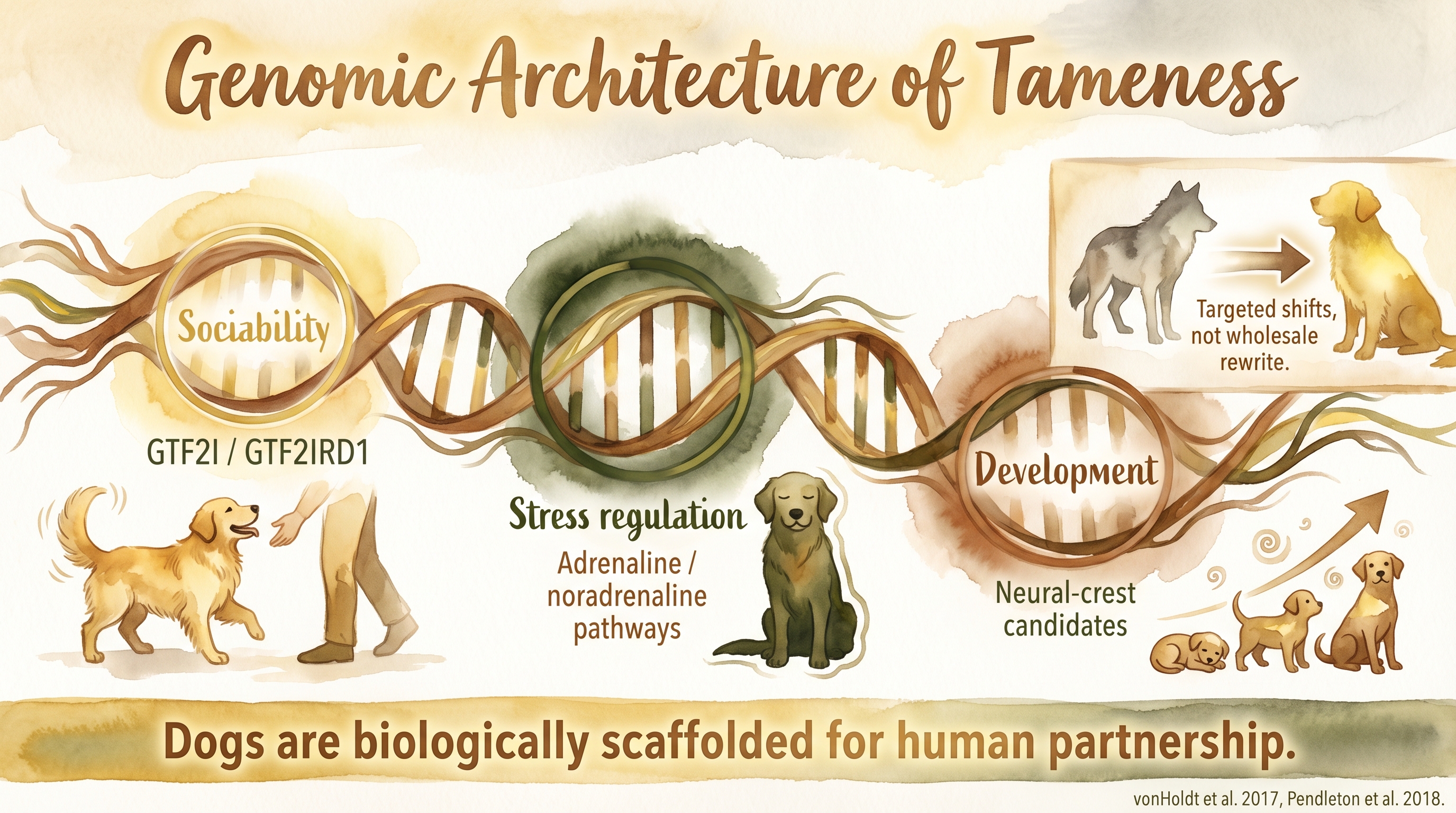
Domestication changed dogs through targeted genomic shifts in sociability, stress regulation, and development - dogs are biologically scaffolded for human partnership.
Key Takeaways
- Domestication changed dogs through targeted, high-impact genomic shifts rather than through a total rewrite of the canid genome.
- The WBS-region findings around GTF2I and GTF2IRD1 are among the clearest signs that dog sociability has a real biological scaffold.
- Selection also appears to have touched stress and developmental systems, which helps explain why dogs are easier than wolves to integrate into human social life.
- For JB, the practical point is simple: dogs are biologically prepared for partnership, which is why calm adult guidance matters so much.
The Evidence
This entry uses observed claim-level tags beyond the dedicated EvidenceBlocks below. These tags mark JB program observation or practice-derived claims that need dedicated EvidenceBlock coverage in a later content pass.
- vonHoldt, B. M. et al. (2017)domestic dogs
Identified structural variants in the canine Williams-Beuren syndrome region associated with stereotypical hypersociability toward humans. - Pendleton, A. L. et al. (2018)village dogs and wolves
Highlighted developmental candidate regions consistent with early domestication acting on behavioral and neural-crest-linked pathways. - Axelsson, E. et al. (2013)dogs and wolves
Showed that domestication left detectable selection signatures in metabolic and ecological adaptation systems, reinforcing that targeted genetic shifts can have large functional consequences.
- Kukekova, A. V. et al. (2018)silver foxes
Found genomic and regulatory divergence associated with tame versus aggressive fox lines, showing that selecting on behavior can leave measurable genomic signatures. - Lord, K. A. et al. (2020)silver foxes and multiple domesticates
Argued that the fox experiment has important methodological limits and should not be treated as a one-to-one model of canine domestication.
No published study directly maps specific domestication-associated genetic variants onto the exact household-level developmental outcomes JB cares about, such as calm baseline, mentorship receptivity, or prevention-first maturation in family homes.
SCR References
Sources
vonHoldt, B. M., Shuldiner, E., Koch, I. J., Kartzinel, R. Y., Hogan, A., Brubaker, L., et al. (2017). Structural variants in genes associated with human Williams-Beuren syndrome underlie stereotypical hypersociability in domestic dogs. Science Advances, 3(7), e1700398. https://doi.org/10.1126/sciadv.1700398
Pendleton, A. L., Shen, F., Taravella, A. M., Emery, S., Veeramah, K. R., Boyko, A. R., et al. (2018). Comparison of village dog and wolf genomes highlights the role of the neural crest in dog domestication. BMC Biology, 16, 64. https://doi.org/10.1186/s12915-018-0535-2
Axelsson, E., Ratnakumar, A., Arendt, M. L., Maqbool, K., Webster, M. T., Perloski, M., et al. (2013). The genomic signature of dog domestication reveals adaptation to a starch-rich diet. Nature, 495, 360-364. https://doi.org/10.1038/nature11837
Kukekova, A. V., Johnson, J. L., Xiang, X., Feng, S., Liu, S., Rando, H. M., et al. (2018). Red fox genome assembly identifies genomic regions associated with tame and aggressive behaviours. Nature Ecology & Evolution, 2, 1479-1491. https://doi.org/10.1038/s41559-018-0611-6
Lord, K. A., Larson, G., Coppinger, R. P., & Karlsson, E. K. (2020). The history of farm foxes undermines the animal domestication syndrome. Trends in Ecology & Evolution, 35(2), 125-136. https://doi.org/10.1016/j.tree.2019.10.011