The Commensal Pathway
Compound evidence detail1 SCR / 2 parts
- Documentedthe commensal pathway model of canine domestication treated as a leading working model in evolutionary biology, supported by Bergstrom 2020 genomics, Thalmann 2013 mtDNA, Larson and Bradley 2014, and Freedman 2014
- Heuristicthe JB interpretive bridge mapping the Five Pillars onto the selection pressures inferred to have operated during commensal domestication, a synthesis without direct genomic or archaeological support
The commensal pathway is a leading working model for how dogs first entered human life. Instead of beginning with formal taming or deliberate instruction, it argues that some wolf-like animals gained an advantage by staying near human camps long enough to feed, survive, and reproduce there. That model is widely cited and well supported, while the exact geography and full sequence of domestication remain under debate. Ambiguous
What It Means
The core idea is simple. Human camps created a new ecological niche. Food waste, carcass remains, shelter edges, and predictable human movement patterns rewarded canids that could tolerate nearness without constant flight or constant conflict. Mixed Evidence Over generations, that niche would have favored reduced fear, lower reactive aggression, greater attentiveness to human activity, and a better capacity to function inside human-adjacent space. The first dog was not selected because it knew commands. It was selected because it could live near people without coming apart.
That distinction matters because domestication timing and domestication mechanism are not the same question. Documented Ancient DNA and archaeology support a long premodern dog-human relationship, and the current genomic literature keeps the commensal pathway among the leading working models. But the record does not yet force a single clean story about exactly where domestication began or whether it proceeded through one origin, two origins, or a multistage process. Frantz et al. (2016) argued for a dual-origin model, Botigue et al. (2017) argued for continuity from ancient European dogs, and Bergstrom et al. (2022) showed a more complicated ancestry picture in which modern dogs trace to wolf populations that have not been directly sampled. The direction of selection is clearer than the map.
That is the most useful way to read the evidence. The strongest documented claim is that reduced fear of humans and successful proximity to human life sat near the center of domestication. The weaker, more interpretive claim is how to translate that into a philosophy of raising. JB does not need to say evolution proved the Five Pillars as named doctrine. The narrower and cleaner claim is that a species shaped by successful nearness to people is more likely to flourish in calm, readable, socially coherent human environments than in chronically conflict-heavy ones.
One way to picture this is to think about what a camp-edge animal had to solve. It had to notice humans without panicking, stay close without escalating, read movement and opportunity quickly, and recover from ordinary novelty fast enough to remain in the niche. Mixed Evidence Those are not training-school traits. They are regulation and social-fit traits. That is why the commensal pathway belongs in the Foundations category. It helps explain why relationship and environmental readability are not sentimental extras layered onto an otherwise wolf-like animal. They sit much closer to the species story than that.
Why It Matters for Your Dog
For families, the commensal pathway changes the picture of what kind of animal a dog is. Heuristic A dog is not just a wolf waiting to be managed through technique. A dog is an animal whose lineage was filtered by successful life around humans. That does not make every dog naturally calm in every home. It does mean that human proximity, human predictability, and human social coherence are not biologically irrelevant conditions. They are part of the niche the species was shaped to occupy.
If domestication filtered for animals that could stay near humans without escalating conflict, then calm human space is not softness. It is one of the most biologically legible conditions a dog can succeed in.
This is also why JB keeps returning to structure without theatrics. A dog lineage selected through successful proximity should be expected to organize around readable human routines more easily than around constant confrontation. Mixed Evidence That does not eliminate adolescence, temperament differences, or household mistakes. It does explain why dogs often respond so strongly to the emotional texture of the home. The home is not merely where the dog lives after training. It is part of the kind of environment dogs were selected to survive inside.
The practical takeaway is straightforward. Families do not need to create dog-human partnership from nothing, but they can absolutely make it harder or easier for that partnership to mature well. A calm, structured household fits the domesticated animal better than a household that runs on noise, unpredictability, and repeated social pressure. The commensal pathway does not prove every JB claim. It does make the JB starting point look much more evolutionarily sensible.
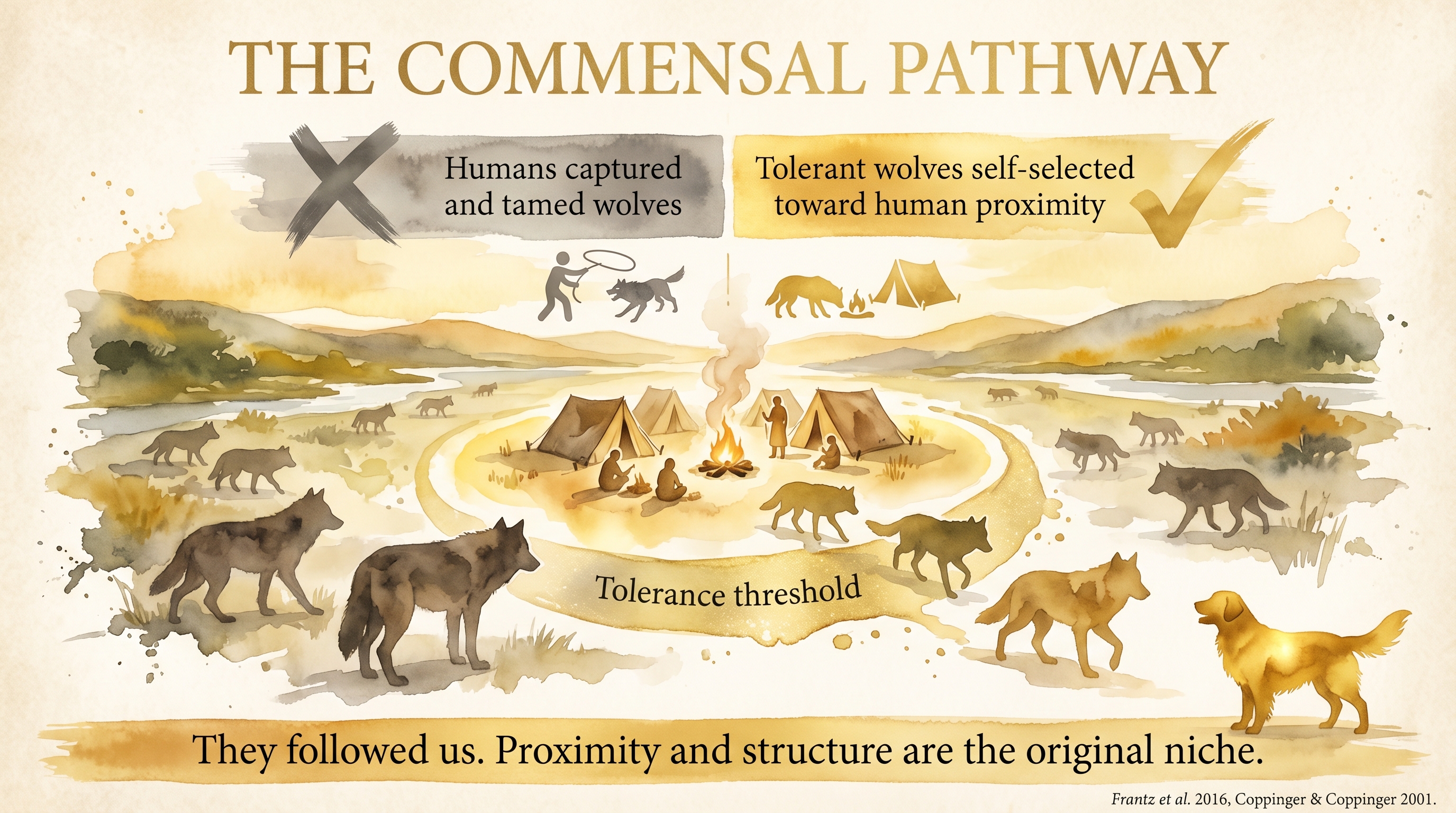
Dogs emerged because tolerant wolves gained survival advantages near human camps - proximity, structure, and human readability are the original niche, not extras.
Key Takeaways
- The commensal pathway says dogs likely emerged because some wolf-like animals were better at living near humans, not because humans first taught them formal skills.
- The strongest documented claim is about successful proximity to human camps. The exact geography and full sequence of domestication remain under debate.
- This matters for JB because it places human readability, conflict tolerance, and social fit near the center of dog biology rather than at the margins.
- A calm and coherent home does not fight domestication. It works with the kind of animal domestication appears to have produced.
The Evidence
This entry uses heuristic claim-level tags beyond the dedicated EvidenceBlocks below. These tags mark JB interpretive application rather than direct study findings.
This entry uses mixed-evidence claim-level tags beyond the dedicated EvidenceBlocks below. These tags mark claims that combine documented findings with observed practice, heuristic application, or unresolved gaps.
- Frantz, L. A. F. et al. (2016)ancient dogs and wolves
Argued from genomic and archaeological evidence that dog domestication involved a deep premodern history and may have included multiple ancestral streams. - Botigue, L. R. et al. (2017)ancient European dogs
Showed continuity between ancient and later dog populations, reinforcing that recognizable dog lineages were established long before modern breeding. - Bergstrom, A. et al. (2022)ancient wolves and dogs
Found that dogs trace to ancient wolf populations that have not been directly sampled, while still supporting a long domestication process centered on human-associated adaptation.
- SCR-001 boundaryevolutionary biology and archaeology
The commensal pathway is a leading working model in the field, but the exact geography and full sequence of domestication are not fully settled. - Coppinger, R. & Coppinger, L. (2001)dogs and village dogs
Popularized the campside ecological account, while later critiques have argued that a pure scavenger story may be too simple on its own.
No published study directly tests whether households organized around calmness, structure, and prevention produce outcomes that specifically mirror the pressures implied by the commensal pathway. That translation from evolutionary model to modern raising practice remains interpretive.
SCR References
Sources
Frantz, L. A. F., Mullin, V. E., Pionnier-Capitan, M., Lebrasseur, O., Ollivier, M., Perri, A., et al. (2016). Genomic and archaeological evidence suggest a dual origin of domestic dogs. Science, 352(6290), 1228-1231. https://doi.org/10.1126/science.aaf3161
Botigue, L. R., Song, S., Scheu, A., Gopalan, S., Pendleton, A. L., Oetjens, M., et al. (2017). Ancient European dog genomes reveal continuity since the Early Neolithic. Nature Communications, 8, 16082. https://doi.org/10.1038/ncomms16082
Bergstrom, A., Frantz, L., Schmidt, R., Ersmark, E., Lebrasseur, O., Girdland-Flink, L., et al. (2022). Grey wolf genomic history reveals a dual ancestry of dogs. Nature, 607, 313-320. https://doi.org/10.1038/s41586-022-04824-9
Coppinger, R., & Coppinger, L. (2001). Dogs: A New Understanding of Canine Origin, Behavior, and Evolution. University of Chicago Press.