Dog-Wolf Genomic Differences
Dogs and wolves are genetically close enough that people often talk as if the difference between them must be superficial. Genomics says something more interesting. The whole genomes are indeed highly similar, but domestication appears to have concentrated important changes in a relatively small number of regions affecting sociability, stress biology, development, metabolism, and morphology. Axelsson et al. 2013 made AMY2B famous as part of the starch-adaptation story. vonHoldt et al. 2017 linked dog hypersociability to structural variation in the WBSCR17 region containing GTF2I and GTF2IRD1, genes homologous to the human Williams-Beuren syndrome region. Pendleton et al. 2018 compared village dogs and wolves and highlighted loci near genes acting early in embryogenesis, consistent with neural-crest-related developmental pathways. The dispatch source review also points to selection signatures involving adrenaline and noradrenaline biosynthesis, which fit broader arguments about altered stress responsiveness in dogs. Documented
So the right takeaway is not "dogs are genetically almost wolves, therefore behavior is mostly training." The better takeaway is that a relatively small set of changes can reorganize how a species lives, learns, eats, and affiliates.
That is why genomics matters so much for JB. It lets the conversation move beyond general claims that dogs are different and toward specific systems in which domestication left a mark.
It also helps calm a common false choice. People often assume they must choose between saying dogs are basically wolves or saying dogs are an entirely separate biological mystery. Genomics supports neither extreme. Dogs remain close kin to wolves, but the places where selection landed are focused enough to matter enormously.
That focused pattern is what makes the genomic story so compelling. Evolution often works by changing leverage points rather than rewriting every trait from scratch. A shift in social, developmental, or metabolic control systems can travel outward into much larger differences in everyday behavior than raw percentage similarity would ever suggest.
What It Means
Similarity at the Whole-Genome Level Does Not Mean Small Functional Difference
One reason this topic is often misunderstood is that people hear "dogs and wolves are genetically very similar" and infer that the behavioral gap must be minor or cosmetic. Observed-JB Biology does not work that way. Small genomic differences, especially in regulatory or developmental pathways, can have large phenotypic consequences. Dogs do not need to be massively rewritten at the DNA level to become behaviorally and metabolically distinct from wolves.
That is why domestication genomics focuses less on total difference and more on selected regions. The interesting question is not how many letters differ in the abstract. It is which systems were pushed by selection.
The Best-Known Selection Signals
AMY2B remains the most publicly famous example because it gave a direct metabolic story: dogs adapted to human-associated starch use. The WBSCR17 region identified by vonHoldt et al. 2017 is equally important for social behavior. Structural variation in genes related to the Williams-Beuren syndrome region was associated with individual differences in dog hypersociability toward humans. That did not prove a single gene "causes friendliness," but it provided one of the most concrete dog-genome links between domestication and human-directed sociality.
Pendleton et al. 2018 then broadened the picture by comparing village dogs and wolves, arguing that some of the earliest domestication-relevant selection may have acted through genes involved in embryonic development and neural-crest-linked processes. Documented The result was a more mechanistic bridge between behavior-first selection and the broader domestication syndrome conversation.
The genome story is one reason JB can say dogs are not merely trained into social partnership. Selection altered the biological systems that make partnership possible.
Stress and Social Biology Are Part of the Genomic Story
The source synthesis for this dispatch highlights another important point: domestication genomics is not only about digestion or coat changes. Documented It also includes regions plausibly linked to stress regulation, sociability, and conflict processing. That matters because dog-human difference is not just an obedience difference. It is a relationship difference, and relationships require altered social and emotional machinery.
This is where the genetic literature fits naturally with the behavioral literature. Hare 2002, Miklosi 2003, Topal 1998, and Nagasawa 2015 describe dogs acting very differently from wolves in human-directed social contexts. The genomics does not replace those studies. It helps explain why such differences could arise from a relatively modest but targeted set of evolutionary changes.
Why the Genetic Story Still Needs Humility
Even strong associations have limits. The WBS analogy is suggestive, not identity. Structural variants in a homologous region do not mean dogs are tiny Williams syndrome patients, and the gene-to-behavior pathway remains incomplete. The same caution applies to stress-related selection signals and neural crest claims. Domestication genomics is powerful, but it does not magically turn every behavioral interpretation into settled fact.
So the disciplined position is this: a small number of selected genomic regions appear to have played high-impact roles in domestication, especially around diet, sociability, and development. The full mechanistic chain from DNA to everyday behavior remains only partly mapped.
Even with that incompleteness, the field has already done something important. It has shown that domestication did not merely shave rough edges off a wolf template. Documented It modified systems that govern how the animal develops, responds to people, and uses human-created niches. That is a stronger and more biologically serious claim than most popular summaries allow.
It also provides a better bridge between genes and household life. Families do not need a full map from variant to behavior in order to understand that a species selected around sociability, stress handling, and developmental timing is likely to respond differently to human relationship than a wolf lineage would. The genomics supports the direction of that claim even where the fine detail remains unfinished.
Why It Matters for Your Dog
For families, this topic matters because it explains why a dog can be genetically close to a wolf and still be categorically different in daily life. Your Golden does not need a huge genomic gulf from wolves in order to be much more willing to look at you for help, remain near your body, tolerate your handling, or organize her behavior around your presence. Selection on a small number of key pathways can change the whole social economy of the animal.
That matters when people argue that dogs are "really wolves underneath" and that everything human-friendly must therefore be trained in artificially. The genomic evidence pushes back. Human-directed sociability is not merely painted over the species from outside. Part of it is built into the biology of dogs because selection acted on it.
Owners also gain a better frame for understanding why dogs can be so variable while still being deeply domesticated. Small sets of important genes can create large population-level tendencies without eliminating individual differences. A dog lineage can be overall more sociable, more conflict avoidant, and more human-responsive than wolves while still producing dogs who are shy, intense, or difficult in individual homes.
This also helps families interpret breed selection more realistically. Goldens inherit the deep domestication background shared by dogs in general, and then additional selection on top for cooperative temperament, social softness, and family compatibility. Documented So when families see strong human orientation in the breed, they are looking at layered selection. The domestication genomics explains the lower layer. Breed history helps explain the upper one.
The metabolic findings matter in the home too. A dog that is genomically adapted to human food ecologies should not be treated as if strict wolf analogies are the only honest biological guide. Likewise, a dog that carries selected sociability-related variation should not be treated as if human relationship is an artificial add-on unrelated to the species. Both diet and relationship are part of the domestication package.
Another practical value is that genomics helps families reject crude moral storytelling about dogs. A dog who struggles socially is not "bad wolf blood," and a dog who is beautifully people-oriented is not merely a training triumph. Both traits emerge from interactions among inherited biology, later selection, and developmental environment. The genome papers do not answer every family problem, but they improve the baseline picture.
This is especially helpful when families are told that high-pressure methods simply reveal the dog's true nature. The genomic record suggests that dog nature itself includes domesticated pathways for sociability and reduced conflict cost with humans. Harshness may still coerce behavior, but it should not be dressed up as a more authentic reading of the species.
Families can also use these findings to appreciate why apparently small changes in routine or relationship sometimes have big behavioral effects. If the domesticated dog is built from targeted changes in stress, social attention, and developmental regulation systems, then changes in those systems may reverberate widely. Attention, recovery, social checking, and tolerance can move together because they are not unrelated modules.
This also helps families avoid two opposite errors. One is fatalism, where genetics is treated as destiny and raising is dismissed. The other is environmental absolutism, where lineage biology is treated as irrelevant because everything important is supposedly created by training. The genome papers support a middle position: inherited systems matter a great deal, and those systems still unfold inside real developmental conditions.
For family life, that middle position is liberating. Adults do not have to manufacture dog-human partnership from nothing, because domestication already built parts of that partnership into the species. They also cannot assume biology will self-organize without help. A socially biased genome still needs a coherent household in which those biases can mature well.
The same point helps explain why some dogs seem to change dramatically when the household becomes calmer and more readable. If the underlying systems are integrated, then improved adult behavior can release capacities that were always there but poorly supported. Genomics does not prove every such change will happen, but it makes the possibility more intelligible.
The general lesson is strong: the dog is not a wolf clone with a different haircut. Domestication acted through real biological modifications, some of them surprisingly focused and surprisingly powerful.
This is part of why the genomic story matters in the home rather than only in the lab. A species whose selected differences involve sociability, stress handling, and human ecological fit is a species likely to respond meaningfully to the quality of human life around it. That makes adult steadiness look less like preference and more like biological relevance.
What This Means for a Just Behaving Family
JB families should take the genomic evidence as support for a simple but important idea: dogs are biologically prepared for life with humans in ways wolves are not, and that preparation is not just a training effect.
That does not mean every behavioral difference is already fully mapped from gene to trait. It means the field has enough concrete genomic findings to justify speaking of dogs as a truly transformed lineage.
For the home, that supports Mentorship and Structured Leadership. A species with selected human-oriented sociability and altered stress biology is likely to use humans as real social reference points, not merely as external controllers.
It also supports humility. The genome papers show high-impact regions, not total explanatory closure. JB should therefore speak firmly about the existence of domestication-related biological change while staying careful about overspecifying causal chains the literature has not yet fully resolved.
That posture has practical value in the home. Families can respect the dog's inherited social design without turning every behavior into a gene story and without pretending the dog starts as blank clay. The resulting stance is steadier, more accurate, and much less vulnerable to ideology.
It also reinforces why adult conduct matters so much. If domestication touched systems related to sociability, fear regulation, and developmental patterning, then the human household is interacting with biologically prepared material. Calmness and readability are not magic tricks. They are conditions that may fit the lineage better than confusion and chronic social pressure do.
For JB, that means biology and raising stop looking like separate conversations. The genome papers do not tell families exactly how to behave, but they do make it harder to dismiss adult steadiness as sentimental fluff. When the selected systems concern sociability and stress, the adult social environment becomes a very serious variable.
That balance is the right one. The dog is not a mystery to be mythologized, and not a machine already solved. The genome has clarified enough to improve how families think and act.
In that sense, dog-wolf genomic differences are not remote technical trivia. They are part of the reason the dog in the home can live the kind of life JB thinks dogs are built to live. Heuristic
That is a meaningful bridge between science and raising. The genome does not tell the family exactly what to do, but it does make it much harder to pretend that calm human partnership is only a sentimental overlay on wolf biology.
That is already enough to change how families think about the dog.
That is already a serious corrective to the wolf-clone picture.
That is already enough to retire several old myths.
Families should let it.
The genomic record makes domestication harder to dismiss as mere training layered onto an unchanged animal.
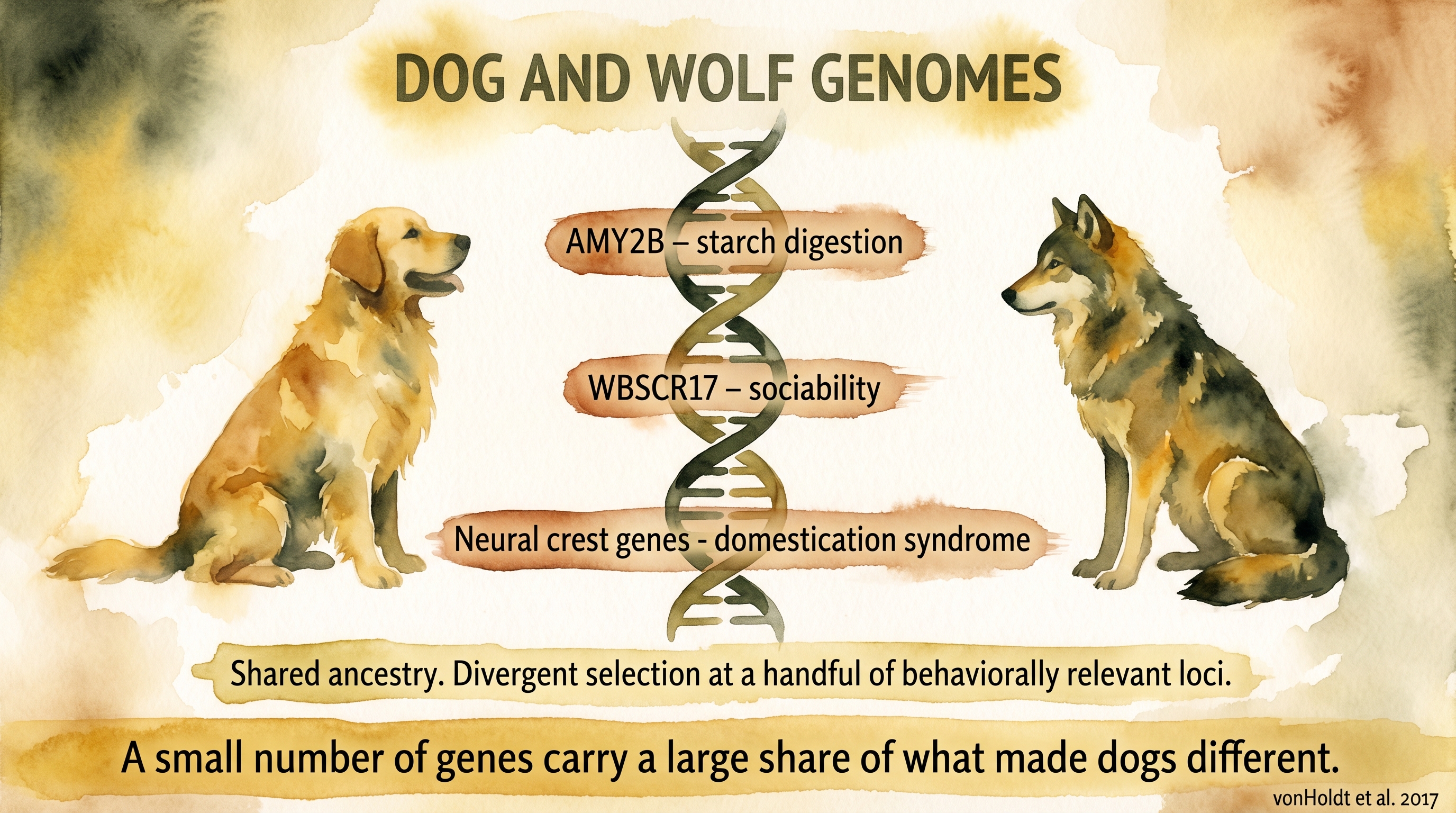
A small number of genes carry much of what made dogs different.
Key Takeaways
- Dogs and wolves are genetically close overall, but the important domestication differences cluster in selected regions with large functional impact.
- The best-known examples involve starch metabolism, hypersociability, and developmental pathways.
- These findings support the idea that domestication changed the species biologically rather than merely adding training on top of a wolf template.
- For JB, the genomics supports talking about dogs as a transformed human-associated lineage while staying cautious about unresolved mechanistic details.
The Evidence
This entry uses observed claim-level tags beyond the dedicated EvidenceBlocks below. These tags mark JB program observation or practice-derived claims that need dedicated EvidenceBlock coverage in a later content pass.
This entry uses heuristic claim-level tags beyond the dedicated EvidenceBlocks below. These tags mark JB interpretive application rather than direct study findings.
- Axelsson et al. (2013)dogs and wolves
Identified regions under selection in dogs, especially those tied to starch digestion and glucose handling. - vonHoldt et al. (2017)domestic dogs and wolves
Linked structural variation in the WBSCR17 region to differences in canine hypersociability toward humans. - Pendleton et al. (2018)village dogs and wolves
Highlighted developmental and neural-crest-related candidate regions relevant to domestication. - integrated domestication genomics
Emphasizes that a relatively small number of high-impact changes may underlie large behavioral divergence between dogs and wolves.
No published study directly tests the practical implications of dog-wolf genomic differences for domestic dog raising programs. The application to household dog raising remains an interpretive synthesis rather than a directly tested intervention finding.
SCR References
Sources
- Axelsson, E., et al. (2013). The genomic signature of dog domestication reveals adaptation to a starch-rich diet. Nature.
- vonHoldt, B. M., et al. (2017). Structural variants in genes associated with human Williams-Beuren syndrome underlie stereotypical hypersociability in domestic dogs. Science Advances.
- Pendleton, A. L., et al. (2018). Comparison of village dog and wolf genomes highlights the role of the neural crest in dog domestication. BMC Biology.