The Dominance Retirement
Compound evidence detail1 SCR / 2 parts
- Documentedthe wolf-side scientific record on the dominance model - Schenkel 1947 captive-pack methodology limitations, Mech 1999 wild-pack family-unit field data, and the AVSAB 2008 position statement against dominance-based training
- Heuristicthe JB application transferring the wolf family-unit framing to the dog-human relational architecture, an interpretive bridge that Mech's wolf data does not directly test in training contexts
Dominance theory was not retired because dog culture became soft. It was retired because the biological story supporting it became weaker under scrutiny. The alpha narrative came from captive-wolf work, later field data corrected that picture, and the training culture that had built so much of its identity on rivalry lost its main scientific foundation. That correction matters to the Foundations layer because it clears room for leadership without requiring conflict mythology. Mixed Evidence
What It Means
The historical sequence matters. Schenkel's captive-wolf work and Mech's early popularization of alpha language gave trainers a vivid story: canids are rank-driven, therefore dogs are trying to seize status unless humans get there first. Mixed Evidence That story fit beautifully with command culture, compulsion traditions, and the emerging consumer training market because it turned ordinary household problems into political dramas.
Later field work changed the picture. Wild wolf packs were better understood as family groups organized around breeding parents and offspring, not around endless competition among unrelated adults. The scientific correction was not that asymmetry never exists. It was that rivalry is not the master story. Once that changed, the dominance frame began to look much less like biology and much more like a cultural habit imported into dog handling. Mixed Evidence
The historical layer deepens the point. Konrad Most's 1910 manual marked a codification moment in which dog handling became portable method rather than embedded relationship. Fisher (2017) showed how training culture then moved through distinct phases in which authority, dominance, and later optimization rhetoric were each treated as the key to better dogs. Documented JB's line that "the method creates the need for the method" is interpretive, but it sits on a documented history of professionalized dog culture becoming more method-centric over time.
The retirement matters because it removes one of the biggest conceptual distortions in companion-dog life. Mixed Evidence Once every problem becomes a status problem, adults stop asking developmental questions and start asking conquest questions. The dog is no longer a young social mammal to raise. The dog becomes an opponent to decode. That shift makes a great deal of bad advice feel justified.
Why It Matters for Your Dog
For families, dominance retirement is practical relief. It means a puppy who jumps, mouths, or ignores a cue is not best understood as attempting a coup. Those behaviors still matter, but the right questions are about arousal, routine, clarity, development, and reinforcement history. Documented The family no longer has to pretend it is in a political struggle with a Golden Retriever.
Retiring dominance theory does not retire leadership. It retires rivalry. The adult still leads, but as a parent and organizer rather than as an alpha performing control.
This also clarifies what JB is and is not doing. JB is not reviving dominance with softer language. It is trying to preserve asymmetry without aggression, structure without theater, and adult authority without ideological rank combat. That is exactly why the retirement matters. It allows the human variable to become developmental again rather than adversarial.
The broader philosophical consequence is important too. When dominance loses its footing, the relationship moves back to center. The dog is once again allowed to be a domesticated social animal who learns through proximity, rhythm, and guidance rather than a wolf proxy waiting to challenge the adults. That is not only better science. It is a better home.
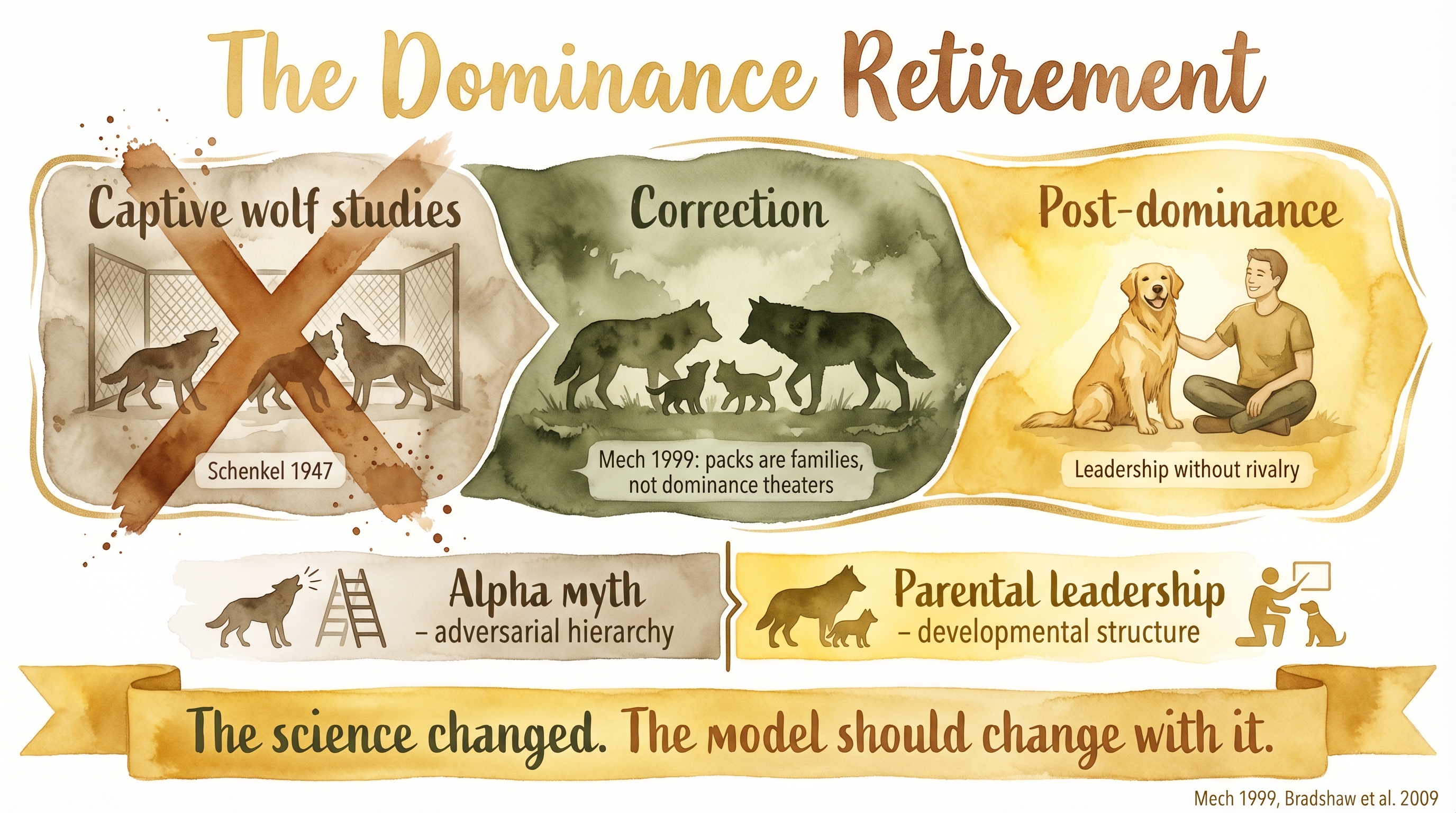
Dominance theory lost credibility when field research showed wild packs are family units - retiring the alpha myth clears space for leadership without rivalry.
Key Takeaways
- Dominance theory lost scientific credibility because the wolf story underneath it changed, not because people stopped caring about structure.
- The alpha model came from captive-wolf work and spread into dog culture far beyond what the data could support.
- Retiring dominance does not retire leadership. It makes room for leadership without rivalry.
- For JB, this is one of the biggest conceptual shifts: stop reading dogs as opponents and start reading them as developing social mammals.
The Evidence
This entry uses mixed-evidence claim-level tags beyond the dedicated EvidenceBlocks below. These tags mark claims that combine documented findings with observed practice, heuristic application, or unresolved gaps.
- Mech, L. D. (1999)wild wolves
Corrected the alpha narrative by showing that natural wolf packs are primarily family units. - Bradshaw, J. W. S., Blackwell, E. J., & Casey, R. A. (2009)domestic dogs
Argued that dominance is not a useful broad explanatory model for companion-dog behavior and training. - Herron, M. E., Shofer, F. S., & Reisner, I. R. (2009)domestic dogs
Found aggressive responses associated with confrontation-based techniques often justified through dominance logic.
- Fisher, J. (2017)training culture history
Mapped a historical progression from earlier relational handling toward compulsion, dominance, and later optimization frameworks in modern training culture. - Kirby, K. C. et al. (2023)cross-cultural human-dog societies
Showed that dog treatment tracks function across societies, supporting the narrower claim that intensive formal training culture is historically specific rather than universal.
No single study directly measures how much of modern companion-dog difficulty is created by the dominance framework itself rather than by broader environmental change. The historical case is strong, but the exact causal weight of the ideology is not experimentally isolatable.
SCR References
Sources
Mech, L. D. (1999). Alpha status, dominance, and division of labor in wolf packs. Canadian Journal of Zoology, 77(8), 1196-1203. https://doi.org/10.1139/z99-099
Bradshaw, J. W. S., Blackwell, E. J., & Casey, R. A. (2009). Dominance in domestic dogs: useful construct or bad habit? Journal of Veterinary Behavior, 4(3), 135-144. https://doi.org/10.1016/j.jveb.2008.08.004
Herron, M. E., Shofer, F. S., & Reisner, I. R. (2009). Survey of the use and outcome of confrontational and non-confrontational training methods in client-owned dogs showing undesired behaviors. Applied Animal Behaviour Science, 117(1-2), 47-54. https://doi.org/10.1016/j.applanim.2008.12.011
Fisher, J. A. (2017). Positioning dogs in society: dog training from the nineteenth century to the twenty-first. Animal Studies Journal, 6(1), 4-25.
Kirby, K. C., Chira, A. M., et al. (2023). Function predicts treatment in human-dog relationships across cultures. Scientific Reports.