The Developing Brain
Compound evidence detail1 SCR / 2 parts
- Documentedthe EEG measurement of declining NREM delta-power amplitude between 8 and 14 months of canine development (Reicher et al. 2021)
- Heuristicthe cross-species inference that this delta-power decline reflects synaptic pruning in canine cortical development
The puppy brain is not simply learning during the early months. It is actively under construction. Myelination is progressing, white matter organization is maturing, pruning machinery is present and necessary, and experience is already altering functional connectivity. That is why the breeder period and early transition period matter so much. The brain is not only taking information in. It is becoming the architecture that will process later life. Mixed Evidence
What It Means
Gross et al. (2010) showed that the domestic dog brain undergoes major postnatal maturation with visible MRI changes tied to water content and progressive myelination. Documented Adult-like appearance is approached by around sixteen weeks, but maturation continues far beyond that, especially in subcortical white matter. That timing matters because it overlaps directly with the breeder window, the go-home transition, and the early family period that JB treats as foundational.
The details matter because they prevent casual borrowing from human timelines. Mixed Evidence In dogs, frontal regions myelinate earlier than they do in primates, and the pattern is more central-to-peripheral than the human story many families vaguely imagine. Wu et al. (2011) then extended the picture with diffusion tensor imaging, showing ongoing white-matter maturation through later developmental windows. The message is not that the puppy brain is fragile in a melodramatic sense. It is that it is physically unfinished in measurable ways.
Pruning belongs in the same conversation, but it needs more careful language. The general developmental principle is documented across mammals: unused neural connections are eliminated and more-used networks are stabilized. In dogs, Seppala et al. (2011) showed that the LGI2 gene is part of the pruning and cellular-adhesion machinery of the developing canine brain. That proves the machinery is present and functionally necessary. What it does not give us is a fully quantified canine pruning curve that tells us exactly how much pruning has happened by a specific week.
This is also where one of the most common overclaims has to be avoided. The often repeated statement that the dog brain reaches "70 percent of adult size by six weeks" is not verified against a primary canine growth series. Observed-JB The literature supports major early maturation. It does not support casual numeric folklore. That is why the best Foundations writing anchors itself to what is actually documented: major postnatal myelination, continued maturation beyond sixteen weeks, present pruning machinery, and a still-developing network during the breeder and transition periods.
Why It Matters for Your Dog
For families, the practical meaning is clear. What happens early is not just remembered. It is physically incorporated into a nervous system that is still wiring itself. Calmness, overstimulation, routine, sleep, challenge, and human social tone all arrive while the puppy brain is still building its operating structure. Mixed Evidence
The developing brain is one reason Prevention carries so much leverage early. During construction, repeated experience is not merely practice. It is part of the build.
This is also why JB talks so differently about the breeder period than mainstream puppy culture does. The first twelve weeks are not dead time before training begins. They are a major portion of the build. The family does not arrive at the start of development. The family arrives in the middle of it, which is why preserving continuity matters so much.
The honest boundary still matters. We do not yet have a full canine developmental atlas that links every household practice to every underlying neural milestone. But we have enough to make the important point with confidence: the early dog is neurologically unfinished, highly plastic, and physically changing in the exact windows where adult behavior is easiest to shape well or badly. Documented
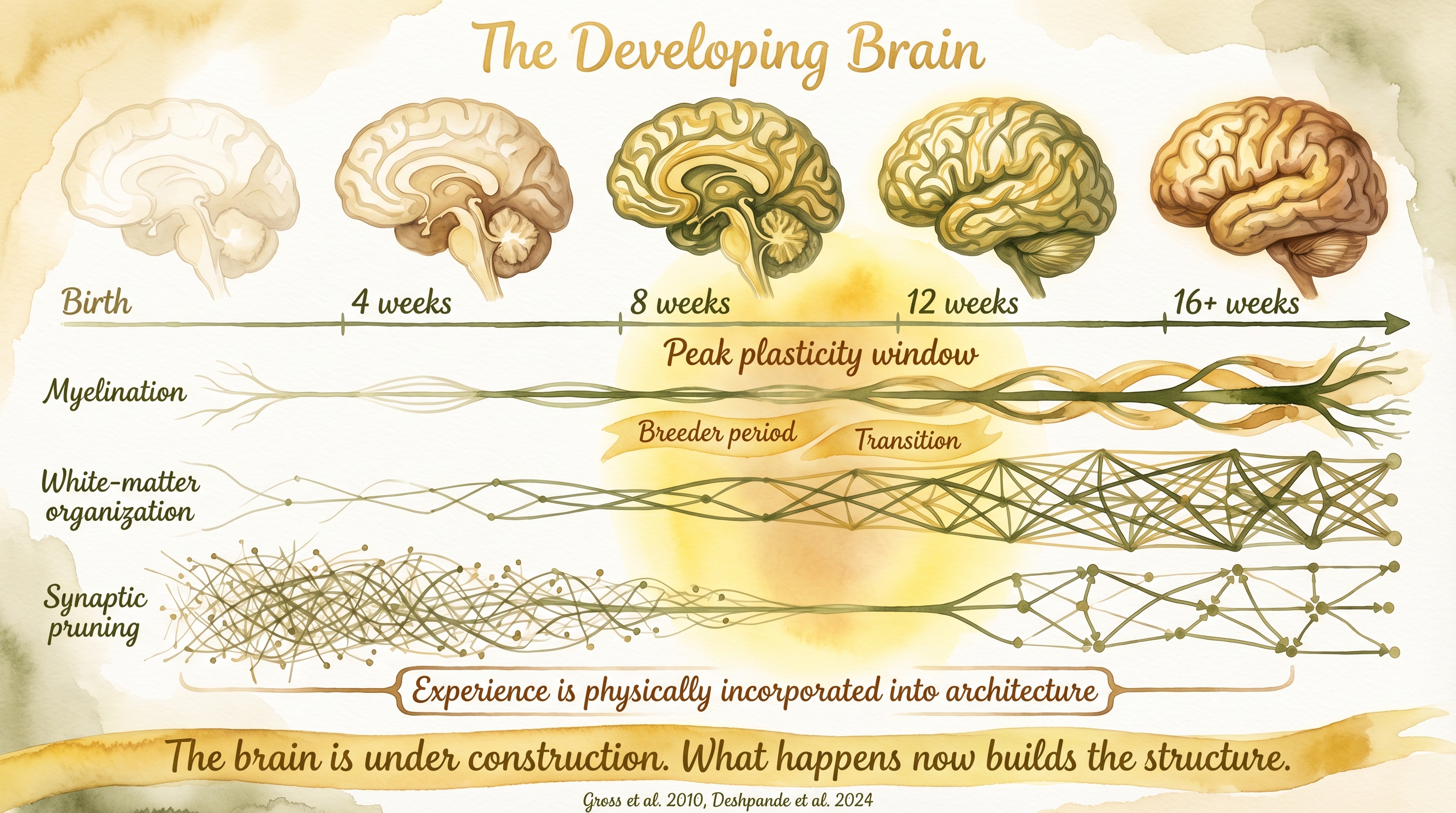
The puppy brain is under construction during the breeder and transition windows - experience is physically incorporated into nervous-system architecture, not just remembered.
Key Takeaways
- The puppy brain is physically maturing during the breeder and transition periods, not waiting in a finished state for training to begin.
- Myelination and white-matter development continue well past the first weeks of life, which is why timing matters so much.
- Dogs clearly have the pruning machinery needed for developmental circuit refinement, even though the exact canine pruning curve is still incomplete.
- This is why early experience has such leverage. The brain is not only learning. It is still building.
The Evidence
This entry uses observed claim-level tags beyond the dedicated EvidenceBlocks below. These tags mark JB program observation or practice-derived claims that need dedicated EvidenceBlock coverage in a later content pass.
This entry uses mixed-evidence claim-level tags beyond the dedicated EvidenceBlocks below. These tags mark claims that combine documented findings with observed practice, heuristic application, or unresolved gaps.
- Gross, B. et al. (2010)domestic dogs
Longitudinal MRI work documented major postnatal myelination and structural maturation, with mostly adult-like appearance by around sixteen weeks but continued development beyond that. - Wu, Y.-C. et al. (2011)domestic dogs
DTI work showed ongoing white-matter maturation through later developmental stages, extending the postnatal brain-development timeline. - Deshpande, G. et al. (2024)domestic dogs
Showed that structured experience changes functional brain connectivity in dogs, confirming that canine brains are experience-responsive rather than static.
- Seppala, E. H. et al. (2011)domestic dogs
Showed that LGI2 participates in synaptic pruning and cellular adhesion in the developing canine brain, confirming the machinery is present and necessary. - SCR-041 boundarydomestic dogs
Warns that commonly repeated quantitative claims about percentage-of-adult-brain size at six weeks remain unverified and should not be presented as settled fact.
No published study gives a fully quantified canine pruning curve linking week-by-week neural elimination to specific household experiences. The science documents development and machinery, but not a complete intervention map from early family life to exact pruning outcomes.
SCR References
Sources
Gross, B., Garcia-Tapia, D., Riedesel, E., Ellinwood, N. M., & Jens, J. K. (2010). Normal canine brain maturation at magnetic resonance imaging. Veterinary Radiology & Ultrasound, 51(4), 361-373. https://doi.org/10.1111/j.1740-8261.2010.01694.x
Wu, Y.-C., Field, A. S., Whalen, P. J., & Alexander, A. L. (2011). High b-value and diffusion tensor imaging in a canine model of dysmyelination and brain maturation. NeuroImage, 58(3), 829-837. https://doi.org/10.1016/j.neuroimage.2011.06.076
Seppala, E. H., Jokinen, T. S., Fukata, M., Fukata, Y., Webster, M. T., Karlsson, E. K., et al. (2011). LGI2 truncation causes a remitting focal epilepsy in dogs. PLoS Genetics, 7(7), e1002194. https://doi.org/10.1371/journal.pgen.1002194
Deshpande, G., et al. (2024). Two separate brain networks for predicting trainability and tracking training-related plasticity in working dogs.