Dog Domestication: An Overview
Compound evidence detail1 SCR / 2 parts
- Documentedevolutionary-biology research establishing commensal scavenging at human settlements as the leading account of dog domestication
- HeuristicJB-specific reading that connects the Five Pillars to selection pressures operating during the commensal phase of canine evolution
Dog domestication is the long evolutionary process through which a wolf-like ancestral population became the animal we now call the domestic dog. That sentence sounds simple, but nearly every part of it contains an active research question. Archaeologists debate which fossils are truly dog remains and which are unusual wolves. Geneticists debate whether the key lineage split happened closer to 20,000 years ago or deeper toward 40,000 years ago. Ancient-DNA teams debate whether dogs arose once and then spread, or whether early dog populations carried ancestry from more than one wolf-like source population. Even the mechanism remains contested. Raymond and Lorna Coppinger popularized a commensal scavenger model, Frantz et al. 2016 proposed a dual-origin history, Botigue et al. 2017 argued for continuity in ancient European dogs, and Bergstrom et al. 2022 analyzed 72 ancient wolf genomes without finding a sampled wolf that matched the direct progenitor of modern dogs. Bonn-Oberkassel, dated to about 14,000 years ago, remains the earliest widely accepted morphologically domestic dog, while the Goyet canid from around 36,000 years ago is still debated rather than universally accepted. Axelsson et al. 2013 then added a genomic layer by showing strong selection signals in dogs around starch digestion and neural development. Documented
The field therefore works with a real consensus and a real uncertainty at the same time. The consensus is that dogs are the oldest domesticated animal, that their ancestor was wolf-like rather than jackal-like, that domestication clearly predated agriculture in its earliest phase, and that the resulting species is not just a tame wolf wearing a new label. The uncertainty lies in the exact route.
That mixture is important for JB because the Evolutionary Foundation argument does not need a fake certainty. It needs the documented core stated cleanly and the disputed edges kept in their proper confidence bands.
What It Means
The Broad Chronology Is Older Than Farming
One of the clearest takeaways in this field is that dog domestication began before settled agriculture. Genetic divergence estimates repeatedly fall somewhere in the broad 20,000 to 40,000 year range, and the oldest clearly accepted dog burial at Bonn-Oberkassel sits near 14,000 years ago. Estimated That chronology matters because it makes a simple farming-waste story incomplete on its own. Dogs did not suddenly appear when villages and grain stores appeared. Whatever the earliest stage was, it began in Late Pleistocene human worlds populated by mobile hunter-gatherers rather than by farmers.
Researchers separate lineage splitting from full domestication for that reason. A wolf-derived lineage can begin diverging genetically before the skeleton looks obviously dog-like in the archaeological record. repeatedly stresses this distinction, because many public retellings blur it. A genetic split is not the same thing as a morphologically modern dog standing in a campsite.
The Geography Is Still Open
The where question remains unresolved. Frantz et al. 2016 argued for a dual-origin model drawing on eastern and western Eurasian evidence. Documented Botigue et al. 2017 pushed against the idea of a major Neolithic replacement in Europe by finding continuity in ancient European dog genomes. Bergstrom et al. 2022, using a far deeper ancient-wolf dataset, supported a dual-ancestry picture in dogs while still failing to identify a directly sampled ancestral wolf population. That is why modern review papers often land on a careful formulation: dogs probably arose somewhere in Eurasia from now-extinct or unsampled wolf-like populations, and later admixture complicates any neat map pin.
The uncertainty here is not a weakness of the field. It is what serious ancient DNA work often looks like when the reference populations are incomplete. Researchers are reconstructing a vanished branching history from fragmentary bones, degraded molecules, and scattered archaeological contexts.
The documented point is not that every detail is settled. The documented point is that dogs emerged through a long evolutionary relationship with humans, and that relationship shaped the species before any modern training industry existed.
The Mechanism Debate Centers on Human Tolerance
The best known mechanism model is the commensal pathway: some wolf-like animals tolerated human proximity better than others, scavenged around human camps more successfully, and reproduced more effectively in that niche. The Coppingers made this story influential because it explains why selection would target fear distance, conflict tolerance, and social flexibility before anything like formal obedience.
Competing models remain live. Some researchers argue hunter-gatherer conditions were too lean to support a large scavenger niche and favor pup-adoption or hybrid multistage accounts instead. The source document is explicit that self-domestication is a leading hypothesis rather than a universally settled consensus, which is exactly the ceiling set by SCR-001. What most serious models share, however, is the idea that reduced fear of humans and increased ability to function around human social worlds were central selection targets.
Dogs Are Not Wolves With Better Manners
Domestication changed more than behavior. Axelsson et al. 2013 identified selection signatures around starch metabolism, including AMY2B copy number expansion, which helped show that dogs adapted biologically to human food ecologies. vonHoldt et al. 2017 linked dog hypersociability to structural variation in genes homologous to the human Williams-Beuren syndrome region. Pendleton et al. 2018 argued that village-dog versus wolf comparisons highlighted developmental pathways consistent with neural-crest-related hypotheses. Range and Viranyi 2022 also argued that the cleanest dog-wolf difference is not simply "dogs are nicer," but that dogs are more conflict avoidant and more tuned to human-shaped social rules.
So the modern dog is a species shaped by both ecological adaptation and social-cognitive specialization. That is why the question "how did wolves become dogs?" matters so much more than a museum fact. It is a question about how a nervous system, a social strategy, and a species niche were remade together.
Why It Matters for Your Dog
The first practical reason domestication matters is that it changes what kind of animal families think they have brought home. Many families slip into one of two bad simplifications. One says the dog is basically a wolf and therefore needs old pack theories, dominance rituals, or hard-edged control. The other says the dog is basically a furry child with limitless social pliability and no species-specific history to respect. The domestication literature rules out both extremes. Your dog is neither a household wolf nor a blank mammal waiting to be scripted by modern ideology. Your dog is a domesticated canid whose lineage was shaped for life around people.
That has consequences in ordinary home life. A Golden Retriever who watches your face, checks in under uncertainty, reads emotional tone, and relaxes more easily in predictable company is not performing a cute coincidence. Those tendencies reflect a species history in which human proximity became adaptive. Hare 2002, Miklosi 2003, Topal 1998, and Nagasawa 2015 all sit downstream from domestication rather than apart from it. They make sense because domestication already altered the dog-human interface long before any puppy class existed.
This is also why crude wolf rhetoric misleads families so badly. Modern wolves and modern dogs are not interchangeable proxies for a shared ancient ancestor. Bergstrom 2022 explicitly notes that the direct ancestral wolf population appears unsampled or extinct. Range and Viranyi 2022 warn against broad claims that flatten dog-wolf differences into slogans. When a trainer tells a family their pet dog is trying to reenact a wolf rank struggle, the domestication record gives them strong reason to doubt the frame before any deeper argument even begins.
The question also matters because it sharpens what households should prioritize during development. If domestication repeatedly favored reduced fear, human-directed attention, social flexibility, and success in human-adjacent niches, then the raising environment should support those capacities rather than fight them. Calm predictability, readable human behavior, stable routines, and careful social exposure all fit better with the documented direction of selection than chaotic arousal, constant command pressure, or social unpredictability.
There is a dietary implication too. Axelsson 2013 does not prove every dog thrives on the same feeding plan, but it does undermine the popular claim that the biologically appropriate dog is just a preserved wolf waiting for a raw carcass. Documented Dogs evolved under human ecological conditions and show genomic evidence of adapting to those conditions. That matters because pseudo-evolutionary arguments often get used to sell rigid feeding and training ideologies together. The actual domestication literature is more interesting and less romantic. Dogs became successful precisely by moving away from strict wolf ecology.
Families also benefit from understanding that domestication is a process, not a single magical event. That helps owners think in developmental terms. Selection can set a direction without guaranteeing every outcome. A dog can be biologically prepared for human attachment and still become dysregulated in a chaotic home. A Golden can inherit strong affiliative tendencies and still grow noise sensitivity, social overarousal, or conflict habits if the environment repeatedly pushes the nervous system in the wrong direction. Domestication gives the starting architecture. Raising still matters.
This is one reason the field's uncertainty is actually useful. Because the exact origin story remains partially unresolved, families are forced back to the robust middle rather than to myth. The robust middle says dogs are a domesticated species shaped by long coexistence with humans; they are behaviorally and cognitively distinct from wolves; and their most stable functioning should be interpreted in light of that evolutionary partnership. That is already enough to overturn a remarkable amount of bad advice.
Goldens make this especially visible. Their cooperative expression, readiness to engage socially, and tendency to orient toward people are not evidence that training made the breed dog-like. They are evidence that centuries of domestication and later breed selection amplified dog-like human compatibility. What a household does afterward can either support that inheritance or disorder it.
Another benefit of reading domestication carefully is that it protects families from false binaries about freedom versus structure. Some families hear "dogs evolved alongside humans" and imagine that means unlimited informality should work because the species is naturally social. Others hear "descended from wolves" and imagine that only pressure can maintain order. Domestication points elsewhere. The dog is an animal selected for partnership, which means relationship and structure both matter. A species built around human co-living does not need domination, but it also does not benefit from total household vagueness.
Once families see that, many daily decisions become easier to interpret. Attention to routine stops looking fussy. Calm adult conduct stops sounding sentimental. Clear boundaries stop feeling anti-dog. All three make more sense when the species itself is understood as a long human-associated lineage rather than as a wolf costume or a blank slate.
What This Means for a Just Behaving Family
JB families should hold the domestication story in a disciplined way. The documented part is strong: dogs became dogs through prolonged evolutionary life with humans, not through the invention of modern training systems. The disputed part is which exact pathway and geography got the process started. Those two statements can coexist without tension.
That matters because JB's Evolutionary Foundation is not a demand that archaeology prove the Five Pillars word for word. It is a claim that the species was shaped in relational, ecological, and behavioral conditions that make the Pillars intelligible rather than alien. The evidence for domestication itself is documented. The further synthesis from that evidence into the full JB philosophy belongs in explicitly named heuristic territory.
Practically, this means a JB home should treat the dog as an animal prepared for human partnership, human guidance, and human emotional readability. It should not treat the dog as a failed wolf or as a creature who becomes functional only after artificial behavior technology is layered on top.
The Mentorship, Calmness, and Structured Leadership pillars all begin to look more ordinary against this backdrop. They are not claims that humans invented the right tricks. They are claims about what kind of interspecies environment a domesticated dog is most likely to function well inside.
That stance also encourages humility. A family does not need to pretend the field has already resolved every ancient-DNA debate. They only need to understand that the broad direction of the evidence already points away from dominance myths, away from wolf cosplay, and toward a more historically literate way of living with dogs.
For JB, that is enough to matter. Evolutionary history is not decorative background here. It is part of the explanation for why the dog in the kitchen is the kind of animal that can use a human as a secure base, read a face for guidance, and thrive in a household that acts like a stable social world rather than a command lab.
That is why this overview belongs at the front of the category. It does not answer every debate, but it gives families the right species picture before more specialized entries start filling in the detail. Ambiguous
It also gives the household a better compass. The dog is not asking adults to recreate prehistory, but the species story strongly suggests that calm human partnership, social legibility, and low-conflict coexistence are closer to the grain of dogness than constant tension or performative control are. Documented
That perspective is often enough to change how a family reads the dog in front of them.
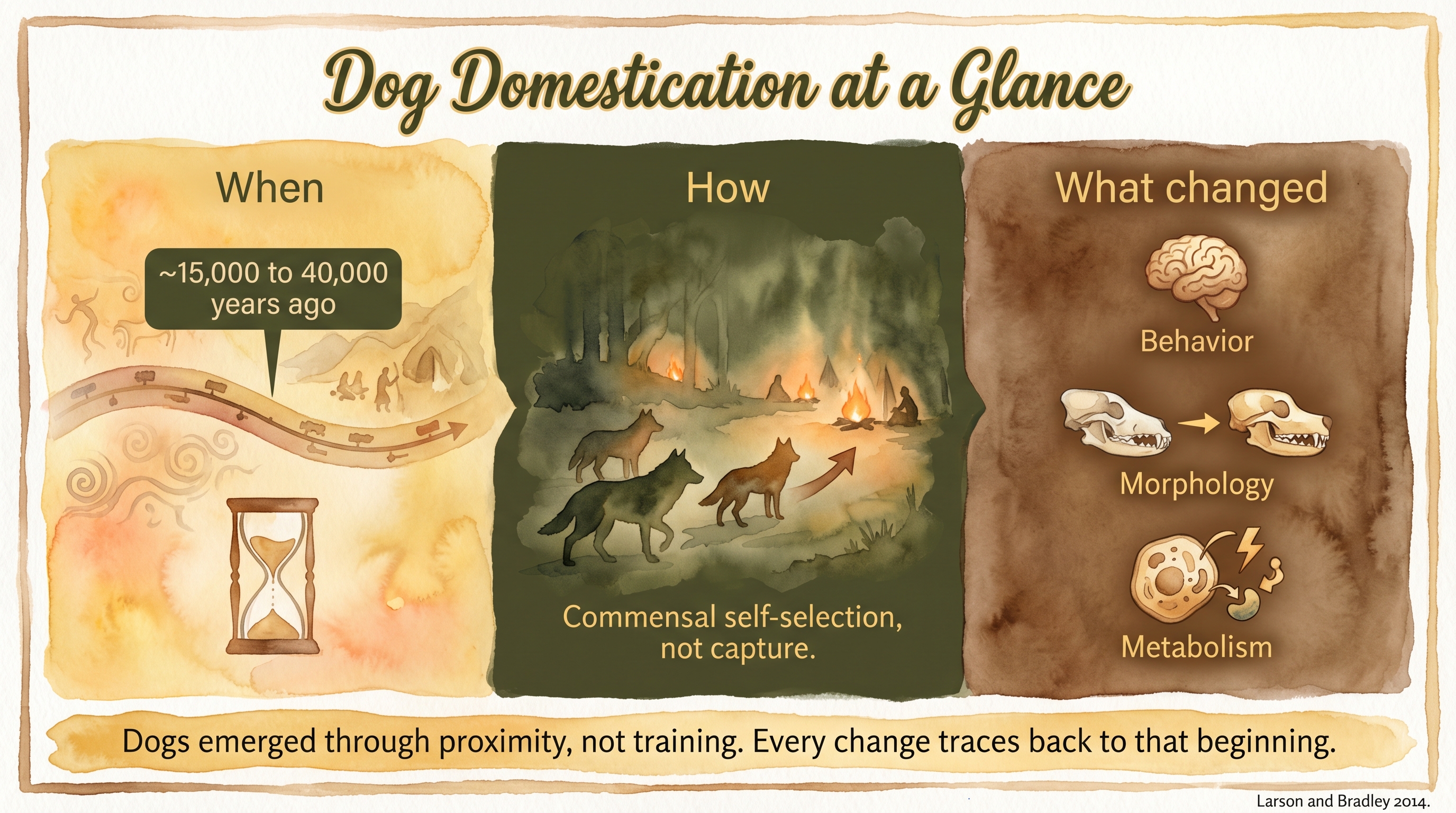
Dogs emerged through proximity, not training. Every change traces back to that.
Key Takeaways
- Dogs are the oldest domesticated animal, but the precise timing, location, and initiating pathway remain actively debated.
- The safest consensus is that dogs emerged from a wolf-like ancestral population through prolonged coexistence with humans.
- Domestication changed both behavior and biology, including diet-related and social-cognitive systems.
- For JB, domestication matters because it frames dogs as a species selected for human partnership rather than as household wolves or blank slates.
The Evidence
This entry uses estimated claim-level tags beyond the dedicated EvidenceBlocks below. These tags mark approximate ranges or timing claims that should remain bounded by the cited sources.
This entry uses ambiguous claim-level tags beyond the dedicated EvidenceBlocks below. These tags mark claims where the literature remains unsettled or multiple interpretations coexist.
- Frantz et al. (2016)ancient dogs and wolves
Used genomic and archaeological evidence to argue for a dual-origin history in eastern and western Eurasia. - Botigue et al. (2017)ancient European dogs
Found continuity in ancient European dog genomes, constraining simple replacement stories. - Bergstrom et al. (2022)72 ancient wolves and ancient dogs
Showed dogs carry deep ancestry not directly matched by any sampled ancient wolf genome and supported complex ancestry structure. - Axelsson et al. (2013)modern dogs and wolves
Identified strong domestication-related genomic signatures including starch metabolism and neural development pathways.
No published study directly tests the practical implications of dog domestication: an overview for domestic dog raising programs. The application to household dog raising remains an interpretive synthesis rather than a directly tested intervention finding.
SCR References
Sources
- Frantz, L. A. F., et al. (2016). Genomic and archaeological evidence suggest a dual origin of domestic dogs. Science.
- Botigue, L. R., et al. (2017). Ancient European dog genomes reveal continuity since the Early Neolithic. Nature Communications.
- Bergstrom, A., et al. (2022). Grey wolf genomic history reveals a dual ancestry of dogs. Nature.
- Axelsson, E., et al. (2013). The genomic signature of dog domestication reveals adaptation to a starch-rich diet. Nature.
- vonHoldt, B. M., et al. (2017). Structural variants in genes associated with human Williams-Beuren syndrome underlie stereotypical hypersociability in domestic dogs. Science Advances.
- Range, F., and Viranyi, Z. (2022). Comparing wolves and dogs: current status and implications for human self-domestication. Trends in Cognitive Sciences.